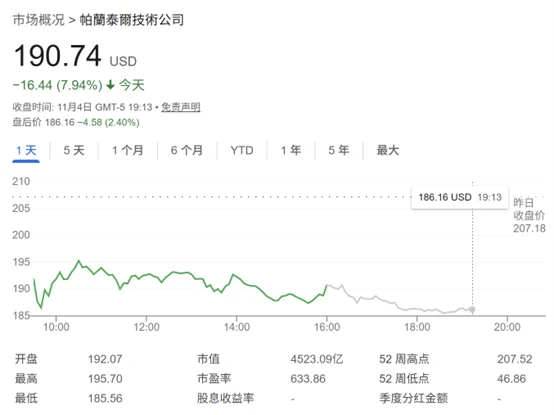
Tesla Stock valuations are increasingly linked to artificial intelligence. Related to (AI), such as humanoid robots that have attracted much attention. Tesla has plans for driverless taxis, but these projects haven't yet generated revenue. This is why some analysts are increasingly reluctant to recommend Tesla stock.
Tesla CEO Elon Musk stated that the company's Optimus robotics business could ultimately account for a significant portion of Tesla 's total value. It represents 80% of the market capitalization. However, Truist Securities currently states that this is "zero."
Although Tesla has made it clear that its future lies in artificial intelligence , Truist Securities analyst William Stein said it is “difficult” to recommend investors go all in on the stock, mainly because Tesla still has a lot of work to do.
In a new report to investors, Stan stated, "We still believe that the vast majority of Tesla's future (and even present) value lies in the development of artificial intelligence technology. However, all of these projects are unproven. "
He reiterated his "hold" rating on Tesla stock. Stein estimates that only 22% of Tesla's valuation relates to its revenue-generating automotive and energy businesses. Meanwhile, the artificial intelligence products, which are of greater interest to investors, "have a long way to go" and generate very little revenue.
Tesla's Full Self-Driving (FSD) system has been available in the US for several years and is central to the company's driverless taxi program. However, as of last October, only about 12% of Tesla vehicles had the service activated. In the US, the service costs either a one-time payment of $8,000 or $99 per month.
Despite Tesla's claims that using its software is far safer than relying solely on a human driver, regulators have launched multiple investigations into the technology. Tesla has also been accused of exaggerating the software's capabilities and has faced lawsuits over alleged incidents involving the technology.
Stan pointed out that Truist's own testing last month showed that FSD did not perform as expected, although he noted that Tesla has been working to improve it. However, he added that if Tesla wants to expand its eventual autonomous ride-hailing service, the software needs to work "perfectly."
Tesla currently only offers its self-driving taxi service in Austin, Texas, and the San Francisco Bay Area, California. The company currently uses Model Y SUVs equipped with Full Self-Driving (FSD) capabilities, supervised by a safety driver.
However, according to Musk, the company plans to expand its operations to five more U.S. cities and grow its existing fleet to at least 1,500 vehicles by the end of this year. Ultimately, it also plans to replace its SUVs with designated robotabbles , Cybercabs, which will begin production next April.
But Stein points out that several factors could hinder Tesla's expansion efforts, including regulatory approval, which could vary by state or municipality. Furthermore, Tesla will have to compete with many rivals, such as Alphabet's Waymo.
Stan also discussed Tesla's humanoid robots . Musk has expressed concerns about the development of "Optimus Prime." He has stated that the robot could eventually account for 80% of Tesla's value and "eliminate poverty." Tesla plans to eventually use these robots for commercial and residential purposes.
Musk stated that investors can expect a demonstration of the third-generation Optimus Prime in early 2026. According to Musk, production will also begin around the end of next year.
Stan wrote: "While the number is zero today, it is easy to accept the idea that Optimus Prime could sell millions of units a year at $30,000 if we expect it to eventually become a general-purpose robot that combines human dexterity and superhuman intelligence."
(Article source: CLS)