① US President Trump signed an executive order that would regulate marijuana at the federal level to the same level as less dangerous drugs such as steroids and Tylenol; ② Analysts believe that the executive order is "more of a symbolic victory" for the marijuana industry, as funding remains one of the biggest challenges facing marijuana producers.
On Thursday (December 18), US President Trump signed an executive order directing the federal government to classify marijuana into a less restricted category. As the new category is still far from legalization, US marijuana-related stocks plummeted.
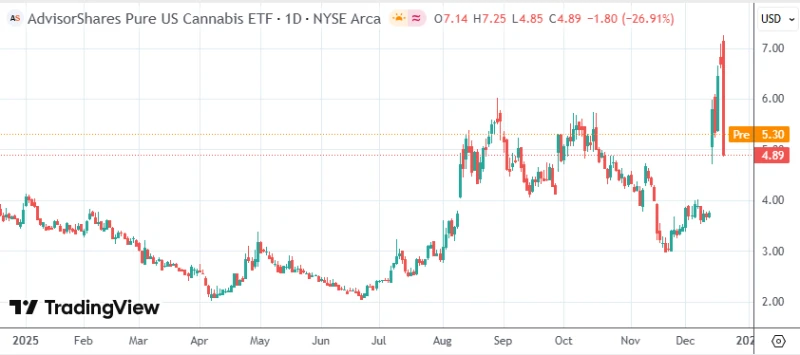
Market data shows that as of Thursday's US stock market close, the cannabis ETF "AdvisorShares Pure US Cannabis ETF" (ticker symbol: MSOS) fell 26.91%, erasing all of its gains for the week. The last time it recorded such a single-day drop was on November 6, 2024.
However, it should be noted that MSOS has still risen by more than 40% this month and by more than 28% year-to-date.
According to the executive order, Trump instructed the U.S. Department of Justice to take all necessary measures to classify marijuana as a "Tier III controlled substance" under the Controlled Substances Act as quickly as possible, in accordance with federal law. Currently, marijuana is classified as a "Tier I controlled substance."
According to the definition in the Federal Controlled Substances Act, "Class I controlled substances" are substances that have no accepted medical use, have a high potential for abuse, and lack guarantees of safe use; "Class III controlled substances" are substances that have accepted medical use and whose use may cause moderate/low physical dependence or high psychological dependence.
Since the implementation of the Federal Controlled Substances Act in 1971, cannabis has been a Class I controlled substance, belonging to the same category as heroin, methamphetamine, and the new drug LSD. The adjustment to Class III means that cannabis will be controlled at the same level as less dangerous drugs such as steroids and Tylenol.
Trump explained at the White House: "I've always told my kids, 'Don't do drugs, don't drink, don't smoke,' but the facts have forced the federal government to acknowledge that marijuana is legal for medical use when used properly."
Trump also mentioned that he received numerous calls urging him to make marijuana more accessible to people with health problems such as severe pain. "This reclassification will make marijuana-related medical research much easier, enabling us to study its benefits, potential dangers, and future treatments."
In response, Jaret Seiberg, an analyst at the U.S. investment bank TD Cowen, commented that the executive order signed by Trump on Thursday was "more of a symbolic victory" for the cannabis industry.
He wrote in the report: "This executive order does not change policy. The state-level legal recreational and medical marijuana market still violates federal law. This is why it is unlikely to have any impact on capital markets or commercial banks. " This has a substantial impact on service access.
Funding remains one of the biggest challenges facing cannabis producers, as federal restrictions prevent most banks and institutional investors from entering the industry, forcing cannabis producers to turn to expensive loans or other lending institutions.
The two analysts said that investors had previously expected the executive order to include provisions authorizing cannabis banking , but the fact that it did not ultimately include such provisions may have disappointed them.
According to ETF provider AdvisorShares, as of November 30, 37 U.S. states and Washington, D.C. have legalized medical marijuana, and another 24 states have legalized its recreational use.
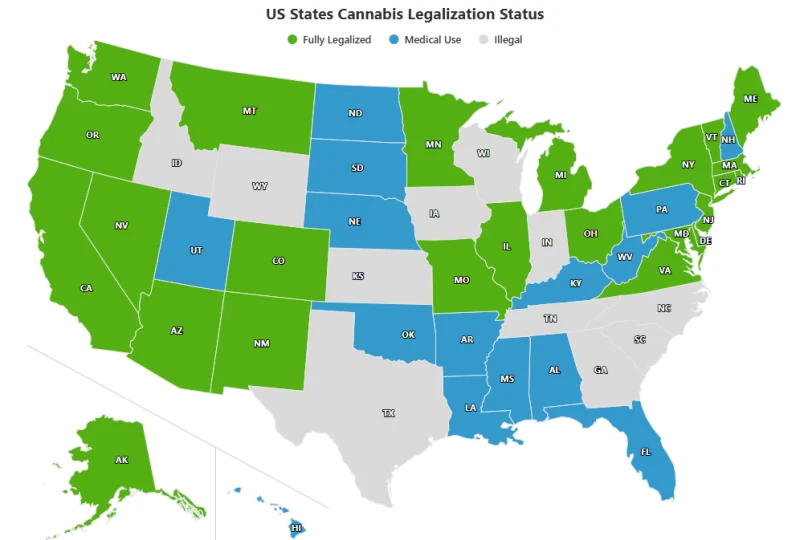
However, more than a dozen states still consider medical marijuana illegal, most of which are traditionally "red states" (states with a Republican majority). Earlier this week, several Republican members of the House of Representatives wrote to Trump, urging him to continue classifying marijuana as a Schedule I controlled substance.
(Article source: CLS)