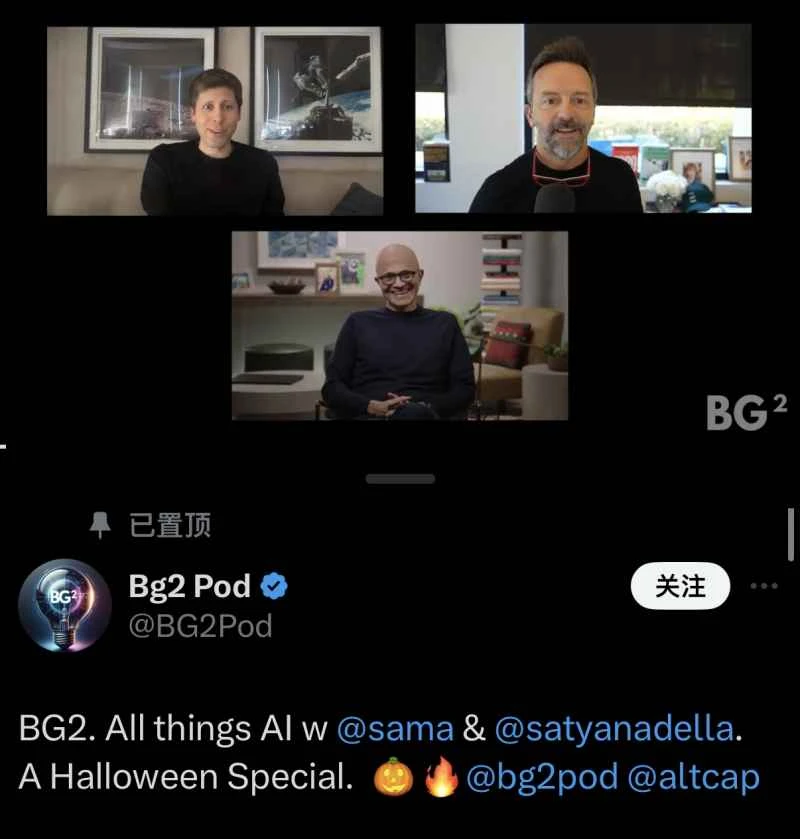
A recent podcast episode has garnered industry attention, featuring OpenAI CEO Sam Altman and Microsoft... In a joint interview with CEO Satya Nadella, Altman denied rumors of an IPO next year and revealed that current revenue is far more than $13 billion. They also discussed industry concerns such as whether there is currently an oversupply of computing power and the future of AI.
OpenAI's recent trillion-dollar bet on computing infrastructure has sparked much discussion and skepticism, with some questioning whether it represents a bubble. The host also asked: How can a company with $13 billion in revenue sign a $1.4 trillion spending commitment?
Altman refuted this claim, stating, "Our actual revenue is far more than $13 billion," and added that many people are eager to buy OpenAI stock. "Those who are making a fuss about our computing power spending online would be scrambling to buy OpenAI shares if they could." He indicated that if any shareholders wanted to sell, he could quickly sell them to those who were making the biggest fuss on social media.
Altman further explained that the company's revenue is currently growing rapidly, and these infrastructure investments are a forward-looking bet: a belief that this growth will continue. Beyond ChatGPT's revenue, the company will become a significant AI cloud service provider, the consumer device business will be a meaningful and important segment, and the technology that enables AI to automate scientific research will also create enormous value.
He stated that OpenAI's planning is "very prudent," and the team clearly understands the direction of technological evolution, what kind of products can be built around these capabilities, and what kind of revenue can be generated. "Of course, it's also possible to mess things up, and that's a risk we're willingly taking." But without sufficient computing power, it's impossible to produce better models.
Regarding the current issue of computing power, Altman stated bluntly that there will inevitably be a surplus of computing power someday. Whether it will be in two or three years, or five or six years, is uncertain, but it will certainly happen, and it may happen multiple times. This is influenced by human psychology and also involves the "bubble cycle." He frankly admitted that the supply chain is extremely complex, all sorts of strange things can happen, and the technological landscape will continue to change dramatically.
Nadella pointed out that the biggest problem now is not "overcapacity," but rather the speed of power and infrastructure development. "If we can't build data centers fast enough near power sources..." "If you build a system, even if you have a bunch of chips, you might not be able to plug it in." However, OpenAI's bet is that as intelligence becomes cheaper, demand will continue to explode.
During the one-hour interview, the host also touched on recent rumors about OpenAI's IPO. Altman directly denied the information that OpenAI plans to go public next year, stating, "We don't have any specific plans or timelines, and the board hasn't made any decisions on this." He mentioned that in the long run, it might be a step that the company will naturally take, nothing more.
Recently, OpenAI completed a capital restructuring, with its non-profit entity now renamed the OpenAI Foundation. The foundation holds approximately $130 billion in equity in its for-profit division, which has been restructured into a non-profit company called OpenAI Group PBC. This is widely seen as paving the way for an IPO.
Speaking about AI progress, Altman believes the most interesting development this year is the advancement of Codex (an AI programming model). Next year, it may leap from handling tasks that take "a few hours" to tasks that take "days," allowing humans to create software at unprecedented speeds and in entirely new ways. He is very optimistic about this and believes this trend will extend to other industries, truly reshaping the boundaries of human creativity.
By 2026, Altman hopes that AI will bring even the smallest scientific discovery, which would be a momentous occasion for human civilization.
(Article source: CBN)