semiconductor Tech giants are vying to flex their muscles at this year's CES. Nvidia CEO Jensen Huang showcases artificial intelligence for autonomous driving applications. Models, and dozens of robots Model. Hours later, AMD CEO Lisa Su unveiled several new chips from the company in an effort to gain a voice in the artificial intelligence industry.
Lisa Su stated that current global computing power is far from sufficient to accomplish everything people want to do, but the speed and pace of innovation in the field of artificial intelligence in recent years has been incredible. Nevertheless, this industry is still in its infancy.
At the same exhibition, OpenAI President and co-founder Greg Brockman also stated that OpenAI's computing needs have tripled annually over the past few years, with revenue growing at a similar rate. The challenge lies in how humans can meet this demand with limited resources, given that advanced AI work requires massive amounts of computing power.
Lisa Su predicts that the artificial intelligence industry will grow to have more than 5 billion users per day within five years. The current unit of computing power is YottaFLOPS, which is 10 to the power of 24 operations per second. She hopes that computing power can be increased to over 10 YottaFLOPS in the next five years.
Data CenterFaced with the extreme demand for computing power from AI companies, AMD is attempting to leverage its advantage of producing a full range of computing engines to stay ahead of its competitors. The company recently launched its next-generation platform, Helios, which weighs nearly 3,200 kilograms—equivalent to two small cars—and is scheduled to launch before the end of the year.
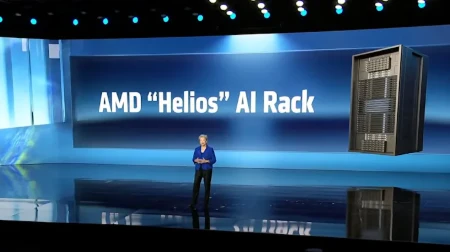
On this platform, AMD has equipped four core hardware drivers: the newly launched Instinct MI455X GPU and EPYC Venice GPU , as well as the Pensando Vulcano 800 AI network card and the Pensando Salina 400 DPU.
Among them, the newly launched MI455X GPU is a new generation flagship GPU chip, with performance reportedly 10 times higher than the previous generation MI355X. Meanwhile, the MI350 chip, released last June, already achieved the goal of running large models with 520 billion parameters on a single chip.
Lisa Su also stated that the next-generation MI500 GPU, expected to launch in 2027, will achieve AMD's goal of increasing AI performance by 1,000 times within four years.
Another cutting-edge chip is the EPYC Venice Zen 6 CPU, which AMD says will improve performance and efficiency by more than 70% and increase thread density by more than 30%.
AIPCIn addition to data centers and AI, AMD also released the new Ryzen AI 400 series, which is the most widely used and most advanced AIPC processor series in the industry.
AMD pointed out that, with Intel Compared to the Core Ultra 9 288V, the new Ryzen series offers 1.7x faster content creation and 1.3x faster multitasking. The first PCs equipped with the new Ryzen series will begin shipping in the first quarter of this year, including models from Dell and HP. Major brands such as Lenovo will use this chip, and desktop computers will ship in the second quarter.
The real significance of this Ryzen chip lies in liberating the local production capabilities of laptops. Users can translate, create videos, or generate images locally without waiting for cloud transfers, thus protecting privacy and extending battery life . Battery life. This is important for Apple. and Qualcomm The ARM chip it uses has posed a challenge.
In addition, AMD has developed a brand new mini PC for AI developers called Ryzen AI Halo, which is said to be able to run up to 200 billion model parameters locally and is expected to be released in the second quarter of this year.
(Article source: CLS)