Despite the U.S. government just ending its shutdown this week, signs of liquidity strain continue to intensify in the $12 trillion money market, which provides crucial funding for Wall Street's daily operations. This has led to increasing calls from market participants for the Federal Reserve to take further action to alleviate the pressure.
Bank of America Mitsui Sumitomo Nikko Securities and Barclays bank Some institutions have warned that the Federal Reserve may need to take further measures, such as increasing short-term market lending or directly purchasing securities , to inject funds into the banking system and ease the tensions that are causing overnight interest rates to continue to rise.
Gennadiy Goldberg, head of interest rate strategy at TD Securities , said that given recent pressures, some investors believe the Federal Reserve has acted too slowly and may find it difficult to avoid a shortage of bank reserves.
As reported by Cailian Press last week, a series of short-term interest rates have remained high in recent weeks, with the overnight secured funding rate (SOFR) even experiencing its largest single-day fluctuation outside of the interest rate hike cycle since the peak of the pandemic in March 2020.
While tensions eased somewhat afterward, they now appear to be resurfacing. As shown in the chart below, the spread between SOFR and the Federal Reserve's interest rate (IOR) has widened again to 8 basis points.
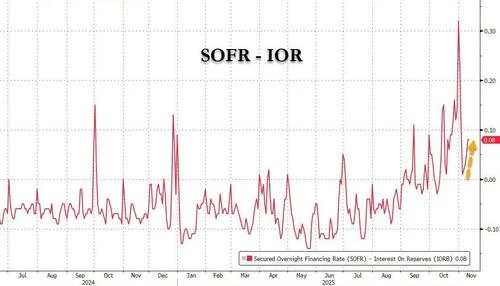
Goldman Sachs Analysis from the repurchase transaction department shows that not only SOFR, but also the tri-party repo rate has recently rebounded to about 0.8 basis points above the reserve requirement ratio.
The root cause of the liquidity crunch lies in the increased issuance of Treasury bills by the Treasury, leading to short-term capital outflows from the market and a reduction in funds within the banking system. Even though the Federal Reserve recently announced that it will stop reducing its holdings of Treasury bonds starting December 1, the tight liquidity situation has not eased, and there are concerns that even ending the government gridlock may not completely solve the problem.
Market concerns lie in the possibility that insufficient liquidity could exacerbate market volatility, which would weaken the Federal Reserve's ability to control interest rate policy and, in extreme cases, even force position liquidation, thereby impacting the government bond market, which serves as a global benchmark for borrowing costs—especially given the uncertain economic outlook.
Many market veterans still vividly remember the scene in September 2019: when the key overnight rate soared to 10%, forcing the Federal Reserve to inject $500 billion into the financial system.
Zachary Griffiths, Head of U.S. Investment Grade and Macro Strategy at CreditSight, said: “It’s safe to say that 2019 was a disaster. What we’ve been observing in the funding markets recently is that bank reserves have largely fallen to a level where they can stop shrinking their balance sheets, which is currently a manageable sign.”
However, while pressure is expected to ease significantly in the coming weeks as the Treasury plans to reduce the size of weekly bill auctions and cash held in the Federal Reserve’s TGA accounts will be redeployed after the government shutdown ends, the risk of market volatility remains at the end of the year – when banks typically reduce repurchase market activity to bolster their balance sheets in order to meet regulatory requirements.
This "contraction" often occurs before December and could exacerbate any disturbances in the year-end funding markets.
Federal Reserve officials have begun to hint at taking action.
It is worth mentioning that Federal Reserve officials are currently paying close attention to the tight liquidity situation in the money market.
On Wednesday, Roberto Perli, a New York Fed official responsible for overseeing the central bank's securities portfolio, said that the recent rise in funding costs indicates that the banking system's reserves are no longer sufficient, and the Fed "won't have to wait long" to purchase assets . This statement echoed the sentiment of his superior that day—New York Fed President Williams. This echoes similar comments.
Williams also reiterated on Wednesday that the Fed is getting closer to restarting bond purchases as part of a technical measure to maintain control over short-term interest rates.
In prepared remarks at a conference hosted by the Federal Reserve Bank of his region, Williams stated that these bond-buying actions would not have any impact on monetary policy. The Fed's third-ranking official indicated that the Fed is using a "not-so-precise scientific method" to determine what it considers "adequate" levels of bank reserves to ensure effective control over the central bank's interest rate target and to maintain normal money market trading conditions.
Williams stated, "The next step in our balance sheet strategy is to assess when bank reserve levels will reach an adequate (marginal) level. At that point, as other Federal Reserve liabilities grow and potential demand for reserves increases over time, we will begin to gradually purchase assets (release funds) to maintain adequate bank reserve levels."
Dallas Fed President Logan also stated last month that if repurchase rates remain high, the central bank will need to purchase assets, adding that the size and timing of such purchases should not be mechanical. Logan previously worked for many years in the markets department of the New York Fed.
Of course, opinions within the Federal Reserve on this issue are not unanimous , with some officials believing there is no need to be overly concerned about the recent volatility in the money market. Cleveland Fed President Hammark stated last week that as reserves continue to move towards ample (red line) levels, officials are working to determine acceptable levels of volatility. "I think a certain degree of volatility is good as long as short-term interest rates remain within our set range, so I think 25 basis points of volatility is healthy."
However, for some market participants, if the Federal Reserve does not intervene to boost market liquidity, the self-correction of the money market alone may not be enough.
“What level do you expect the money market to reach? And what is money market control?” said Mark Cabana, head of interest rate strategy at Bank of America . “In our view, expecting repo rates to self-adjust is unlikely to achieve the results the Fed desires.”
(Article source: CLS)