With artificial intelligence The boom is beginning to be hampered by increasing bottlenecks in infrastructure and energy supply, and the next major leap in artificial intelligence may not happen on land, but in space.
This is Elon Musk's latest ambitious vision for X.
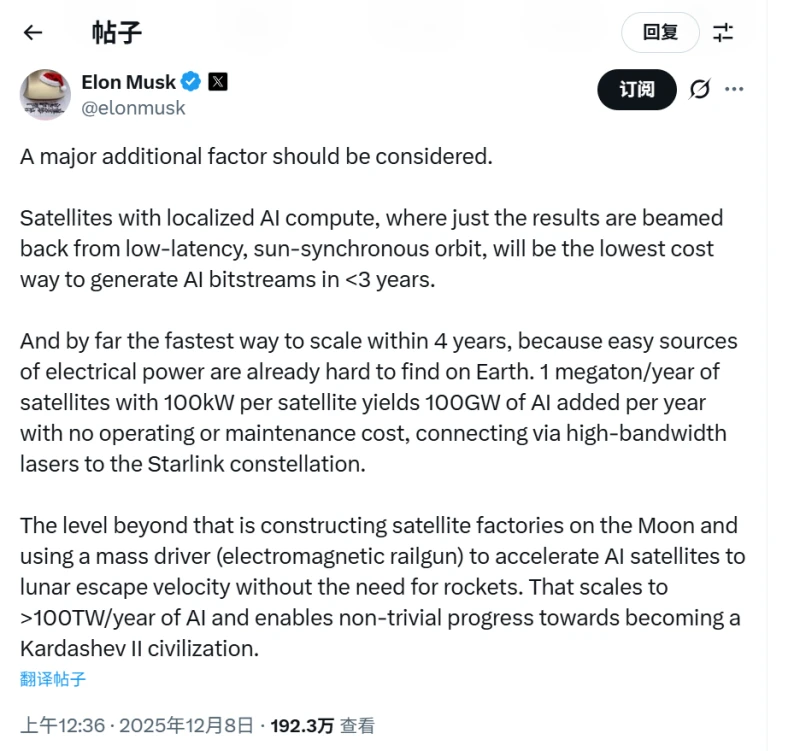
On Sunday, Eastern Time, Musk wrote on X:
Localized AI computing satellites, operating in low-latency sun-synchronous orbits and transmitting only the computation results back, will become the lowest-cost way to generate AI bitstreams within three years.
Moreover, given the scarcity of readily available electricity resources on Earth, the speed at which large-scale expansion can be achieved within four years is far ahead of the competition. Launching 1 million tons of satellites annually, each equipped with 100 kilowatts of power, can add 100 gigawatts of artificial intelligence computing power per year , without any operating or maintenance costs, and connecting to the Starlink constellation via high-bandwidth lasers.
Furthermore, satellite factories could be built on the moon , and mass drives (electromagnetic railguns) could be used to accelerate AI satellites to lunar escape velocities without the need for rockets. This would enable AI computing power to exceed 100 terawatts per year, propelling humanity towards a significant step towards a Kardashev II civilization.
The "Kardashev scale" mentioned by Musk is a technology assessment system proposed by Soviet astronomer Nikolai Kardashev in 1964. It classifies civilizations into three levels based on their energy utilization capabilities: Type I (controlling planetary energy), Type II (collecting energy from star systems), and Type III (controlling galactic energy).
Musk added in another post:
"Once there are lunar factories and robots on the moon..." With large-scale drivers, the entire cycle would close, and this system could potentially decouple from traditional currencies and operate autonomously in units of watts and tons.
In recent months, not only Musk, but also Google's "Project Suncatcher" and Amazon's... Leo satellite internet Like Musk's grand vision, the Constellation Propulsion project also points to the next direction of artificial intelligence development: space.
Taking artificial intelligence into space—while it may sound far-fetched, behind the flashy press releases and ambitious pronouncements of tech giants lies a very real dilemma faced by AI developers: the ever-expanding scale of AI models and the skyrocketing demand are overwhelming the data centers that underpin the world's digital backbone. Fiber optic networks and power systems are already showing significant pressure . Meanwhile, the pace of developing new energy sources is struggling to keep up with demand growth, and factors such as delays, climate risks, and political obstacles must also be considered.
Google's " Suncatcher " project aims to build orbital computing nodes powered by near-continuous solar radiation and cooled by the vacuum of space. The idea is that these satellites, carrying a large number of Google TPUs, will ultimately be able to run machine learning models more efficiently than ground-based data centers , especially for tasks that don't require real-time human-computer interaction. In orbit, solar energy... Battery The plates are more efficient and easier to cool. Moreover, they will not stop operating due to storms or power outages.
Amazon , through its "LEO" project, hopes to build a global broadband network of thousands of low-Earth orbit satellites that will eventually connect to cloud and artificial intelligence infrastructure. Some of these satellites may one day provide edge computing for regions lacking or unable to access cloud services. Services used to perform artificial intelligence tasks.
Meanwhile, Elon Musk is conceiving of an "orbital computing farm" for xAI and SpaceX to address related issues. This system would not only run models but also train them, a more challenging technical problem, but potentially meaningful for resource-intensive missions requiring uninterrupted energy supply and physical isolation.

(Article source: CLS)