Nvidia They were arguably the most watched vendors at this year's CES.
This chip company has fundamentally impacted artificial intelligence. The trajectory of technological waves, from AI infrastructure to the model layer and then to the application layer, is closely related to the development trends of each layer. At the same time, changes in market demand in related fields also determine the long-term fate of this company.
The company continues its rapid pace of technological iteration in its core business. On January 5th local time, during his keynote speech, Jensen Huang officially announced that NVIDIA's next-generation AI supercomputing platform, Vera Rubin, has entered full-scale production. The platform's core—the Rubin GPU—achieves inference performance five times that of the previous generation Blackwell platform.
According to data released by NVIDIA , the Rubin GPU features the third-generation Transformer engine, achieving 50 PFLOPS of NVFP4 inference performance. In terms of training performance, the Rubin platform is 3.5 times faster than its predecessor, Blackwell; its HBM4 bandwidth is 22TB/s, 2.8 times that of Blackwell; and it contains 336 billion transistors, 1.6 times that of Blackwell.
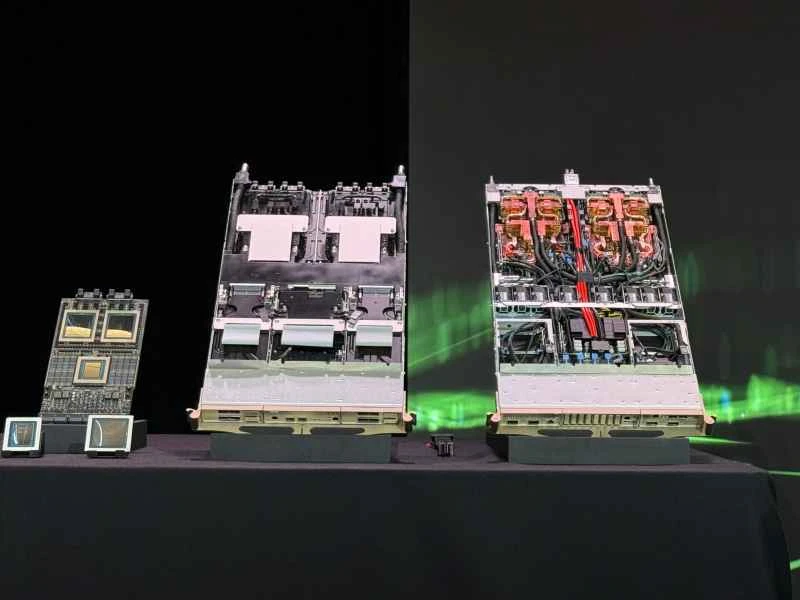
Vera Rubin series (Image source: Jiemian News)
On January 6th, Jensen Huang was interviewed by Jiemian News and other media outlets around the world. Beyond product definition and technical architecture, he also discussed several important issues, such as how the development of large-scale models and AI applications will influence NVIDIA's technological direction, the specific progress of selling H200 chips to the Chinese market, NVIDIA's investment ecosystem and its boundaries, and his personal views on robotics. Company development, etc.
The following is a transcript of an interview with Jensen Huang, slightly edited by Jiemian News:
Media: It's been almost a month since the US government approved Nvidia's license to export H200 chips to China. When do you expect to begin shipping to Chinese customers? What has been the feedback from customers and regulators in China?
Jensen Huang: Customer demand (in China) is very high, indeed very high. We have accelerated supply chain production, and the H200 is running on the production line. The company is finalizing some details regarding the US government's approval process.
(In China) My expectation is that there won't be any grand public announcements; ultimately, everything will be reflected in purchase orders.
If a purchase order appears, it means the customer can and is permitted to place an order. It's probably that simple. So, what I'm looking forward to now is seeing the purchase order come in.
Media: Do you think the H200 is still competitive in the Chinese market? You yourself have said that Nvidia may be a very strong competitor, and there are many startups in China doing similar things.
Jensen Huang: The H200 is competitive in the market now, but it won't be competitive forever. Hopefully, we can release other competitive products by then.
Media: In your keynote speech, you mentioned that Vera Rubin has entered full production, but your team previously stated in pre-conference communication that the overall timeline was to begin delivery to customers in the second half of 2026. Has this series now completed verification and testing and entered the mass production stage? What are your thoughts on the potential challenges?
Jensen Huang: What we're doing is extremely difficult. Never before has any computer system incorporated so many entirely new chips at this scale.
Specifically: the CPU and GPU are based on the new Rubin architecture; the CX9 network chip is new; the NVLink switching chip is new; and the Spectrum-X switch is also new.
We've had these chips for a while now. Our processes are very rigorous, and we have indeed introduced a lot of new technologies. But to the best of our ability, we've mitigated the risks of these new technologies as much as possible.
Even so, I must emphasize that what we are doing is extremely difficult in itself. Moreover, there is only one company in the world capable of doing this at our current scale and speed. Therefore, I will never underestimate the challenges of this work, but I am very confident of ultimate success.
Verification is an ongoing process: the software is constantly being improved, and the system is continuously being optimized. As for the chips themselves—they are ready for manufacturing and can be put into production.
Media: What feedback have you received from customers regarding energy pressures related to power issues? Do they want to relocate their existing data centers ? Infrastructure upgrades or migrations to the new NVIDIA product portfolio?
Jensen Huang: We are standing at the starting point of a new industrial revolution, and any new industry cannot grow without energy.
We need energy in various forms: from natural gas From sustainable energy to any form of electricity, it will be used. But one thing is more important than ever—ultimate energy efficiency.
This is precisely why we are so aggressively pushing for technological evolution. Because in each generation of products, if throughput increases tenfold while power consumption only increases twice, then energy efficiency is effectively improved fivefold.
So when our technology achieves 10 times the throughput per watt, or 5 times the throughput per watt—whatever the exact percentage—these improvements will directly translate into increased revenue for our customers.
The reason is simple: today, tokens can be directly converted into cash.
In a power-constrained, physically limited data center : if we can generate more tokens, revenue will increase; if we can support larger models, the intelligence level of the models will increase, and the ASP (average selling price) of a single token will also increase.
The end result is that, under the same limited energy conditions, your token price is higher, your throughput is higher, and your total revenue increases accordingly.
Therefore, energy efficiency is crucial. Our ongoing goal is to produce more tokens per unit of watt and per unit of dollar.
Media: We all know that one of the secondary effects of AI is memory shortage, which is driving up gaming costs. Regarding the price of equipment, gamers are also worried about whether graphics card prices will rise further. Do you have any concerns about this?
Jensen Huang: Many people may not know that Nvidia is probably the only chip company in the world that directly purchases memory on such a large scale.
We are one of the world's largest direct buyers of memory, and we cooperate with all major memory suppliers, some of which are HBM ( High Bandwidth Memory). ) partners.
Frankly, all the HBM plants currently under construction are basically exclusively for our use. For quite some time, we don't expect other manufacturers to adopt HBM on a large scale. This is very important to us because our demand is extremely high, so all HBM suppliers are expanding production at full capacity, and overall progress is very smooth.
At the same time, we also purchase large quantities of GDDR memory for our graphics cards and are a major customer of LPDDR5X. So overall, we have always been a very large customer, and we have done a very thorough job in supply chain planning.
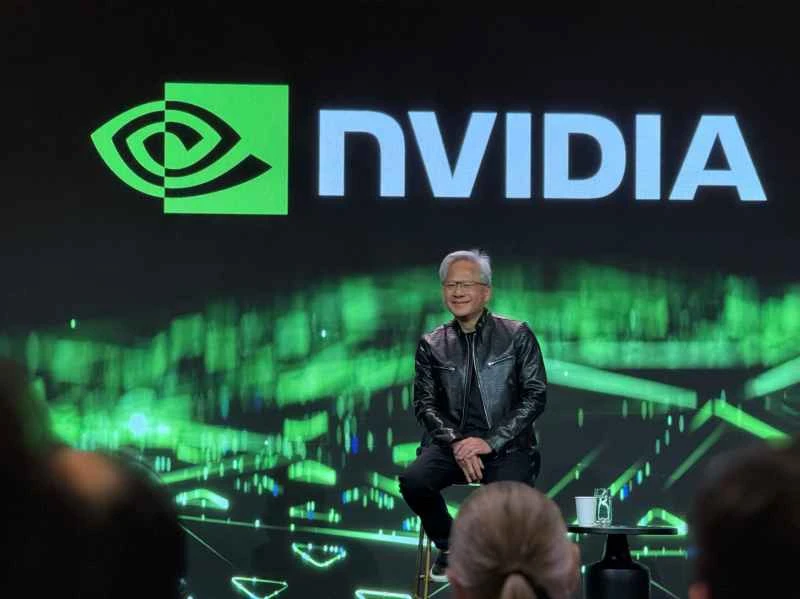
Nvidia CEO Jensen Huang (Image source: Jiemian News)
Media: You currently possess a huge mountain of cash. Can you talk about how you plan to allocate these funds in the future? For example, acquisitions, hiring, etc.
Jensen Huang: We invest our funds in the ecosystem, and in a multi-dimensional way.
The first type of investment is to build things that no one else in the world can build or that simply don't exist. Unless we build them, they simply won't exist. NVLink is such an example.
The second type of investment is in the upstream and downstream supply chain. Looking at the upstream, for example, memory suppliers. We've invested heavily in supporting our memory partners, system partners, and technology partners, whether they're developing unique technologies for us or mass-producing them.
Our downstream supply chain is essentially our market channel—one of the world's largest and most diverse markets. We have partners in almost every cloud service provider, computer manufacturers in almost every country (HP, Dell, etc.), as well as regional cloud service providers and supercomputing centers around the world.
Sometimes we also invest in companies that open up new customer categories but are important for the future of the ecosystem.
In general, when we think about investing systematically, we invest in five levels of the ecosystem, including energy, chips, infrastructure, models, and applications.
Our investment goal is to nurture and accelerate the development of AI, while building closer partnerships and collaborations. Investing in these startups is fantastic because they will become some of the most influential companies of the future.
Media: What advice would you give to an embodied intelligence startup to help them choose the right application area or the right idea to generate the greatest impact and get the most opportunities?
Jensen Huang: For robots , the question boils down to a few choices: Do you want to be a horizontal company or a vertical company?
The advantage of horizontal expansion is that you don't need to worry too much about specific applications and can focus more on the technology itself. If successful, the scale can be very large. However, horizontal expansion is also very difficult, as your competition comes from all directions.
Vertical industry companies require a very deep understanding of specific applications. This could be EMS manufacturing, AI supercomputer assembly, car factory construction and sales, or specialized fields like surgical robots . Having strong domain expertise can be a huge advantage.
If you were to ask me, my personal preference is usually to look for opportunities in vertical fields, but some leaders prefer a horizontal approach, which is fine too.
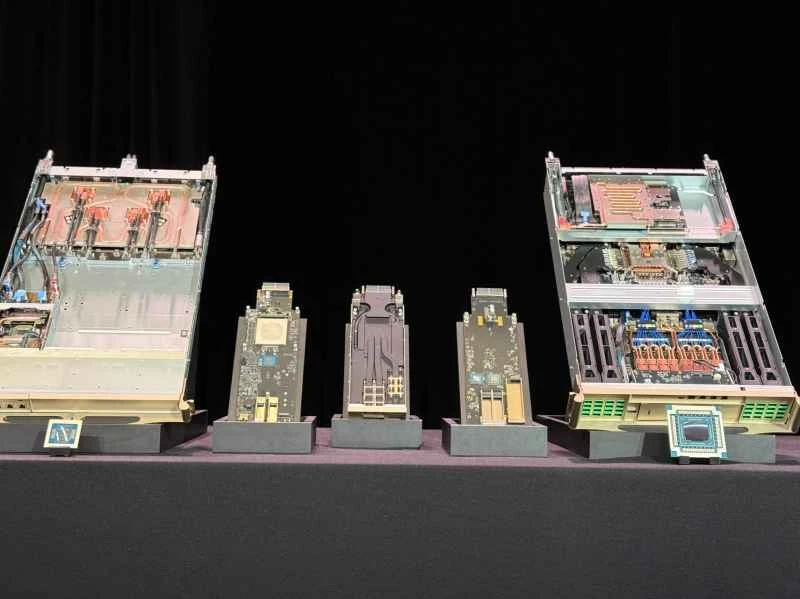
Vera Rubin series (Image source: Jiemian News)
Media: What's it like managing Nvidia? It's probably the most stressful company in the world right now.
Jensen Huang: First of all, I don't do it all by myself; I have a fantastic team to help me share the workload.
There is no doubt that Nvidia has a huge influence in the global technology industry, supply chain and network market today, but with that comes a huge responsibility, which we take very seriously.
One of the most important things we can do is build the best technology in the world. By doing so, not only do we remain relevant, but our partners continue to succeed, and we ensure that AI progresses in a way that allows it to scale continuously.
Second, we need a rich ecosystem so that other companies can also benefit from this industrial revolution. That's why I always appear on stage with other CEOs. Our responsibility is to lead everyone forward.
I believe that if the entire industry is more resilient, rather than moving in isolation, this global ecosystem network can evolve alongside technology.
Media: What's the secret to being a CEO for so long? Do you think you can stay in this role for another ten years?
Jensen Huang: There are two secrets to being a CEO for a long time: first, not getting fired; second, not getting bored. I'm not sure which will come first. As long as I'm worthy, I will continue to be CEO.
Media: We see global competitors, including emerging AI companies in China, developing rapidly. Against this backdrop, how do you foresee the evolution of the competitive landscape in 2026?
Jensen Huang: China has seen a surge in startups, many of which have gone public and are performing exceptionally well. This demonstrates the vitality and capability of China's technology industry. It is no exaggeration to say that China's entrepreneurs, engineers, technical experts, and AI researchers are among the best in the world.
It's safe to say that China's technology ecosystem is developing very rapidly, engineers are incredibly hardworking, and they also possess a strong entrepreneurial spirit and brilliant ideas. Therefore, I firmly believe that China's technology market will continue to prosper and progress.
In order to contribute to and provide value to the Chinese market, we must compete and continuously advance our technology.
So I'm not surprised at all to see so many entrepreneurs wanting to join the competition. My final words to them are: I look forward to your competition, but you need to work even harder.
(Article source: Jiemian News)