Peng Xin, reporter for 21st Century Business Herald
Nvidia has not released any new graphics cards. At this year's CES, for games Business updates were implemented in the software.
On January 6, NVIDIA released its latest generation of deep learning super sampling technology DLSS 4.5 and showcased the latest progress in the application of ACE, a generative AI-based NPC (non-player character) technology.
AI becomes the dominant factor in game graphics.
As NVIDIA 's core software moat in the gaming field, the update of DLSS (Deep Learning Super Sampling) technology is the focus of this release. NVIDIA announced the release of DLSS version 4.5, which introduces "Dynamic Multi Frame Generation" technology and a brand-new 6x multi-frame generation mode.
According to NVIDIA, DLSS 4.5 utilizes the second-generation Transformer model, generating up to five additional frames on top of each traditional frame rendered. This means that in games with this mode enabled, the number of pixels generated by AI far exceeds that of traditional rasterization or ray tracing rendering, and AI has essentially "taken over" the final game visual presentation.
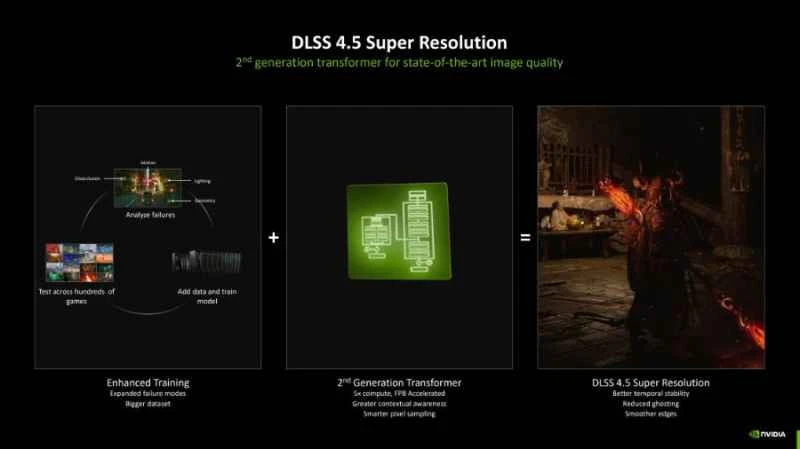
DLSS 4.5 is expected to officially launch this spring and will be available on all RTX series graphics cards, but will run fastest on NVIDIA's latest RTX 40 and 50 series graphics cards. NVIDIA claims that, combined with GeForce RTX 50 series graphics cards, this technology can achieve a 4K gaming experience of over 240 frames per second in high-load scenarios with path tracing enabled.
Regarding the progress of DLSS ecosystem promotion, NVIDIA also introduced that more than 250 games and applications currently support DLSS 4 technology, including new games such as "007: The First Steps", "Shadow Blade Zero" and "Resident Evil: Requiem" which will support the technology upon release.
Game NPCs have "memories"
NVIDIA is also driving generative AI to change the interaction logic within games. NVIDIA has expanded its ACE (Avatar Cloud Engine) technology suite, transforming traditional scripted NPCs into autonomous characters with the ability to perceive, plan, and act.
In a collaborative demonstration with game developer KRAFTON, NVIDIA showcased "PUBG Ally," an AI teammate for PlayerUnknown's Battlegrounds (PUBG) equipped with "long-term memory." This AI teammate can not only execute tactical commands but also remember players' past performance and in-game interactions, mentioning previous events in conversations. For example, the AI teammate can understand commands like "where to loot supplies" and remember the lesson learned from the previous match where a player "got killed because of greed for fire" and will comment on it at the start of a new game. This feature is planned for limited testing in PUBG's Arcade mode in the first half of this year.
Furthermore, in the strategy game Total War: Pharaoh, the AI advisors demonstrated even stronger logical capabilities, providing players with real-time tactical guidance that aligns with the game's global situation based on real-time battle conditions and the game's database.
In response to concerns about potential computational costs and latency arising from the "long-term memory" of large models, NVIDIA provided a detailed breakdown of its technical architecture at a press conference. Staff clarified that ACE NPC's memory function does not simply rely on the extremely long context window of the cloud model, but rather is based on RAG (Retrieval Enhanced Generation ). (Success) technical implementation.
Under this architecture, the game will establish a vector database on the player's local PC to store and "vectorize" the player's behavioral logic and dialogue history. When the player interacts with an NPC, the system will retrieve the most relevant memory fragments from the local database, rather than uploading all historical data to the cloud. NVIDIA stated that this "local retrieval + on-demand generation" model significantly reduces the cost of cloud-based inference while effectively solving privacy leaks and high network latency, making it the optimal solution for NPCs to maintain long-term memories.
Nvidia's cloud gaming service, GeForce NOW, also announced that it will offer performance comparable to an RTX 5080 graphics card, and has added support for Linux and Amazon. Native support for Fire TV Stick.
For content creators, NVIDIA released a series of AI acceleration solutions based on RTX GPUs. These include up to 3x improvements in video and image generation performance and a 60% reduction in VRAM usage in the ComfyUI graphical interface tool, through PyTorch-CUDA optimization and native NVFP4/FP8 precision support. NVIDIA also announced a 35% acceleration inference speed for small language models such as Llama.cpp.
It's worth noting that NVIDIA specifically mentioned its optimized support for the domestic open-source model DeepSeek-R1 during its media briefing regarding AI productivity tools, demonstrating its continued investment in maintaining the global developer ecosystem. NVIDIA stated that DeepSeek R1 currently performs exceptionally well among inference models, and NVIDIA has made specific optimizations for this model on RTX graphics cards, enabling extremely high inference throughput.
(Article source: 21st Century Business Herald)