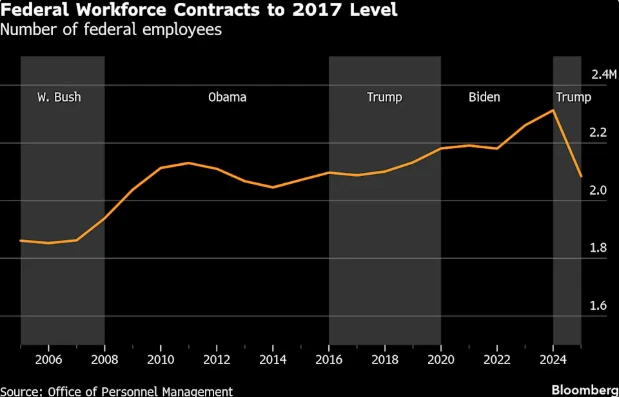
According to government data released Thursday, President Trump's federal employee cuts last year affected almost all major government agencies—with cabinet departments such as the Department of Education, the Department of Housing and Urban Development, and the Treasury Department being the hardest hit by the layoffs.
Since Trump took office last January, more than 322,000 federal employees have left the country, a ratio of more than three to one in terms of departures to new hires.
The latest federal employee data from the U.S. Bureau of Personnel Management indicates that the government workforce is undergoing its most dramatic transformation in decades. This comes after President Trump announced a hiring freeze on his first day in office and briefly appointed Tesla CEO Elon Musk to lead a sweeping campaign to cut government spending.
Trump had vowed to abolish the Department of Education, and the department did indeed reduce its staff by about 39% between January and November 2025. During the same period, the Department of Housing and Urban Development reduced its staff by 23%, and the Treasury Department by 21%.
In absolute numbers, the departments with the largest layoffs include the Department of Defense, the Department of Veterans Affairs, the Department of the Treasury, and the Department of Health and Human Services. The IRS, under the Treasury Department, was particularly hard hit—it lost 22,000 employees since the start of Trump's second term—and the Veterans Affairs Administration—which cut more than 21,400 jobs.
One of Musk's most notable initiatives during his tenure at the Department of Efficiency was the "Fork in the Road" deferred resignation buyout program—allowing federal employees to retain their pay for more than six months after leaving the company. Currently, most departures are achieved through voluntary resignation and retirement plans. Only 3% of departures are due to layoffs, but the scale of layoffs could still expand depending on court rulings and potential agreements reached by Congress to keep the government running.
Of course, not all federal agencies experienced staff reductions: as of last November, about 12 of the 127 agencies tracked by the Bureau of Personnel Management had net increases of a small number of positions. These included the White House Office of Administrative Management, the Council of Economic Advisers, and the Office of the United States Trade Representative.
Intelligence agencies, the diplomatic system, and the U.S. Postal Service, among others, have not yet reported personnel data to the Office of Personnel Management. The statistics also do not include employees of the majority of the legislative and judicial branches.
If hiring factors are taken into account, the net number of government employees decreased by approximately 219,000.
This latest assessment of the size and structure of the federal workforce stems from the Office of Personnel Management's modernization of its employee data system—which previously often released data with a lag of six to nine months. Prior to Thursday's release, the latest data on the federal workforce was still from March of last year.
The new system will enable monthly data updates. The Human Resources Administration Bureau will also release monthly statistics on retirement eligibility, performance ratings, and remote work—data that previously often resulted in inconsistencies in reporting among different agencies.
Scott Cooper, the U.S. Office of Personnel Management, called the new platform "a significant step forward in government accountability and data-driven decision-making."
The newly released data also reveals the following trends:
As the Trump administration tightened flexible work arrangements during the pandemic, the proportion of federal government employees working remotely generally declined. In October of last year, full-time remote work hours decreased by 75% compared to January of the previous year.
The percentage of federal employees represented by collective bargaining units has fallen below 38%, far lower than the over 56% in January. This means that Trump has successfully stripped federal employees of their "union protection umbrella" on a large scale through legal means. In March of last year, Trump signed an executive order excluding entire categories of federal employees from unions on national security grounds.
The federal government is still hiring, but the number of jobs to be hired in fiscal year 2025 is down 42.7% compared to the last full fiscal year of the Biden administration.