① SpaceX makes rare disclosure of an on-orbit anomaly involving a Starlink satellite, suspected to have exploded; ② With the explosive growth in the number of low-Earth orbit satellites, the operational safety and systemic risks of satellite networks are gradually emerging.
Hours ago, SpaceX, which has recently been attracting much attention from the capital market, made a rare disclosure about an on-orbit satellite accident.
According to the official Starlink account, Starlink satellite number 35956 experienced an anomaly on Wednesday, losing contact at an altitude of 418 kilometers . The anomaly caused a leak in the satellite's propellant tanks, resulting in a rapid descent of 4 kilometers in altitude and the release of a small amount of debris.
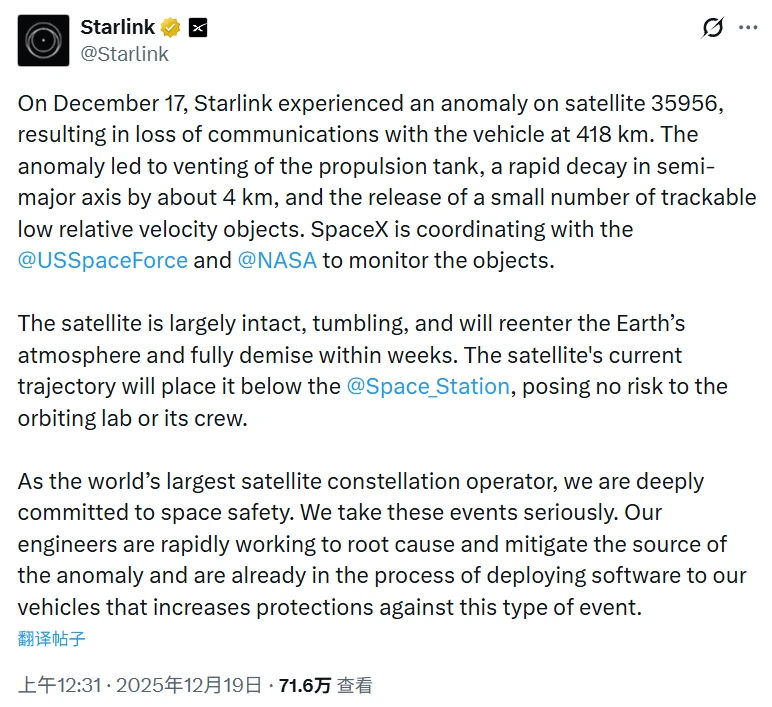
This description usually implies that the satellite experienced some kind of internal explosion.
The company disclosed that the satellite's overall structure is largely intact. It is currently tumbling and will re-enter Earth's atmosphere within weeks, where it will completely burn up and disintegrate . SpaceX is currently coordinating with the U.S. Space Force and NASA to monitor these targets.
Although the cause of the satellite accident was not explained, Starlink disclosed that it has begun deploying software updates to its existing satellites to enhance their ability to protect against such incidents.
Space tracking company LeoLabs said it has detected "dozens" of pieces of debris that may have been generated by the incident, and expects to identify more as it continues to track the event. LeoLabs added that the satellite's rapid drop in altitude likely indicates that the accident was caused by an internal problem, rather than a collision with another satellite or space debris.
With satellite internet As the focus of private equity investment and capital markets, the operational risks of space orbital business are also attracting attention from the industry.
For example, SpaceX alone currently operates more than 9,300 satellites in orbit , and that number is growing rapidly. This year alone, SpaceX has conducted 122 Starlink satellite launches, sending more than 3,000 satellites into orbit.
As a milestone for the company, SpaceX achieved the milestone of launching 10,000 Starlink satellites at the end of October this year. These satellites have an expected lifespan of about 5 years and will need to be actively maneuvered to lower their orbit and burn up in the atmosphere when they are decommissioned from operation.
A study published in Acta Astronautica in October of this year shows that there were approximately 13,700 objects (including satellites and space debris) orbiting the Earth in low Earth orbit (below 2,000 kilometers) in 2019, and this number is expected to rise to 24,185 by early 2025. Industry forecasts predict that by the end of this decade, the number of satellites operating in low Earth orbit alone could reach approximately 70,000.
This also means that at altitudes with high deployment density, a large number of satellites will have to perform frequent maneuvers to avoid collisions. For example, according to a report submitted by SpaceX to US regulators, in the first six months of this year, Starlink satellites performed 145,000 collision avoidance maneuvers, equivalent to each satellite maneuvering four times per month.
The new study also found that at certain altitudes, many satellites perform more than 10 evasive maneuvers per month.
Frequent maneuvers by satellites in orbit also increase the risk of subsequent collisions with other aircraft , because the satellite's trajectory changes due to orbital maneuvers, and collision prediction algorithms may not be able to adjust immediately. The more satellites in orbit, the higher the risk of maneuver failure.
"While most orbits are not yet saturated, some regions are," explained Maya Harris, a co-author of the study and a research assistant at MIT. "The two most affected regions are between 400 and 600 kilometers—where there are a lot of satellites in orbit, and between 700 and 800 kilometers—where there is a lot of space debris."
(Article source: CLS)