According to a Bloomberg report cited by CCTV Finance, SpaceX, Elon Musk's rocket manufacturer, is seeking an IPO in the mid-to-late part of next year, targeting a valuation of approximately $1.5 trillion. This valuation would rival Saudi Aramco's record of approximately $1.7 trillion set in 2019. According to the Bloomberg Wealth Index, Musk holds approximately 42% of SpaceX's shares. This means that Musk is poised to become the world's first trillionaire.
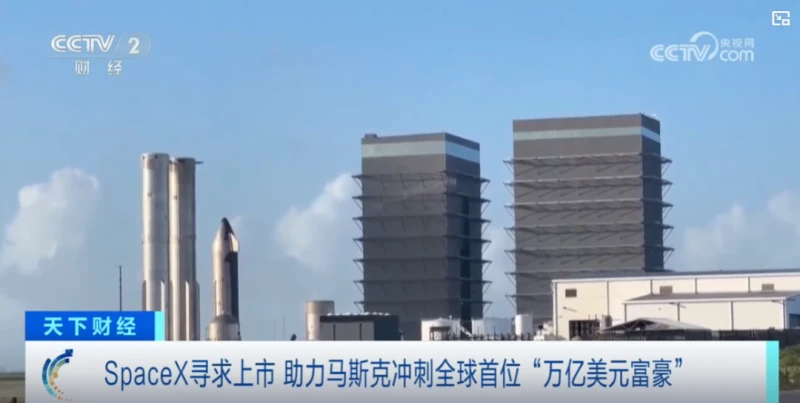
According to CLS (China Lianhe Securities), SpaceX executives are beginning to select Wall Street banks. The firm has provided advisory services to SpaceX for its initial public offering (IPO). This represents a significant step towards SpaceX's IPO.
On December 12th local time, SpaceX CFO Brett Johnson sent an internal memo to employees indicating that if the IPO goes through, the funds raised will be used to: increase the launch frequency of Starship rockets to "crazy levels" and deploy an AI data center in space. And to advance unmanned and manned Mars missions.
The memo also revealed that SpaceX has set its latest internal stock offering price at $421 per share, corresponding to a staggering $800 billion valuation for the company, more than double its valuation of approximately $400 billion earlier this year.
The rocket and satellite maker's decision to seek an IPO surprised some people close to the company. Musk has long been outspoken in his opposition to taking SpaceX public. He has repeatedly stated publicly that he does not want SpaceX to become like Tesla . He believes that the capital market's pursuit of short-term financial gains is fundamentally at odds with core missions like SpaceX's Mars colonization, which require long-term, massive investments and have little chance of short-term returns.
According to a report released by space consulting firm Novaspace, SpaceX's total revenue reached approximately $11.8 billion in 2024, with Starlink revenue accounting for about $7.8 billion. Besides the United States, SpaceX has also provided satellite launch services to countries such as Argentina and South Korea.
On December 11th, Beijing time, the author of the SpaceX biography "Takeoff" posted an article on social media, stating that SpaceX's revenue is actually quite substantial, potentially reaching $22 to $24 billion next year. However, SpaceX founder Elon Musk's support for an IPO is attributed to rising AI costs, including database development, as SpaceX plans to build a space-based database, thus requiring financial support. Musk subsequently replied, "Eric is right," indirectly hinting at SpaceX's IPO plans for next year.
Some investors have stated that SpaceX's potential IPO and its financing needs have also impacted the global commercial space industry. The competition has intensified.
Domestically, the China National Space Administration (CNSA) recently established a Commercial Space Department, marking the arrival of a dedicated regulatory body for China's commercial space industry. Furthermore, the CNSA released the "Action Plan for Promoting High-Quality and Safe Development of Commercial Space (2025-2027)," proposing to incorporate commercial spaceflight into the national space development strategy. The overall plan aims to accelerate the formation of new-type aerospace productivity, achieve an overall improvement in the efficiency of aerospace development , and strongly support the construction of a space power. It explicitly encourages Chinese commercial aerospace companies to "go global" and participate in international competition and cooperation.
On December 3, LandSpace's Zhuque-3 reusable launch vehicle was launched into orbit, marking the first time in China that a launch vehicle had attempted first-stage recovery, which attracted widespread attention from all sectors of society. Unfortunately, the recovery was unsuccessful.
According to Jiemian News, Tianbing Technology and the Long March 12A rocket will conduct reusable test flights in December, which is expected to take a new step in breaking through the "shackles" of China's commercial spaceflight.
The Long March 12A carrier rocket was developed by the Eighth Academy of Aerospace Science and Technology . On November 7, the group mentioned that Li Jianqiang of the Eighth Academy is leading his team in the final push for the maiden flight of the new Long March 12A carrier rocket. "New rocket, new launch pad, new model, great challenges," he said. "But we must fully identify all kinds of risks in the current development process and formulate practical and effective measures to ensure success, with the goal of 'steady progress, solidifying every step, and achieving perfection on the first attempt' to ensure the maiden flight mission is 'successful launch and successful recovery'."
China International Capital Corporation It was pointed out that my country's main commercial rocket models are gradually entering the stage of routine launches. In terms of total numbers, the number of commercial rocket launches has increased from 1 in 2017 to 16 in 2024, and as of November 2025, my country has completed 15 commercial rocket launches in 2025.
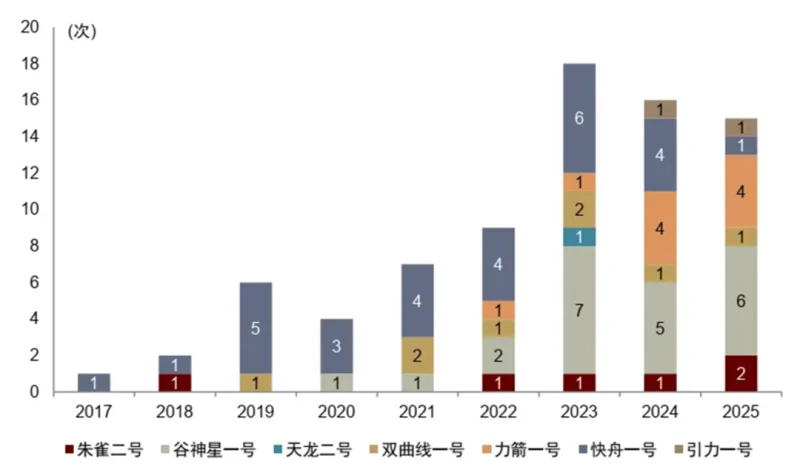
Recent Developments and Launch Counts of Domestic Commercial Space Companies
Analysts point out that commercial rockets are clearly geared towards low cost, rapid delivery, and large capacity. Large-scale, reusable commercial rockets are expected to provide ample low-cost capacity support for space infrastructure construction, thereby further solidifying the foundation for the development of the commercial aerospace industry.
Reusability is key to reducing the cost of commercial rockets, and the demand for reusability drives the development of rocket subsystems. On the one hand, the rocket body and propulsion system account for approximately 60% to 80% of the rocket's cost, and reusing key structures can effectively reduce launch costs. On the other hand, the application of new technologies further reduces rocket manufacturing costs. Most high-thrust commercial rockets use variable-thrust liquid engines, and liquid oxygen and methane, with their low cost and low carbon buildup, are expected to become the mainstream fuels. Stainless steel is being used to replace aluminum alloys in the rocket body structure, and complex structures are being developed using 3D printing. The process achieves weight reduction and cost reduction.

(Source: Daily Economic News)