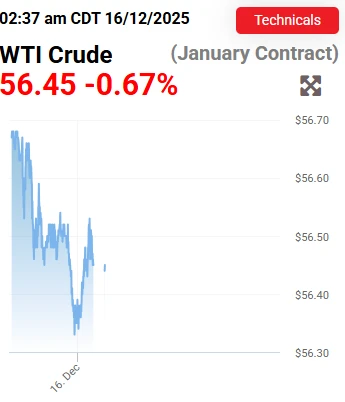
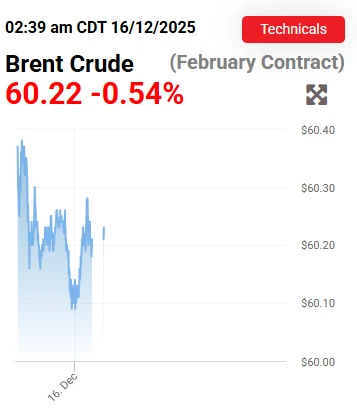
① On Monday, US President Trump said that a peace agreement between Russia and Ukraine was close, prompting traders to weigh the potential supply changes in the oil market after the conflict ends; ② WTI crude oil futures fell below $57 per barrel, while Brent crude fluctuated above $60 per barrel, with oil prices expected to post an annual loss this year; ③ In addition, market concerns about a super supply glut in the oil market next year further weighed on oil prices.
On Monday, US President Trump said he had a very successful dialogue with European leaders and was now closer than ever to achieving peace between Russia and Ukraine.
This statement prompted traders to weigh the potential supply changes in the oil market following the end of the Russia-Ukraine conflict, causing the benchmark price of US crude oil (WTI) to fall to its lowest level since October 2021. Traders are also concerned that crude oil may face demand issues next year due to the slow global economic recovery.
Currently, WTI January futures prices have fallen below $57 per barrel, while Brent crude is fluctuating above $60 per barrel. Oil prices are projected to post an annual loss this year; so far, WTI crude prices have fallen 21.2% year-to-date, while Brent crude prices have fallen 19.3%.
According to data from Bridgeton Research Group, on Monday, trend-following commodity trading advisors held 100% short positions in both Brent and WTI crude oil.
Negative factors dominate the market
Canadian Imperial Bank of Commerce Rebecca Babin, a senior energy trader at a private wealth group, pointed out that news reports on Monday indicated that the international community had gradually reached a consensus on some aspects of the Russia-Ukraine ceasefire agreement, which led to a continued weakening of crude oil prices.
She added that while a ceasefire would not trigger a massive influx of Russian crude oil into the market, it would significantly reduce the risk of future supply disruptions. Nevertheless, some details of the peace agreement remain unclear, which could provide support for oil prices.
Meanwhile, commodities trading giant Trafigura warned last week that new supply in the international crude oil market next year will coincide with an economic slowdown, leading to a super-supply glut. The International Energy Agency had previously predicted that the oil market could see a record surplus of more than 4 million barrels per day next year, equivalent to 4% of global consumption.
On the other hand, the US seizure of a Venezuelan supertanker could disrupt oil prices. PVM analyst John Evans stated that while oil prices continued to decline last week, the US actions regarding Venezuela provided some support.
Furthermore, despite progress in US-Ukraine talks, Ukraine has intensified its attacks on Russia's Caspian region, targeting Russian energy production and refining facilities. Last Friday, the Ukrainian military claimed responsibility for attacks on multiple targets, including Russian oil refineries, prompting a swift retaliation from the Russian military.
(Article source: CLS)