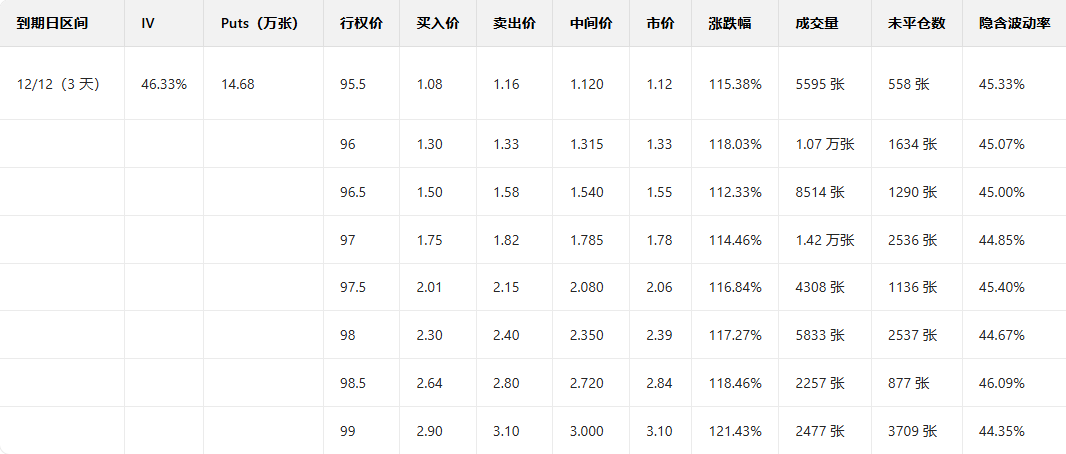
① This year, international copper prices have generally exhibited a trend of "high-level fluctuations with an upward shift in the central value," with LME copper rising by nearly 30% cumulatively and US copper futures rising by about 34%, potentially marking the largest annual increase since 2009; ② Supply-side constraints have intensified, with major global copper mines experiencing successive production disruptions, leading to a decline in output. In the long term, the main problem facing the global copper market remains "new supply failing to keep pace with demand growth."
In 2025, international copper prices are expected to show a trend of "high-level fluctuations and an upward shift in the central value".
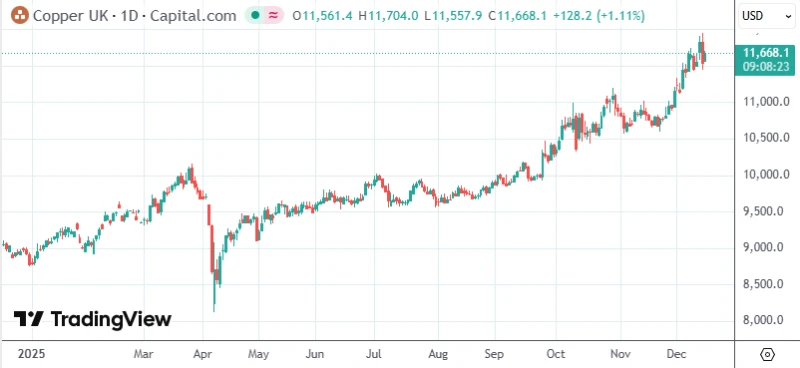
In March of this year, copper prices on the London Metal Exchange (LME) once rose above $10,000 per ton; in April, they quickly fell back to around $8,100, recording the lowest level of the year; after that, LME copper resumed its upward trend and broke through the previous year's record high in October.
As the year draws to a close, London copper prices have accelerated their upward trend, repeatedly hitting new historical highs recently, reaching a peak of $11,944 per ton, close to the $12,000 mark. As of press time, LME copper is trading at $11,697 per ton, representing a year-to-date increase of nearly 30%.
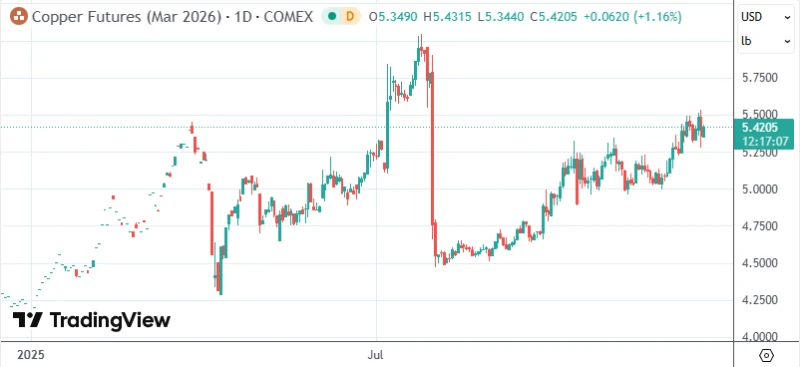
On the New York Mercantile Exchange, U.S. copper futures prices also hit their lowest point of the year in April. In July, U.S. President Trump announced a new 50% tariff on copper, causing U.S. copper prices to rise to a historic high of $5.95 per pound, but subsequently fell significantly to $4.33. Since August, U.S. copper futures have rebounded continuously, currently trading at $5.39 per pound, a year-to-date increase of approximately 34%, outperforming London copper prices and poised to record its largest annual gain since 2009.
Overall, copper prices fluctuated repeatedly at the beginning of the year due to the unclear macroeconomic environment and significant differences in market opinions on the global economic recovery. However, as the supply and demand imbalance gradually emerged, copper prices have clearly deviated from the traditional economic cycle logic and are more indicative of a trend of rising prices under structural tensions.
Recently, spot prices in the London market have consistently outperformed forward contracts, with significant near-month premiums observed at times, reflecting the tight supply in the physical copper market. Particularly in London, low inventory levels have further amplified price volatility.
Increased supply-side constraints have become a key support for prices.
Throughout the year, major copper mines around the world experienced a series of production disruptions, the most significant being the significant production reduction at the Grasberg mine in Indonesia due to a mudslide.
Freeport-McMoRan Copper & Gold Corp., the operator of the mine, announced that the mine was under "force majeure" due to a landslide that caused a mining accident. Copper sales are expected to decline in the third quarter of this year, and the full resumption of operations will be postponed to the first half of 2026.
In addition, supply disruptions at El Teniente, the world's largest underground copper mine in southern Chile, were caused by a safety incident, while the Kamoa-Kakula copper mine in the Democratic Republic of Congo was affected by a mining earthquake. Meanwhile, mining companies such as Glencore lowered their production forecasts for next year, exacerbating expectations of tight supply.
In the long run, the main problem facing the global copper market, rather than the disruptions to mine production, remains "new supply failing to keep up with demand growth." The consequences of insufficient global copper mine investment over the past decade will become apparent in 2025, with slow progress on new projects and significantly longer expansion cycles.
A report by consulting giant Wood McKinsey estimates that by 2035, in addition to the 3.5 million tons/year increase in supply through the direct use of scrap copper, an additional 8 million tons/year of mining capacity will be needed.
Wood McKinsey writes that, taking into account factors such as inflation and tightening supply chains, the cost of achieving this supply growth could exceed $210 billion. In comparison, total capital investment in copper mining over the past six years amounted to only about $76 billion.
Wood McKinsey believes that strict capital discipline, increasingly stringent ESG (Environmental, Social, and Governance) requirements, and rising investor risk aversion are all factors that constrain Western mining companies from increasing output.
Shifting demand structures are transforming copper from a cyclical metal to a "strategic metal".
In stark contrast to the constraints on the supply side, the structure of copper demand is undergoing profound changes.
Analysts believe that while traditional industrial demand does experience cyclical fluctuations, it is the new energy sector that is truly driving market expectations upward. The structural incremental demand brought about by electrification and digital infrastructure.
Electric vehicles, renewable energy, grid upgrades and energy storage The system's reliance on copper continues to deepen, while artificial intelligence... and data centers The rapid expansion of construction has further increased the copper consumption per unit of investment.
Wood McKinsey's research indicates that the vast majority of new copper demand over the next decade will come from these "new economy sectors," rather than traditional real estate or heavy industry. This means that copper demand may no longer fluctuate entirely with the economic cycle, but will gradually acquire characteristics similar to those of other energy metals. Its long-term properties.
JPMorgan Chase The outlook also emphasizes that this trend of "de-cyclical" demand is reducing the copper market's sensitivity to short-term economic fluctuations while increasing its sensitivity to supply risks. This shift is a key factor in the long-term ability of copper prices to remain high in 2025.
Goldman Sachs The research team predicts that by 2030, power grids and other electrical infrastructure will drive copper demand growth by more than 60%—equivalent to adding copper demand to the US market.
US tariffs are expected to alter inventory flows and amplify regional tensions.
Throughout the year, external expectations regarding US tariff policies have become a significant variable influencing the copper market structure.
The US government had announced a 50% tariff on all copper imported into the US, starting in August, leading to a large influx of copper into the US in an attempt to avoid the tariff risk. However, Trump later excluded refined copper from the tariff.
In early November, the U.S. Geological Survey (USGS) added copper to its new 2025 Critical Minerals List. Because imports of these minerals may face tariffs or trade restrictions in the future, this has again attracted a large influx of copper into the United States, creating a regional supply-demand mismatch.
It should be noted that this change did not stem from a sudden surge in US demand, but rather was more of a policy arbitrage and risk-averse behavior: shipping copper into the US in advance before the tariffs were officially implemented in order to lock in costs and delivery advantages.
This inventory migration directly caused regional supply and demand imbalances. On the one hand, COMEX warehouse inventories in the United States accumulated rapidly, and spot prices in North America remained relatively firm; on the other hand, deliverable inventories in London continued to decline, and the tightness of spot markets in Europe and Asia increased significantly.
The shift in inventory distribution from "global distribution" to "regional concentration" has objectively amplified the market's perception of supply shortages and driven up near-month contract prices and premium levels.
From a price perspective, the anticipated US tariffs have not altered the overall global copper supply and demand balance, but have exacerbated short-term tensions by distorting trade flows and inventory structures.
This inventory redistribution driven by policy expectations means that copper prices in 2025 will not only be affected by fundamentals, but will also be more susceptible to sharp reactions to policy signals, becoming one of the important amplifiers of price fluctuations throughout the year.
Institutional View: Short-term divergence, long-term tightness remains.
Despite the strong performance of copper prices in 2025, institutional views on future trends are not entirely consistent.
Goldman Sachs is relatively cautious, believing that high prices, coupled with a partial return of supply and a temporary slowdown in demand, may cause copper prices to fall around 2026. However, it also emphasizes that in the longer term, the structural contradiction between supply and demand has not been resolved, and high prices are actually a necessary condition for maintaining market balance.
In contrast, JPMorgan Chase and Wood Mackenzie hold a more bullish view, believing that the global copper market is gradually entering a long-term tight phase, and even if there are short-term adjustments in the next few years, it will be difficult to change the upward trend of the price center.
Looking ahead, JPMorgan Chase expects London copper prices to reach $12,500 per ton in the second quarter of 2026, with an average price of approximately $12,075 for the year; Goldman Sachs, on the other hand, predicts that copper prices will remain in the range of $10,000 to $11,000 next year.
Last week, Citigroup predicted that copper prices would reach $13,000 per tonne within the next 6 to 12 months.
The copper price trend in 2025 will be the result of the combined effects of long-term supply constraints and structural demand growth. Short-term fluctuations will still exist, but the core variable determining the price direction has changed.

(Article source: CLS)