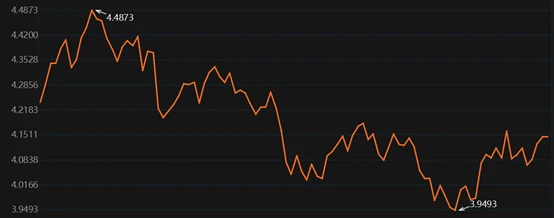
US stocks initially fell at the start of the week due to volatility in the technology sector and concerns about growth. However, the market rebounded in late trading, boosted by easing inflation and positive corporate earnings, ending a volatile week.
While year-end market performance was supported by historical data, the outlook for this year remains uncertain, with continued focus on artificial intelligence. Shifting market sentiment has put considerable pressure on stocks due to overvaluation and investor concerns. Meanwhile, year-end trading volumes are declining, potentially increasing volatility.
Federal Reserve rate cut expectations remain stable
This week, investors received a mixed bag of economic data. The U.S. Bureau of Labor Statistics reported that non-farm payrolls increased by 64,000 in November, exceeding Wall Street's expectations of 50,000. However, the data also showed that the U.S. unemployment rate rose slightly to 4.6% in November, the highest level since September 2021. Furthermore, a revised employment report released last month showed that non-farm payrolls decreased by 105,000 in October, affected by a sharp decline in U.S. government jobs.
The number of Americans filing initial jobless claims fell by 13,000 from the previous week to 224,000, while the number of continuing jobless claims rose from 1.83 million last week to 1.897 million, maintaining an overall "no layoffs, no hiring" situation.
January retail sales data were flat month-on-month, slightly below expectations, but retail sales excluding automobiles performed slightly better than expected, increasing by 0.4% month-on-month, compared to an expected increase of 0.3%. Core retail sales, which excludes highly volatile categories such as car dealerships, gas stations, and building materials stores, significantly exceeded expectations, increasing by 0.8% month-on-month, compared to an expected increase of 0.4%.
Price pressures eased slightly, with core inflation falling to 2.6% in November, the lowest level since the beginning of 2021. University of Michigan consumer inflation expectations also declined: respondents projected inflation of 4.2% over the next year and 3.2% over the next five years, down from 4.5% and 3.4% in November, respectively.
Bob Schwartz, a senior economist at Oxford Economics, told CBN reporters that the batch of data released after the US government shutdown was a "good news" for the Federal Reserve. Despite its flaws, the reports largely confirmed the rationale behind the previous 25-basis-point rate cut, and even suggested that the current cut might have been too conservative. The Fed's core economic forecasts—rising unemployment and cooling inflation—further corroborate that even though the easing policy decision sparked dissent within the Fed, its implementation was fully justified.
Richmond Federal Reserve Bank A survey conducted jointly by the Federal Reserve Bank of Atlanta and Duke University's Fuqua School of Business shows that the large-scale tariff policies implemented by US President Trump have had an unexpected impact on businesses, causing them to slow down their hiring pace. Tariffs remain the primary concern they mentioned.
Market expectations for a Federal Reserve rate cut remain largely unchanged from last week. The probability of the first 25 basis point rate cut in 2026 reached 88% in April, 81% last week, and 100% in June. The market still expects the Fed to cut rates twice in total in 2026; however, the Fed's latest dot plot shows only one rate cut in 2026 and another in 2027.
Schwartz told CBN reporters that the probability of the Federal Reserve cutting interest rates again in January is extremely low. This market skepticism reflects a deeper problem: the reliability of the data itself is questionable. Due to the prolonged US government shutdown, data collection did not resume until mid-November. Therefore, the latest data shows a downward bias, and the lack of a crucial month-on-month comparison dimension—the impact of this data distortion may last for several months.
He argues that overall job growth is slowing, with hiring demand concentrated in only a few sectors; and wage pressures are gradually easing as labor's bargaining power weakens. Inflation drivers (especially service sector inflation linked to labor costs) are fading, and even the housing cost indicator in the Consumer Price Index (CPI) may exaggerate the recent decline in inflation. The rise in unemployment, stemming from a large influx of labor back into the job market, suggests that financial pressure rather than confidence in the economic outlook is driving more Americans back to the job market.
Can the market rebound?
US stocks initially rose but then fell over the past week, with tech stocks experiencing a brief sell-off as inflation reports fell short of expectations and Micron Technology... The release of strong earnings reports and two other factors reignited investor optimism in the field of artificial intelligence , causing the market to stop falling and rebound.
In terms of sector performance, Dow Jones Market Statistics shows that the consumer discretionary sector was the strongest performing sector in the S&P 500 this week, rising 1% cumulatively; materials and healthcare followed closely, both rising 0.6%; technology and communication services... The sector saw a slight increase. On the downside, the energy sector led the decline due to weak oil prices, falling 2.9% cumulatively; real estate and consumer staples sectors fell 1.4% and 0.9% respectively; industrials and utilities... The financial sector also saw a slight decline.
Since the fourth quarter, the artificial intelligence sector has remained a focal point. Investors continued to flock to Micron Technology in the final trading hours, resulting in a nearly 20% cumulative increase over two trading days. This memory chip company... The giant released its earnings report after the market closed on Wednesday, with adjusted earnings and revenue for the previous quarter both exceeding analysts' expectations and far surpassing its guidance.
However, discussions about a bubble in the industry are far from over. Jonathan Krinsky, chief market technical analyst at investment research firm BTIG, pointed out in a recent research report that with the recent increased volatility in AI concept stocks, the sector is beginning to show signs of a "peak." "It's too early to say this is the 'final top,' but in the medium term, the basket of AI stocks has formed a pattern of 'lower lows and lower highs' over the past few months. This is a precursor to a topping process."
Charles Schwab The weekly market commentary noted that lingering concerns about artificial intelligence triggered a sell-off in tech stocks, dragging down overall market sentiment. Next week is a shortened trading week following the holidays, and the market appears to lack sufficient major catalysts. Trading volume is expected to remain low, potentially indicating increased market volatility.
The agency believes that the current market trend is difficult to predict, partly due to mixed economic signals and partly due to a divergent technical picture. It's uncertain whether the trend of funds rotating into non-technology sectors will continue, or whether year-end earnings season and window dressing will revitalize the technology sector. However, from a seasonal perspective, the market still has a bullish foundation, and a "Santa Claus rally" is expected, although the market may experience fluctuations. Rising US Treasury yields could be the biggest potential negative factor.
(Article source: CBN)