"What's special about this price increase is that, in all my years in this industry, I've never seen a price increase cycle last this long," an employee of a domestic storage module factory recently remarked to a reporter from Cailian Press.
Currently, memory chips The market is experiencing an unprecedented wave of widespread shortages and price increases driven by AI. This surge, which began in the first half of the year, has not only failed to slow down in the fourth quarter but has shown signs of further intensification.
An industry insider told CLS reporters that some memory manufacturers have already suspended pricing for some DRAM and Flash production lines; the pressure of rising prices has also been transmitted to the end-user market, as evidenced by Xiaomi founder Lei Jun's Weibo post on the 24th. He bluntly stated, "Memory prices have risen far too much recently."
The core driving force behind this round of price increases is... This is not a simple cyclical fluctuation, but rather an explosion in AI demand, represented by HBM, which is completely disrupting the traditional supply and demand balance in the storage industry.
TrendForce analyst Hsu Chia-yuan told reporters from CLS that manufacturers are prioritizing the allocation of production capacity to high-end server DRAM and HBM, thereby squeezing out traditional consumer electronics. The supply of older process products such as DDR4 and LPDDR4X is still insufficient, and the shortage of DDR4 may continue into the first half of 2026. For domestic manufacturers, Xu Jiayuan believes that module manufacturers have actively stockpiled chip and wafer inventory, and the domestic memory industry chain is attempting to prepare for this new era of structural prosperity by actively hoarding and raising prices.
Fourth-quarter gains exceeded expectations: AI-driven "planned sacrifices" led to supply structure imbalances.
As is well known, the storage industry is highly cyclical, with sharp rises often followed by downturns. This year, however, the price of storage chips has been rising for more than half a year, and entering the fourth quarter, the upward trend has not slowed down but has instead intensified due to a combination of factors.
The latest CFM flash memory market quotes show that the rapid rise in upstream costs has driven the spot price of DDR4 16Gb 3200 to $13.00 this week, a 30% increase from last week; meanwhile, the price of 512Gb Flash Wafer has also increased by more than 20% since October.
An insider from the storage industry chain told reporters from Cailian Press that some DRAM and Flash products from original manufacturers have stopped quoting prices. Even if prices are quoted, the validity period is very short, with "the price changing every day," she said.
Hsu Chia-yuan told reporters that he expects the overall price of DRAM (including HBM) to increase by 13%-18% quarter-on-quarter in the fourth quarter.
Several storage industry professionals told reporters that this "super cycle" of such a long period of comprehensive growth across the entire industry chain is unprecedented.
The capital market has also reacted enthusiastically to this "super cycle." On October 24, A-share memory chip concept stocks surged again, with PuRan Technology leading the charge. (688076.SH), Shannon Chip Innovation Biwin Storage (300475.SZ) surged 20% to its daily limit. (688525.SH), Jiangbolong Stocks like (301308.SZ) rose by more than 10%.
The core logic behind this round of price increases is the structural imbalance in product supply caused by AI-driven capacity transfer.
The development of large-scale AI models is driving demand for infrastructure such as GPUs across the industry chain. Morgan Stanley Recent forecasts indicate that tech giants will invest $400 billion in AI infrastructure this year, creating massive demand for memory chips. Yole Group predicts that by 2025, revenue from HBM products, primarily used in GPU production, is expected to nearly double, reaching approximately $34 billion; the HBM market is projected to maintain a CAGR of 33% until 2030, at which point its revenue will exceed 50% of the total DRAM market revenue.
Because HBM consumes more than three times the wafer capacity of standard DRAM, and with limited total production capacity, memory giants are forced to shift their production focus to the more profitable HBM and DDR5. Xu Jiayuan told reporters from Cailian Press that manufacturers have prioritized the production of Server DRAM and HBM.
Therefore, as manufacturers prioritize shifting production capacity to high-value products, older process products such as DDR4 and LPDDR4X are facing "planned sacrifices" and supply shortages, and the scope of product price increases has expanded from the HBM market, which is experiencing a surge in demand, to the entire storage market.
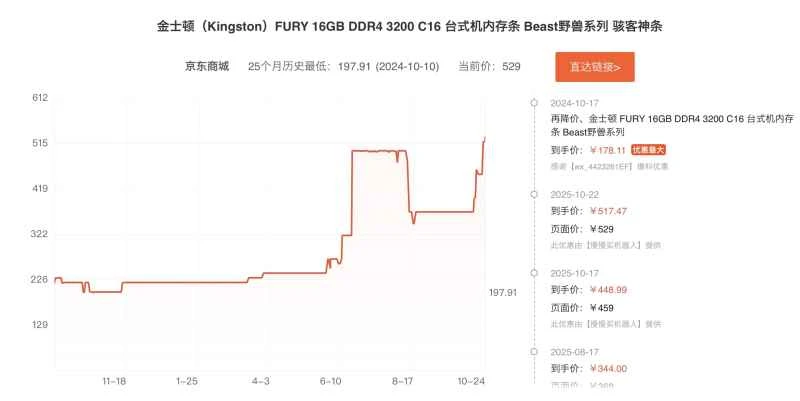
Several module manufacturers told reporters that the original manufacturer prices for DDR4 memory have been rising steadily since the first quarter of this year. According to the Manmanbuy app, the price of a Kingston DDR4 desktop memory module has increased rapidly since March of this year, and its current price is more than double that of the same period last year.
The mobile phone and other terminal markets have also responded to the rising storage prices. The Redmi K90 series phones, released on the 23rd, saw some versions priced 100-400 yuan higher than their predecessors. Xiaomi Group President Lu Weibing publicly stated that the cost pressures from upstream suppliers have been effectively reflected in the pricing of the new products. He admitted that the global supply chain trend cannot be changed, and the increase in storage costs is far higher than expected and will continue to intensify, but Xiaomi hopes this sincerity will be understood by everyone.
Hsu Chia-yuan pointed out that the supply of DDR4 is expected to remain tight, at least until the first half of 2026. ADATA Chairman Chen Li-bai also recently stated publicly that he is optimistic that the fourth quarter will be the starting point of a major bull market in memory and the beginning of a severe shortage of memory, predicting a prosperous industry next year.
Xu Jiayuan told reporters that many downstream manufacturers are already trying to find solutions to this situation. Among them, PC OEMs are accelerating the adoption of DDR5 models, while the consumer sector, including TVs and network communication devices, has slowed down the transition from DDR3 to DDR4.
Domestic module manufacturers are actively stockpiling goods in anticipation of price increases.
In this new industry cycle driven by AI, all segments of the domestic storage industry chain are actively adjusting their strategies in an attempt to expand profitability and enhance market position.
The impact of this "super cycle" varies significantly across different production stages. Firstly, for module manufacturers, stockpiling has become crucial for coping with price increases and ensuring profitability. (Jiangbolong Securities) An insider told reporters from CLS that the price increase from upstream suppliers has a positive impact on the company's gross profit margin because the company had inventory in advance. Hsu Chia-yuan also stated that since August, module manufacturers have actively stockpiled chip and wafer inventory and raised the prices of module products.
However, not all module manufacturers have adopted a policy of large-scale stockpiling. (Longcheer Technology) A representative from the securities department stated that the company adopts an "inventory clearance" operating model, resulting in a lower inventory level compared to its peers, thus reducing the volatility of its performance.
Chip design companies and distributors rely more on price transmission within the supply chain.
A representative from the securities department of Puran Group (688076.SH) told reporters from Cailian Press that the company is negotiating price increases with downstream customers. "There will be some supply shortages starting in the fourth quarter, so we will definitely negotiate with downstream customers to see if we can raise prices."
A representative from the securities department of Shannon Semiconductor (300475.SZ), a distributor, stated that the company's gross profit margin is generally stable in terms of its distribution business. However, as upstream procurement prices rise, the prices distributed to downstream customers will also increase. "The impact of the storage market on us is more about changes in volume; the changes in gross profit will not be particularly significant."
It's worth noting that the price increases from international manufacturers have already impacted domestic wafer foundries. An executive from a major domestic memory manufacturer told reporters from CLS that the price hikes by foreign manufacturers have led some domestic companies to switch to domestic wafer foundries. Against this backdrop, it's a consensus within the industry that manufacturers' profits have significantly increased.
Finally, amidst this structural transformation, domestic manufacturers are also accelerating their embrace of the new AI cycle.
In addition to actively expanding the supply of enterprise-grade SSDs and other products, domestic companies are focusing on high-value-added areas such as HBM, advanced packaging and server DDR5, striving to seize opportunities when major international manufacturers are strategically adjusting their production capacity.
Currently, the more mature segments of the domestic HBM (Hypermetal Matrix) industry chain lie in testing equipment and advanced packaging. (Saiteng Technology) (603283.SH) recently stated on its investor platform that its HBM testing equipment has been recognized by major overseas clients and has already been shipped in batches, while the domestic market is being actively expanded; AMEC (688012.SH) has previously stated that it has made a comprehensive layout in the field of advanced packaging (including high-bandwidth memory HBM process), including etching, CVD, PVD, wafer quality inspection equipment, etc., and has released CCP etching and TSV deep silicon via equipment.
In addition, Biwin Storage recently stated that its wafer-level advanced packaging and testing project is in the process of production preparation. Once completed, the project will provide customers with a one-stop integrated solution of "storage + wafer-level advanced packaging and testing", further enhancing the company's core competitiveness in the field of in-memory computing integration.
Hsu Chia-Yuan predicts that as major manufacturers release their HBM production capacity, although HBM3e may face oversupply pressure in 2026, the new generation HBM4 has a technological threshold and will still be in short supply.
(Article source: CLS)