As OpenAI lays out its multi-trillion dollar gamble, Anthropic's clear financial prospects are beginning to emerge. This current battle for AI supremacy seems to be heading down two different paths in terms of business models…
OpenAI recently signed agreements worth hundreds of billions of dollars, planning to invest heavily in building numerous data centers. In order to solidify its artificial intelligence Its dominant position in the field. But one of its main competitors— Amazon. Anthropic, an AI startup that it supports, now seems to have a clearer path in turning artificial intelligence into a sustainable business.
Indeed, Anthropic and OpenAI are engaged in similar businesses: they both strive to develop the world's most advanced AI-powered large language models, which are used as chatbots. It forms the basis for image generation and many other AI tools.
However, their current approaches to the big question of how to generate revenue and profits from artificial intelligence are quite different.
Anthropic is secretly maneuvering in the enterprise-level market.
In addition to Microsoft Establishing close partnerships—integrating OpenAI models into Microsoft software products—OpenAI is currently primarily aimed at the mass market—its user base is increasingly using chatbot conversations instead of traditional search engine queries, a model that appears to have achieved great success on the surface.
According to the company, ChatGPT's weekly active users have exceeded 800 million as of this month, potentially helping OpenAI achieve approximately $13 billion in annualized revenue. In contrast, Anthropic has far less appeal in the mass market.
However, their strengths and weaknesses in the more stable and lucrative enterprise user market are diametrically opposed. Anthropic states that approximately 80% of its revenue comes from enterprise clients—the company had reached about 300,000 enterprise clients last month. OpenAI, on the other hand, derives only about 30% of its revenue from enterprise clients.
This has resulted in a surprisingly small revenue gap between the two companies, which appear to have a large difference in user scale from the outside world —Anthropic's annualized revenue has reached $7 billion and is expected to reach $9 billion by the end of the year—and it maintains a significant advantage over OpenA in terms of average revenue per user.
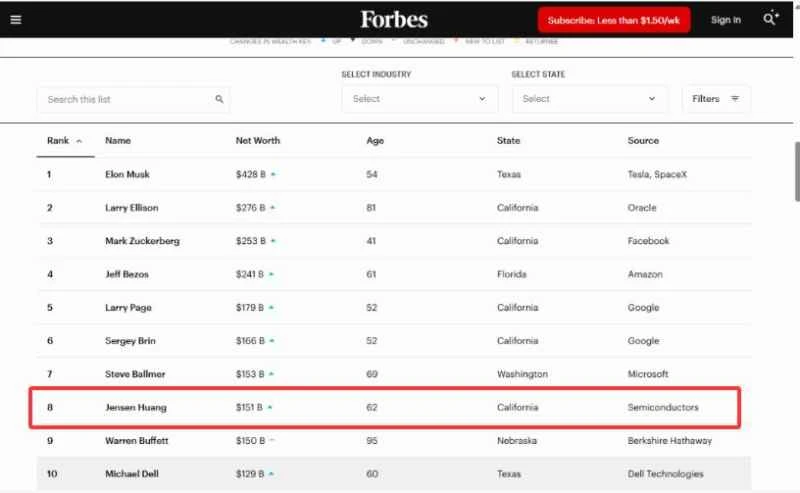
Currently, both companies have received investment support from Silicon Valley tech giants—OpenAI was initially funded by Microsoft , and more recently, it has been continuously partnering with Nvidia. Oracle bone script While giants like AMD have crossed the "red line," Anthropic has received joint investment from Amazon and Google. This support not only provides AI computing infrastructure but also helps its products reach a wide customer base.
But at least for now, Anthropic's growth path seems far clearer than OpenAI's. Many enterprise customers are currently applying AI to numerous fields such as programming, legal document drafting, and billing, hoping to create a host of cost-saving solutions. In comparison, Anthropic's advantages appear more pronounced:
Its cutting-edge language model, Claude, is highly praised for its excellent programming capabilities: a July report by Menlo Ventures estimated that Anthropic has a 42% market share in the programming field, while OpenAI only has 21%.
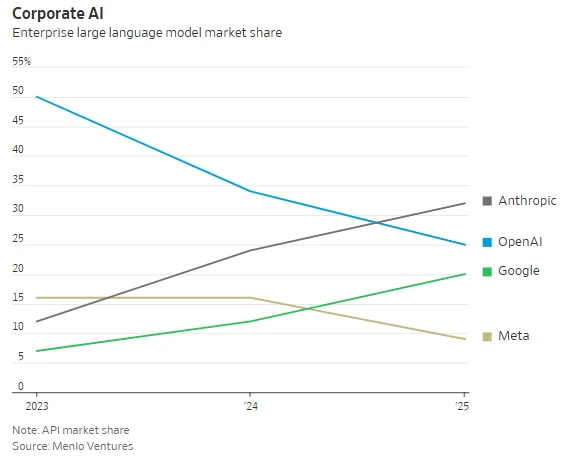
Menlo Ventures The data also shows that Anthropic leads OpenAI in the overall enterprise AI application market share, with the two accounting for 32% and 25% respectively.
As the quantifiability of return on investment increases, these application scenarios will continue to expand in the future, potentially attracting more enterprise customers to choose Anthropic.
In September of this year, Microsoft announced that it would provide Claude, Anthropic's main language model, in its Copilot software suite, which undoubtedly demonstrates the strong demand for Anthropic from enterprise customers —even though Microsoft itself is OpenAI's biggest "big spender".
OpenAI's Business Model Bottleneck
In fact, compared to the enterprise market with stable and growing revenue, the current revenue model for AI targeting mass consumers is much more ambiguous.
Aside from subscription fees, OpenAI has yet to determine other revenue streams —it offers consumers a $20/month "Plus" plan and a $200/month "Pro" plan, with a free version available (limited queries and slower speed). These subscription fees are simply insufficient to offset the enormous costs of developing and deploying cutting-edge AI.
Advertising clearly holds the potential to become a major revenue stream for OpenAI's consumer business, but how to integrate ads into chatbots remains unclear. It's not as straightforward as search advertising—users are also likely to be unwelcoming of brands embedding ads into chatbot conversations. Furthermore, in exploring advertising revenue models, OpenAI will face the awkward situation of competing with Google—which not only possesses a mass-market AI toolkit but also has a deep-rooted presence in the advertising industry.
Of course, OpenAI is actively attracting enterprise customers through Microsoft channels and its own platform. Some believe that Microsoft's massive user base and extensive query data coverage will help OpenAI gain a competitive advantage among enterprise users.
However, OpenAI's mass-market appeal may actually hinder its ability to attract enterprise clients—many of whom prefer AI to focus on practicality rather than entertainment. OpenAI recently announced it will allow adult users to engage in "adult conversations" with ChatGPT and called for more lenient AI regulations. Even if the company restricts product functionality in enterprise settings, its liberal image may still limit its market penetration.
Therefore, despite OpenAI's huge investment, Anthropic, which has moved away from being a "toy" and embraced a "tool," has proven that in the AI field that enterprises care about more, its performance is comparable to or even better than OpenAI.
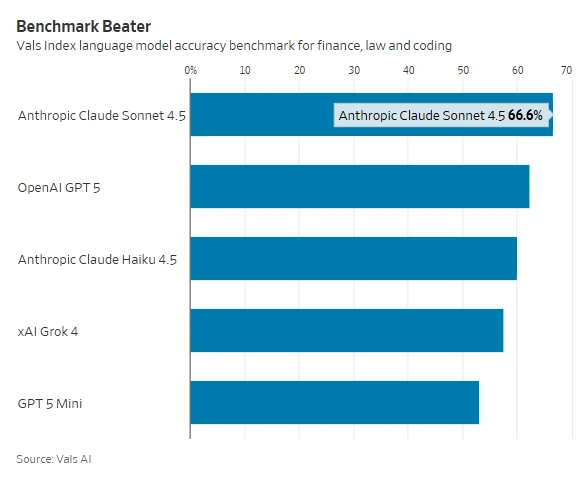
Vals AI, a startup that evaluates AI models, ranked the latest version of the Claude model from Anthropic as number one in a business benchmark test that integrates financial, legal, and coding tasks.
Vals co-founder Rayan Krishnan pointed out: "Anthropic is fully focused on developing enterprise-level intelligent agent applications and is currently in fierce competition with OpenAI."
(Article source: CLS)