① Driven by positive trade news, expectations of interest rate cuts, and corporate earnings reports, many institutions have raised their year-end target prices to above 7,000 points; ② This week will see earnings reports from tech giants and policy decisions from three major central banks. If these events proceed smoothly, the market will experience a "seasonal tailwind," helping the index to reach new highs.
As seasonal volatility nears its end, Wall Street bullish analysts are once again vying to predict a year-end rally in the S&P 500.
As of Monday's close, driven by positive trade news, expectations of interest rate cuts, and strong corporate earnings, the S&P 500 closed at 6875 points, up 993 points (16.89%) year-to-date . Given the current macroeconomic backdrop, bulls confidently state that the S&P 500's breakthrough of the important psychological level of 7000 points has become the "benchmark conclusion."
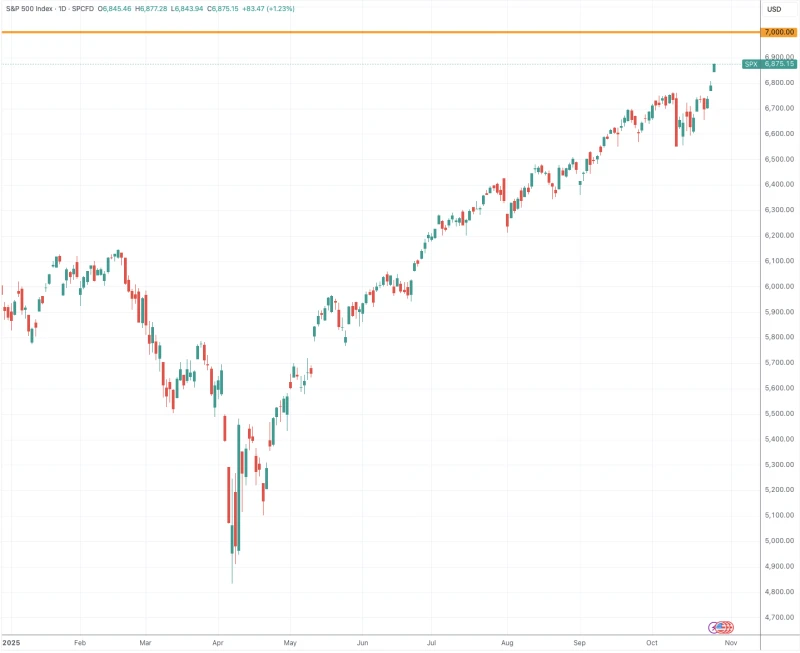
(S&P 500 daily chart, source: TradingView)
UBS Securities Michael Romano, head of derivatives sales at a hedge fund, wrote in a research note last Sunday: "There are plenty of catalysts driving risk assets higher. The 7,100-point level, once seen as the year-end 'ceiling' for forecasts, is rapidly becoming the baseline scenario, as the market is already pricing in next year's upside. "
This optimism will face a crucial test this week: five of the "Big Seven" U.S. stocks (representing a quarter of the S&P 500 by market capitalization) will release their earnings after the market closes on Wednesday and Thursday. Meanwhile, the Federal Reserve, the Bank of Japan, and the European Central Bank will also issue policy statements.
If US stocks remain unscathed by the end of the week, seasonal factors will act as a "market tailwind." Goldman Sachs Statistics show that since 1985, from October 20th to the end of the year, Nasdaq... The S&P 100 index rose by an average of 8.5%, while the S&P 500 index returned an average of 4.2%.
Barclays Alexander Altmann, the global head of equity tactical strategy, currently predicts that the S&P 500 index could reach 7,250 points by the end of the year, citing the index's average absolute annual volatility of 23% over the past five years as his basis.
Technical analysts also point out that once the S&P 500 breaks through 7,000 points (only 1.8% away from Monday's close), it will open up even greater upside potential. John Kolovos, chief technical strategist at Macro Risk Advisors, interprets this as the next resistance level for the S&P 500 being around 7,000 points, and once that level is breached, 7,500-7,700 points will become the next target.
In terms of cash flow, there has been a string of good news.
According to Citadel Securities , retail investors account for approximately 22% of US stock trading volume and have been net buyers in 23 of the past 27 weeks. Meanwhile, with the lifting of earnings season restrictions, listed companies can resume share buybacks. Goldman Sachs points out that the fourth quarter is historically a peak period for buybacks. Hedge fund monitoring data also shows that after two consecutive weeks of significant selling, hedge funds turned to net buying of US stocks last Friday, following weaker-than-expected US inflation data.
Of course, all of the above inferences share a common premise: the earnings reports of major tech stocks this week must not trigger a market crash.
Roundhill Financial CEO Dave Mazza stated that if there are any disappointing signs from tech blue chips, or regarding artificial intelligence... If expenditures fail to yield returns and questions arise, investors will quickly punish them.
He also stated, "On the other hand, solid, better-than-expected earnings could propel the S&P 500 above the 7,000 mark in just a few days. "
(Article source: CLS)