① Musk proposed at X on Monday that artificial intelligence could be launched. ① By positioning a satellite between the Earth and the Sun, Musk could control the energy radiated from the Sun to Earth, thereby preventing global warming; ② Musk's idea has faced opposition from many quarters, including his company xAI's chatbot. Grok;③ Experts point out that this idea could disrupt precipitation, agriculture, and ecosystems, and even cause bigger problems.
Billionaire Elon Musk has a penchant for imaginative ideas, some of which have become reality and created enormous wealth, while others are considered far-fetched and have no apparent possibility of being realized.
This week, Musk shared a new, outlandish idea on the X platform: to launch an AI satellite between the sun and the earth, and precisely control the energy radiated from the sun to the earth to stop global warming.
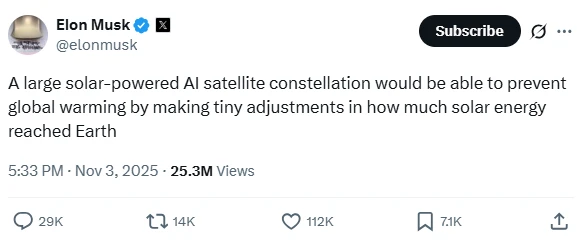
In his subsequent comments, he emphasized that the satellite could be used to control global warming or global cooling.
However, Grok, a chatbot developed by his AI company xAI, objected in the comments section, arguing that managing solar radiation could disrupt global precipitation, agriculture, and ecosystems, and further damage the ozone layer. He also suggested that abruptly ending global warming could trigger even bigger problems than gradual warming, and that any satellite should be prepared for the possibility of hacking.
Others mocked Musk, saying he now wants artificial intelligence to decide how much sunshine humans need. Many more argued that individuals, companies, and governments have no right to interfere with the shared global climate system, and that humanity doesn't need someone to play God.
Criticism arose
Musk's solar radiation fine-tuning project has also failed to gain academic approval. Lili Fuhr, director of the Fossil Economy Project at the International Centre for Environmental Law in Berlin (CIEL), points out that the idea is highly speculative.
She emphasized that solar geoengineering is inherently unpredictable, and such ideas could further damage Earth's already fragile ecosystems. Furthermore, this concept would distract international attention from addressing the climate crisis, and such opportunistic thinking should be abandoned immediately.
Gustav Andersson, a biologist at Umeå University in Sweden, sarcastically remarked that the billionaire Mr. Burns from the animated series "The Simpsons" had a similar idea long ago. In the cartoon, Burns blocks out the sunlight, forcing the residents of the town to use electricity from his family's nuclear power plant.
Scottish entrepreneur Ram ben Ze'ev criticized Musk, saying that while his ideas might be feasible in terms of engineering, the possibility of mistakes is unacceptable to anyone. He warned that reducing sunlight exposure would not only lower temperatures but also directly affect photosynthesis, and even a reduction of only 1% to 2% in sunlight exposure could have a devastating impact on global agriculture, forestry, and oxygen production.
(Article source: CLS)