Recently, Eli Lilly and Nord Agreement reached with the US government on GLP-1 weight loss drug Significant price reduction agreement. According to the agreement announced last week, Medicare ... Medicare and Medicaid patients will be able to access GLP-1 drugs such as Eli Lilly's Zepbound and Novo Nordisk's Wegovy for a list price of $245 per month, with Medicare patients paying only $50 out of pocket.
The Daily Economic News reporter noted that the minor incident of a Novo Nordisk executive fainting at the press conference could not overshadow the earthquake-like impact of the agreement itself on the industry. This marks the first time that the US federal healthcare system has included weight -loss drugs for obesity in its reimbursement program, leading to a precipitous drop in the prices of star drugs such as semaglutide and telpoxetine, and will further reshape the pricing system for GLP-1 drugs globally.
Jiang Han, a senior researcher at Pangoal Institution, told the National Business Daily via WeChat that the agreement, through a "price-for-volume" model, marks the first time that GLP-1 weight-loss drugs have been included in the US Medicare reimbursement scope. This signifies that obesity treatment has shifted from a "self-funded luxury" to a "publicly accessible healthcare product," reshaping the global healthcare coverage logic for metabolic chronic disease drugs. Furthermore, the low prices set in the agreement may become a global benchmark, particularly putting downward pressure on price-sensitive markets such as Europe and Canada, forcing multinational pharmaceutical companies to renegotiate their pricing strategies globally and weakening their ability to maintain high prices in high-income countries.
Reporters contacted Eli Lilly , Novo Nordisk, and other companies for comment, but no response was received by the time of publication.
GLP-1 weight loss drugs are now eligible for universal payment in the United States.
The core focus of this agreement is that it completely rewrites the payment rules for obesity medications. Jiang Han pointed out that this is a landmark event marking the shift in obesity treatment from a personal health choice to a public health issue, and the medical insurance coverage for metabolic chronic disease drugs has been significantly expanded.
The price anchor set in the agreement is even more impactful. According to the text of the agreement released by the White House, Novo Nordisk's semaglutide injection will be reduced from $1,350 per month to an average of $350 through the "Trump Pharmacy" channel; Eli Lilly's telpokinide injection and the pending oral medication (Orforglipron) will be reduced from $1,086 per month to an average of $346. If the FDA (Food and Drug Administration) approves the oral version of semaglutide, or other oral medications from the two companies, the price will start at $150 per month.
Furthermore, both Eli Lilly and Novo Nordisk have pledged to guarantee Most Favored Nation (MFN) pricing for all new drugs launched in the US market. This means companies must either accept a general reduction in global prices or adjust their regional pricing strategies. Industry insiders believe the agreement's influence may rapidly spread to other countries.
Jiang Han emphasized that the agreement's introduction of the "most-favored-nation" clause, requiring new drugs to maintain the lowest global price in the United States, will force companies to adjust their global price tiers and may even trigger a chain reaction of developing countries demanding synchronized price reductions. In the long run, this policy paradigm may drive the transformation of GLP-1 drugs from "patent monopoly premium" to "public health necessity," accelerating the industry's entry into a value-oriented pricing era.
The GLP-1 market has shifted from a duopoly to multi-dimensional competition.
Behind the reshaping of the pricing system lies a profound differentiation in the competitive logic of the GLP-1 market. Industry insiders believe that the past duopoly of Eli Lilly and Novo Nordisk has been broken, and the GLP-1 market has moved from a duopoly phase to a new cycle of multi-dimensional technological competition.
How will the future trend of lower prices for weight-loss drugs reshape the competitive landscape of the industry, and what impact will it have on the R&D and market access of similar products for small and medium-sized pharmaceutical companies? Jiang Han stated that although technological iteration is important, under the US healthcare price controls and the potential threat of generic drugs globally, cost control will become the long-term deciding factor. Whoever can support a low-price strategy and maintain profits with lower manufacturing costs will prevail in the trend of "universal access." Differentiated approaches such as oral dosage forms, long-acting sustained-release formulations, and dual/triple-target agonists are becoming key to breaking through the current predicament.
Among them, oral GLP-1 drugs are considered to have a "greater opportunity" due to their adherence advantages. Eli Lilly's oral drug (Orforglipron), which is awaiting regulatory approval, has locked in a low price of $346/month, and its adherence advantage brought about by the convenience of administration is seen by the market as a "greater opportunity than injectable drugs".
Novo Nordisk also announced that it will invest an additional $10 billion in the United States, including to manufacture the oral semaglutide in the U.S. once it is approved.
In contrast, small and medium-sized pharmaceutical companies are facing a difficult situation in this transformation. Jiang Han pointed out that, firstly, the low price of oral GLP-1 has significantly compressed the market's expected profit margin, making it difficult for small and medium-sized pharmaceutical companies lacking economies of scale to recover R&D costs through high premiums. This may force some companies to abandon similar projects or seek mergers and acquisitions to exit the market.
Secondly, Eli Lilly and Novo Nordisk have built a "low price + wide coverage" moat by leveraging their mature production capacity, access to medical insurance, and direct sales channels. Even if small and medium-sized pharmaceutical companies launch similar products, they will find it difficult to compete with them in terms of price, channels, and payment, significantly raising the market entry threshold.
Jiang Han believes that in the long run, the GLP-1 field will present a dual structure of "giants dominating the mass market and innovators cultivating specific scenarios," and simple imitation-based innovation will be unsustainable.
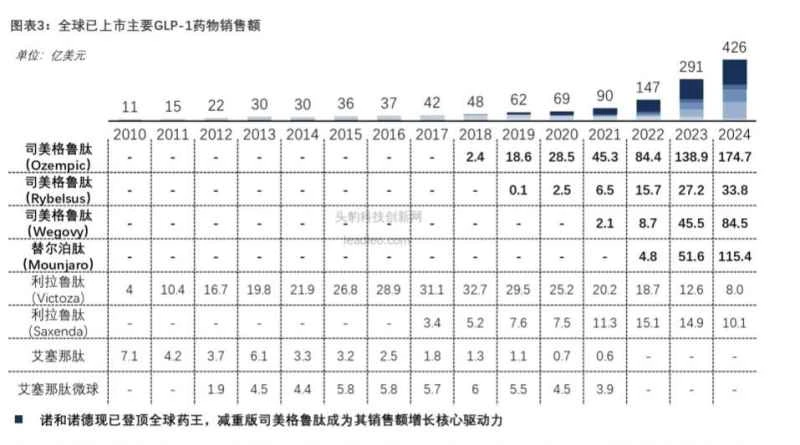
Image source: Head Leopard Research Institute
(Source: Daily Economic News)