As tech giants race to borrow hundreds of billions of dollars to fuel AI investments, lenders and investors are increasingly seeking safeguards against risk—a backdrop to a surge in demand for credit default swaps (CDS) for tech companies.
bank Fund managers are racing to increase their holdings of related derivatives, which will provide compensation should AI hyperscalers default on their debts.
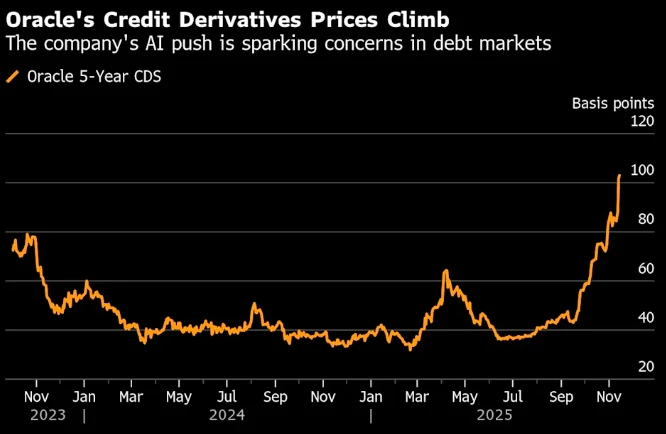
Data shows that since September, with the increasing interest in Oracle... Demand for credit protection on corporate bonds has surged, and the cost of related credit derivatives has more than doubled. In the six weeks ending November 7, trading volume of Oracle -related CDS surged to approximately $4.2 billion, far exceeding the $200 million traded in the same period last year.
JPMorgan Chase John Servidea, Global Co-Head of Investment Grade Financing, said: “We’ve noticed a renewed interest from clients in single-name CDS, a topic that had been waning in recent years. While these mega-cap tech giants have high ratings, their continued expansion of borrowing and increased market exposure naturally lead to more discussions about hedging among clients.”
Demand for CDS surges amid soaring debt.
Traders pointed out that although the current trading volume of these derivatives is still relatively small compared to the total amount of debt expected to flood the market, the growing demand for hedging demonstrates how technology companies are leveraging artificial intelligence. To reshape the world economy and thereby dominate capital markets.
JPMorgan strategists predict that investment-grade corporate bond issuance could reach $1.5 trillion in the coming years. A series of massive AI- related bond issuances have recently flooded the market, including Meta's $30 billion corporate bond offering in late October (the largest U.S. corporate bond issuance this year) and Oracle 's $18 billion bond offering in September.
A JPMorgan report last month showed that technology companies and utilities... Corporate and other AI- related borrowers have become major players in the investment-grade bond market, replacing banks that have long held the largest share. This is driven by companies building thousands of data centers globally. The junk bond and other major debt markets will also see a wave of financing in the AI field.
Traders say that one of the biggest buyers of technology company CDS right now is banks , whose exposure to technology companies has increased dramatically in recent months.
Another source of demand for derivatives comes from equity investors who seek to hedge against the risk of stock price declines at a relatively low cost.
According to data provider Intercontinental Exchange According to data services companies, the cost of protecting against Oracle defaults over the next five years was approximately 1.03 percentage points, equivalent to paying about $103,000 per year for every $10 million of principal protected.
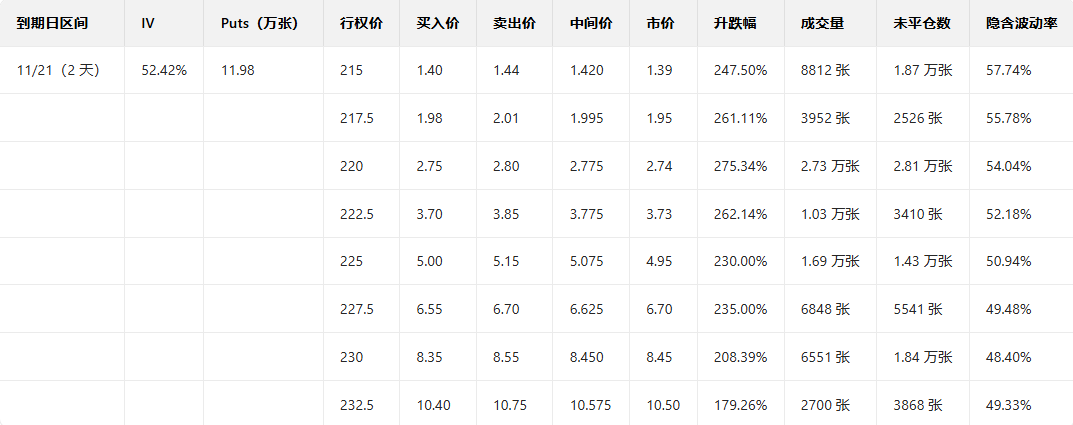
In contrast, as of last Friday, the cost of a put option to buy Oracle stock that would fall nearly 20% by the end of next year was as high as $2,196 per 100 shares, equivalent to 9.9% of the value of the protected stock.
Revisiting the history of the subprime crisis?
In any case, it may make sense for fund managers and lenders to consider reducing some of their risk exposure at this moment: a research report released by MIT this year shows that 95% of companies have not yet received any return from generative AI projects.
While the largest borrowers are currently mostly cash-rich companies, the tech industry is inherently volatile. Even former giants like Digital Equipment Corporation (DEC) can gradually decline and eventually be eliminated. Furthermore, seemingly safe bonds may pose significant risks or even lead to default if data center profits fail to meet company expectations…
Following Meta Platforms' massive bond issuance at the end of last month, its related CDS began trading actively for the first time. CoreWeave derivatives trading is also heating up – the AI computing services provider saw its stock price plummet on Monday after it lowered its annual revenue forecast due to customer contract delays.
It is worth mentioning that in the years before the financial crisis, the trading volume of high-rated single-name credit derivatives was far higher than it is now—at that time, institutions such as bank proprietary traders, hedge funds, and bank loan portfolio managers used such products to hedge or amplify risks.
Following the collapse of Lehman Brothers, trading volume in related credit derivatives plummeted, and market participants generally believed it would be difficult to recover to pre-financial crisis levels. This was partly due to the greater availability of hedging tools and the significantly improved liquidity in the credit market itself, driven by the increased use of electronic trading for more bonds.
Sal Naro, chief investment officer of Coherence Credit Strategies, which manages $700 million in hedge funds, believes the recent rebound in single-name CDS trading volume may be temporary. "The CDS market is currently experiencing a mini-boom due to data center construction. Nothing pleases me more than seeing a genuine recovery in the CDS market."
However, bank traders and strategists say that, for now, related trading activity is continuing to rise.
Barclays Bank credit strategists noted that in the six weeks ending November 7, total trading volume of credit derivatives related to individual companies increased by about 6% year-over-year, reaching approximately $93 billion. "Trading activity has increased, and market interest is certainly greater."
(Article source: CLS)