①Singapore Stock Exchange, Nasdaq ① Singapore announced a partnership to launch a “Global Listing Board,” which allows eligible companies to list simultaneously by submitting only one set of documents; ② Against the backdrop of persistently weak trading liquidity, Singapore is attempting to retain regional tech giants through “dual listings + 24/7 price discovery.”
To enhance its appeal to leading technology companies in the region, Singapore has announced a policy that allows listed companies to list simultaneously on the Singapore Exchange and the Nasdaq in the United States with only one set of documents.
According to announcements released by the Singapore Exchange (SGX) and Nasdaq on Wednesday evening, SGX will launch a "Global Listing Board" in mid-2026 , providing a unified and simplified "trans- Pacific " listing platform for companies with a market capitalization of S$2 billion (approximately RMB10.8 billion) or more. Financing framework.
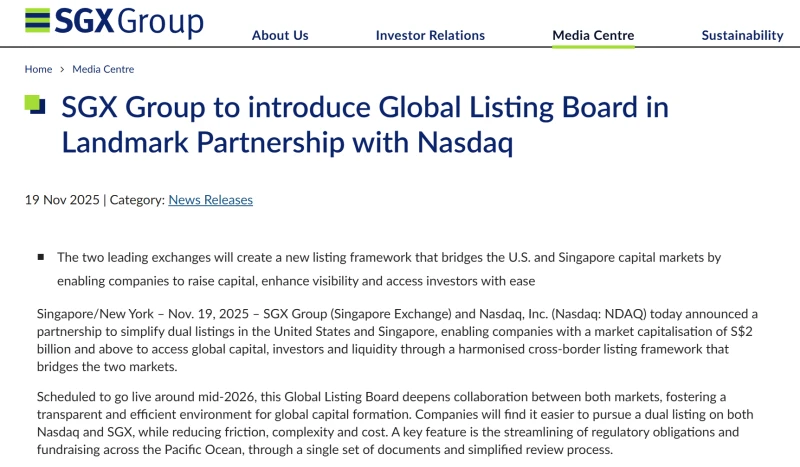
(Source: SGX Group)
In other words, eligible companies only need to fill out one set of documents to meet the regulatory requirements of both stock exchanges .
The new listing framework and the “Global Listing Board” are designed to attract very specific companies. Nasdaq CEO Adna Friedman stated that this dual listing bridge is “a first in its class,” which is exciting for companies with operations in Asia looking for global exposure and a unified regulatory experience .
SGX Group CEO Loh Boon Chye also stated that dual listings across different time zones are equally beneficial to investors. He said, "You can conduct price discovery almost around the clock... Given the current volatility, this allows investors to manage risk 24 hours a day, while also providing them with options whether the price is denominated in US dollars or Singapore dollars."
It is worth mentioning that Singapore's Minister for National Development and Deputy Chairman of the Monetary Authority of Singapore, Chee Hong Tat, also mentioned during the press conference that this dual listing framework is also open to Chinese companies that wish to expand their business in Southeast Asia .
Market liquidity remains questionable.
The new framework was launched against the backdrop of Singapore's status as one of Asia's major financial cities and its securities... However, the market's development has been quite bumpy.
Due to insufficient liquidity in the Singapore market, some emerging technology companies headquartered in Singapore, such as ride-hailing company Grab and Sea Limited, dubbed the "mini-Tencent of Southeast Asia," have chosen to list directly in the United States. Meanwhile, established local companies such as massage chair manufacturer OSIM and warehouse operator GLP have also delisted from the local market in recent years.
According to LESG statistics, as of early November, the Singapore Exchange (SGX) had only five IPOs on its main board this year, which is the best performance in recent years , but far behind its main competitor in the region, the Hong Kong Stock Exchange (HKEX).
In contrast, Hong Kong Chief Executive John Lee revealed in early November that the average daily trading volume of Hong Kong's stock market this year exceeded US$32 billion , doubling from last year. In the first 10 months of this year, Hong Kong saw 80 IPOs raising a total of over US$26 billion, ranking first globally in IPO fundraising .
The Monetary Authority of Singapore (MAS) said that the average daily turnover of the local stock market in the third quarter of this year was S$1.53 billion, the highest level since the first quarter of 2021.
Alongside the launch of the new cross-border listing channel, the Monetary Authority of Singapore (MAS) also announced a "Value Unlocking" scheme to enhance the competitiveness of the Singapore stock market. Simultaneously, as Singapore's central bank, the MAS announced a S$2.85 billion injection into six asset management companies, aiming to develop the fund management industry and increase investor participation.
(Article source: CLS)