Amidst concerns about an AI bubble sweeping the market, the topic of " AI chips" emerged in after-hours trading on Wednesday in the US stock market. Nvidia, the "dominant player" Living up to investors' expectations, the company released a financial report that exceeded all expectations, showing that the AI boom remains strong.
Nvidia is regarded as a bellwether for the AI industry. As a core supplier of AI computing power, its performance directly reflects the real demand and prosperity of the AI industry.
Nvidia's financial report shows that its third fiscal quarter revenue was $57.01 billion, exceeding market expectations of $54.92 billion; net profit was $31.91 billion, a year-on-year increase of 65%, and adjusted earnings per share were $1.30, higher than market expectations of $1.25. (Data Center ) —Nvidia’s most important business—Q3 revenue was $51.2 billion, easily exceeding analysts’ forecast of $49.09 billion, representing a year-over-year increase of 66%.
More importantly, Nvidia expects fourth-quarter revenue of approximately $65 billion, far exceeding analysts' forecasts of $61.7 billion.
Following the release of its earnings report, Nvidia's stock price rose by more than 6% in after-hours trading on Wednesday. Tech giants actively investing in AI also saw their shares rise in after-hours trading, including Amazon. Microsoft rose 1.88%. Up 1.35%, META up 1.64%, Alphabet (Google's parent company) up 2.39%, Oracle... Up 3.01%.
This suggests that Nvidia's strong financial results and guidance have at least temporarily eased concerns about artificial intelligence. Concerns about a bubble have injected positive momentum into Nvidia's short-term stock price performance and even the broader US stock market.
During the earnings call following the release of the financial report, Nvidia CEO Jensen Huang once again refuted the "AI bubble" theory sweeping the market. "There are many claims about an AI bubble. But from our perspective, the situation is quite different," Huang said, also mentioning cloud computing. The company's thirst for Nvidia chips.
The current question is how long the boost from Nvidia's positive earnings report can last, and whether this report can truly quell concerns about an AI bubble.
Following Nvidia's earnings release, Wall Street analysts quickly offered their commentary. Some echoed Jensen Huang's assessment, suggesting that concerns about an AI bubble were exaggerated, while others believed the earnings report might not be enough to quell those concerns.
Are concerns about an AI bubble being exaggerated?
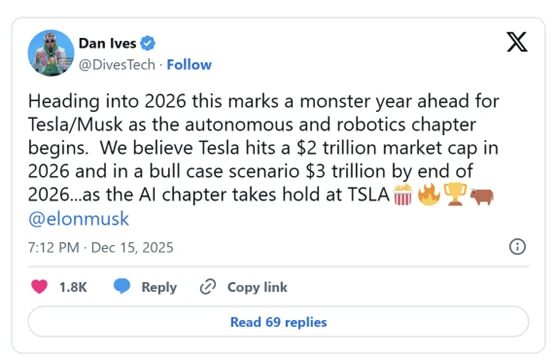
Daniel Ives, a prominent Wall Street tech analyst at Wedbush, views this quarter as a crucial validation point for the artificial intelligence revolution. He believes concerns about an AI bubble are "significantly exaggerated" and states that Wall Street has consistently underestimated the strength of Nvidia's momentum .
One of Ives's core arguments is that corporate purchases of Nvidia's AI hardware typically drive significant spending in other areas, including hyperscale data center operators, cloud service providers, and software developers. This multiplier effect means that Nvidia is a decisive company in the age of artificial intelligence, along with other stakeholders.
Ives also highlighted the strong tone of Nvidia's conference call, particularly the focus on demand for Blackwell chips and the launch of the Rubin platform, calling the guidance "very significant" and expected to reignite bullish sentiment in the tech sector by the end of the year.
"This answers many questions about the current state of the AI revolution, and the conclusion is simple: AI is far from reaching its peak in the foreseeable future, both in terms of market demand and production supply chains," commented Thomas Monteiro, senior analyst at Investing.com, after the earnings release. This indirectly points out that the claim of an AI bubble is unfounded.
Is this not enough to quell bubble concerns?
However, some analysts say the earnings report may not be enough to quell concerns about an AI bubble. They remain skeptical about the sustainability of AI spending and the issue of revolving financing.
Stifel analyst Ruben Roy stated, "Concerns about the lack of sustainability in the growth of AI infrastructure spending are unlikely to subside."
Nvidia significantly increased its revenue from leasing back its chips from cloud customers (often smaller cloud customers with little external leasing demand) in the third quarter. These contracts totaled $26 billion, more than double the amount from the previous quarter.
Cloud giants including Microsoft and Amazon are spending billions of dollars to build AI data centers . Some investors believe that these companies are artificially inflating their profitability by extending the depreciation period of AI computing equipment such as Nvidia chips.
Nvidia's business concentration further increased in the third fiscal quarter, with its four largest customers contributing 61% of sales, up from 56% in the previous quarter.
Nvidia has also increased its bets on artificial intelligence companies, investing heavily in companies that are often its most important customers, raising concerns about "circular financing." In September of this year, Nvidia decided to invest up to $100 billion in OpenAI and supply it with data center chips.
“Despite stronger-than-expected results and outlook, we believe investors will remain concerned about the sustainability of customer capital expenditure growth and the revolving financing issues in the AI sector,” said Kinngai Chan, an analyst at Summit Insights.
(Article source: CLS)