On December 10th local time, Alphabet's (Google's parent company) self-driving car... Technology company Waymo announced that it has completed over 14 million rides so far in 2025, more than tripling the number in 2024, and expects to surpass 20 million rides by the end of the year . The company stated that it is preparing to launch its ride-hailing service in over 20 cities, including Tokyo and London, next year.
Waymo's sudden disclosure of travel data may be related to a "let-before-said" revelation by Waymo's investor, Tiger Global Management.
On December 8th local time, according to CNBC, Tiger Global Management recently launched a new venture capital fund, PIP 17. To enhance the fund's appeal, Tiger Global Management detailed the performance of its previous fund, PIP 16, to investors. The largest holdings were OpenAI and Waymo. Waymo's latest Robotaxi weekly order data was thus revealed—Tiger Global Management stated that Waymo recently had more than 450,000 rides per week , and its safety was 10 times that of human drivers.
Waymo last disclosed its weekly order data in April of this year. At that time, Waymo said that the number of paid rides per week had exceeded 250,000 , with about 1,500 vehicles in active operation. It planned to expand to 3,500 vehicles in 2026 and complete 4 million fully driverless passenger rides by 2024.
In other words, in less than eight months since April, Waymo's weekly order volume has surged by 80%.
What does a service volume of over 450,000 rides per week mean in the Robotaxi industry? This is likely the highest weekly order volume disclosed in the industry to date.
Baidu In November, at the 2025 World Congress, it was announced that its autonomous driving mobility service platform, "Apollo Go," had more than 250,000 fully driverless orders per week, with a cumulative global service volume exceeding 17 million.
WeRide The Q3 financial report shows that the company has more than 1,600 autonomous vehicles, including a fleet of nearly 750 Robotaxi vehicles. In Guangzhou, each commercial Robotaxi can complete up to 25 rides per day during 24-hour operation. In Beijing, each commercial Robotaxi can complete up to 23 rides per day during the 7:30-22:00 period.
Pony.ai The Q3 2025 financial report only disclosed operational efficiency data such as fleet size (961 vehicles) and average daily orders per vehicle (23 orders), without directly providing total weekly orders.
As a platform provider, Uber's financial reports only disclose the total number of trips (e.g., 3 billion trips in Q1), without separately disclosing the number of Robotaxi orders. However, it has partnerships with companies such as Waymo.
In December 2018, Waymo launched its first paid self-driving taxi service, Waymo One, in Phoenix, marking the beginning of its commercial operations. Waymo's approach relies on "highly redundant sensors. " The "high-precision map" technical approach employs multiple lidar sensors . Millimeter-wave radar and cameras are used to pursue the ultimate in system security and reliability.
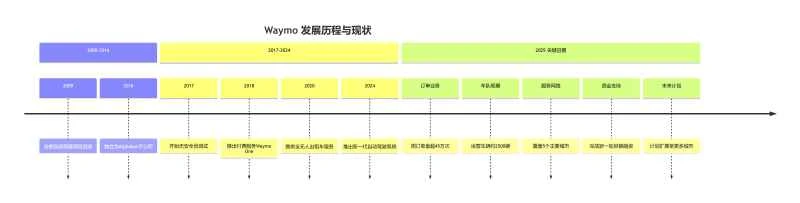
Entering 2025, Waymo announced a series of expansion plans, including launching its highway autonomous taxi service first in the United States, and planning to expand the service to more cities such as Nashville, Miami, and Washington, D.C. in 2026. In October of this year, Waymo announced the completion of a $5.6 billion funding round. This round was led by its parent company, Alphabet, with participation from venture capital firms Andreessen Horowitz and Fidelity. Investment groups such as Perry Creek, Silver Lake, Tiger Global Management, and T. Rowe Price also participated in this funding round. Waymo stated, "With this latest investment, we will continue to expand the Waymo One taxi service area in San Francisco, Phoenix, and Los Angeles, making autonomous taxis available to more people. We are also offering services in Austin and Atlanta through our partnership with Uber."
Robotaxi is expanding both domestically and internationally.
As a consistent leader in the industry's "marathon" race, Waymo has a huge first-mover advantage in data accumulation, system iteration, and security record.
Huaxin Securities It is believed that Waymo is poised to gradually establish itself as the leading player in the US autonomous driving mobility market, leveraging its triple advantages of "urban networking + technological leadership + policy support." While Waymo is currently in a high-investment phase, driven by its user base, technological accumulation, and favorable policies, it is expected to gradually improve its profitability in the coming years and become a benchmark for the commercialization of autonomous driving globally.
Meanwhile, domestic robotaxi companies have also made breakthroughs in commercial operation, leading to increasingly fierce competition in the industry.
Carrot Express, Pony.ai , and WeRide are the main participants in the domestic Robotaxi market, and all three have seen an increase in Robotaxi-related revenue and orders compared to 2024.
Caitong Securities According to the analysis, Pony.ai's passenger fare revenue increased by over 300% year-on-year in the second quarter of 2025; WeRide's Robotaxi-related revenue increased by 364% year-on-year in the first half of 2025; and Carrot Express's order volume exceeded 2.2 million in the second quarter of 2025, an increase of 148% year-on-year. In addition, new entrants are emerging in the domestic market and have announced their future plans, including OEMs, mobility platforms, and intelligent driving suppliers, such as XPeng, Momenta, and Qianli Technology. Didi, Hello, Cao Cao Mobility , etc.
The agency stated that Robotaxi is being rolled out globally and recommends focusing on companies with existing, mature Robotaxi operating experience and those poised to enter the field in the future.
1) Autonomous driving technology companies or intelligent driving solution providers: Pony.ai, WeRide, Horizon Robotics Qianli Technology ;
2) OEM: XPeng Motors Tesla ;
3) Ride-hailing platform companies: Didi Global, Uber Cao Cao Mobility , Ruqi Mobility .
According to China Galaxy Securities News , November 10-12: Leading domestic Robotaxi companies such as Carrot Express, WeRide, Cao Cao Mobility , and Didi Chuxing successively announced their business progress in Abu Dhabi. Previously, these leading domestic Robotaxi companies had also launched operations in Singapore, Switzerland, Dubai, and other locations, demonstrating diversified overseas expansion. This institution believes that the Robotaxi industry has reached a commercialization inflection point, with leading companies in the domestic market benefiting from a triple positive factor: policy support, technological advancements, and cost reductions.
In terms of policy, Beijing, Shanghai, Wuhan, Shenzhen, Guangzhou and other places are actively carrying out Robotaxi pilot operations to provide road testing environments for companies;
From a technical perspective, intelligent driving technology is iterating from modular to end-to-end, with the rapid accumulation of road test data. L4 level intelligent driving technology is constantly maturing. As of 2024, the cumulative test mileage of intelligent connected vehicles in Beijing, Shanghai and Guangzhou reached 47.05 million kilometers, 28 million kilometers and 22.97 million kilometers respectively.
In terms of cost, the significant decline in hardware costs, represented by LiDAR, has led to a decrease in the overall cost of Robotaxi vehicles. For example, the latest generation Robotaxi model RT6 from Luobo Express is priced at only 204,600 yuan, gradually forming a sustainable and profitable business model.
The organization stated that leading domestic Robotaxi companies are rapidly accumulating experience in the domestic market and replicating it in overseas markets, opening up global market opportunities and expected to drive the global Robotaxi market into a period of rapid development.
(Article source: CLS)