According to data from Omdia, an international market research firm, Logic Robotics, a leading Chinese robotics company focusing on embody intelligence, will rank first globally in terms of humanoid robot shipments and market share in 2025.
According to Omdia's latest "2026 General Embossed Intelligent Robot Report," Logic Robots shipped more than 5,168 humanoid robots throughout the year, accounting for 39% of the global market share.
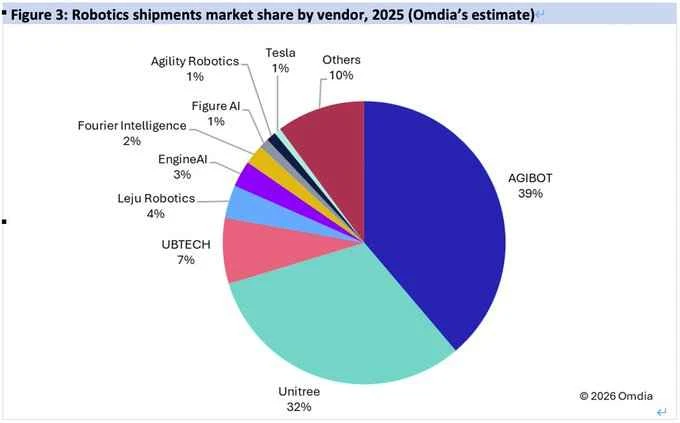
Following closely behind are two other Chinese companies, Unitree Robotics (32% share) and UBTECH (7% share).
The Omdia report indicates that global sales in the industry are projected to more than quadruple in 2025 compared to 2024. Although the humanoid robot competition is still in its early stages, the market is expected to grow rapidly in the coming decades.
The research institute's report covers bipedal humanoid robots as well as wheeled products with humanoid upper bodies.
A previous study by Citigroup indicated that China's current leading position could boost the country's development, as the number of robots is projected to surge to 648 million by 2050. Omdia also stated, "Chinese suppliers are setting the benchmark for large-scale production."
The Omdia report points out that AI integration enables robots to perform complex tasks, thereby increasing the application of such robots in various fields such as manufacturing, logistics, healthcare, and customer service. Meanwhile, robotics companies are investing heavily in cutting-edge AI models.
Chinese humanoid robots are cheaper than those produced by Western companies. For example, an entry-level model from Unitree Robotics costs only $6,000, while a simplified version from Logic Robotics is priced at around $14,000. In contrast, Tesla CEO Elon Musk previously gave the company's Optimus humanoid robot a price range of $20,000 to $30,000, even though the robot has not yet reached full-scale production.
Zhiyuan and Yushu stand out from the crowd.
At this week's CES in Las Vegas, Nvidia CEO Jensen Huang mentioned Calciobot in his keynote address, significantly boosting the company's international profile. Calciobot also launched its next-generation simulation platform, Genie Sim 3.0, and unveiled the Calciobot Q1, a backpack-sized robot, at the show.
Currently, Logic Robotics has built a diverse product portfolio of humanoid robots, covering legged full-size humanoid robots, compact half-body humanoid robots, and wheeled body robots. These humanoid robots have been commercially deployed in a wide range of scenarios, including reception, entertainment and commercial performances, intelligent industrial manufacturing, logistics sorting, security inspection, data collection and training, scientific research and education.
Omdia used its heatmap-based assessment model to evaluate leading global companies across eight dimensions: form and mobility, load and lifting capacity, operational capabilities, perception and navigation, AI learning capabilities, ease of customization, production and deployment scalability, and business impact. Zhiyuan Robotics received the highest rating—"Advanced"—in six of these dimensions, making it the company with the most top-tier ratings in this assessment.
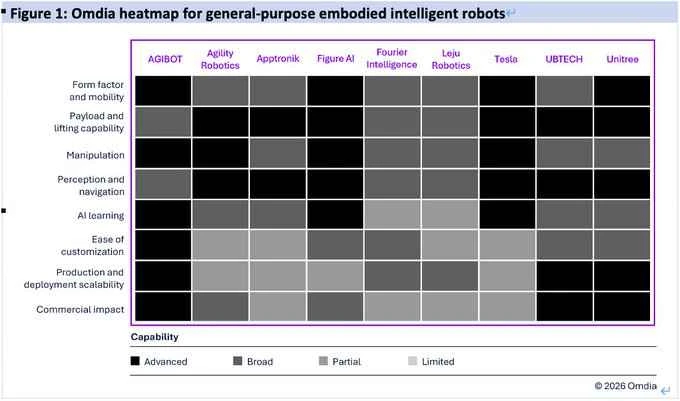
Last year, Unitree Robotics' dancing robot captivated audiences nationwide during the Spring Festival Gala, triggering an explosive growth in humanoid robot development and investment. Omdia currently categorizes companies like Calcium Robotics, Unitree Robotics, and Tesla as the world's "first tier" humanoid robot developers, actively leading industry progress.
Omdia stated that China's preferential industrial policies and infrastructure support, such as training centers, help increase the output of Chinese companies. Currently, the number of Chinese companies involved in the humanoid robot industry exceeds 150.
Omdia predicts that global shipments of humanoid robots will grow exponentially to 2.6 million units by 2035 , as factors such as artificial intelligence models, dexterous robotic arms, and self-reinforcing learning have made robots feasible in industrial, service, and ultimately domestic roles.