On October 28th local time, Nokia Nvidia announced Following the acquisition of company shares, Nvidia CEO Jensen Huang appeared at the GTC DC conference in Washington, D.C., where he announced Nvidia's investment in Nokia .
"Today we are announcing a partnership with Nokia , the world's second-largest telecommunications manufacturer, a $3 trillion industry," said Jensen Huang. He added that with millions of base stations worldwide, this collaboration will build upon new technologies, particularly accelerated computing and artificial intelligence. Change the industry.
This is the latest example of Nvidia's recent series of large-scale investments. Alongside its investment and partnership with Nokia, Nvidia launched a new product line, Arc Aerial RAN Computer, to support 6G. During his speech, Jensen Huang also flexed his muscles by mentioning revenue forecasts for GPU products and discussed other new products Nvidia is developing beyond GPUs.
Another large investment
Nvidia has recently been making frequent large-scale investments. Unlike its other two investments that turned AI giants into close allies, Nvidia's $1 billion investment in Nokia is primarily aimed at entering the telecommunications sector and launching its own new product line.
Nokia announced that its board of directors has decided to issue 166,389,351 new shares in a private placement, enabling Nvidia to make a $1 billion equity investment in Nokia. Subject to certain customary closing conditions, Nvidia will subscribe for these shares at a subscription price of $6.01 per share. This transaction will give Nvidia a 2.9% stake in Nokia. Nokia will adapt its 5G and 6G software to run on Nvidia chips, while Nvidia will explore the use of Nokia data centers in its AI infrastructure. Technological methods.
In a subsequent press release, NVIDIA stated that the investment will accelerate AI-RAN (Radio Access Network) innovation and drive the transition from 5G to 6G. The two companies will also accelerate the development and deployment of next-generation AI-native mobile networks and AI network infrastructure. Along with the investment announcement, NVIDIA also launched Arc Aerial RAN Computer, an accelerated computing platform supporting 6G.
"Nokia will use NVIDIA-ARC as its future base station architecture, and NVIDIA-ARC is also compatible with Nokia's current base station architecture, AirScale. We will use 6G and AI to upgrade millions of base stations around the world. This is the first time we have been able to use AI technology to make wireless communication more efficient," Huang said in his speech.
In his speech, Jensen Huang discussed cloud computing based on wireless telecommunications networks. He stated that the internet made communication possible, and smart companies had already built a cloud computing system on the internet. Now, Nvidia wants to do the same thing on wireless telecommunications networks, enabling cloud computing to reach edge scenarios that data centers cannot reach, because there are base stations all over the world.
Nvidia announced that it will collaborate with Nokia and T-Mobile US to promote and test AI-RAN technology as part of 6G development, with trials scheduled to begin in 2026.
Following the announcement of the investment and cooperation, Nokia shares surged over 26% and Nvidia shares rose over 5% during trading on October 28. Nvidia's stock price exceeded $202 per share during the session, reaching a market capitalization of $4.92 trillion, a record high.
Nvidia's recent frequent external investments have attracted much attention. These investments are often accompanied by collaborations, allowing Nvidia to boost product shipments and expand its new product lines. In addition to investing in Nokia and launching related products, in September, Nvidia also announced a $5 billion investment in CPU manufacturer Intel. The two companies will collaborate on custom chips. Also in September, Nvidia announced it would invest up to $100 billion in large-scale model provider OpenAI, with the collaboration including Nvidia helping OpenAI deploy at least 10 gigawatts of AI data centers containing millions of Nvidia GPUs.

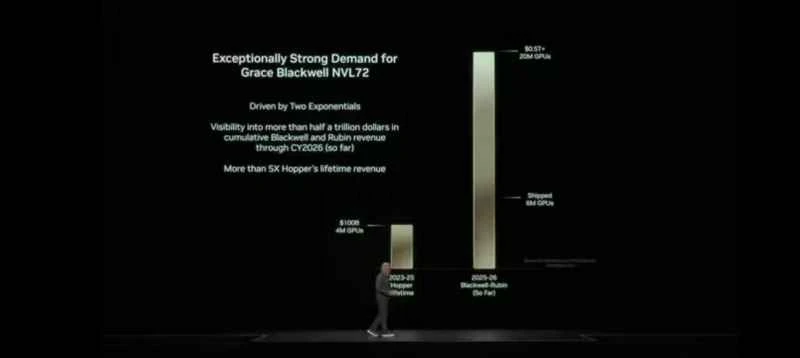
Revenue from the two chip architectures will exceed $500 billion.
In his speech, Jensen Huang also highlighted the progress of the chip business and quantum computing business.
Jensen Huang stated that Nvidia's Blackwell chips are currently in full-scale production in Arizona, USA, and Nvidia is also preparing for the production of chips using the next-generation Rubin architecture. Rubin is expected to enter production around October next year or earlier. "We can already see that Blackwell and Rubin will generate more than $500 billion in revenue this year and in 2026 (calendar year). This revenue will come from 20 million GPUs, of which 6 million have already been shipped. This $500 billion in revenue will be five times the revenue generated by the Hopper architecture chips from 2023 to 2025."
Jensen Huang stated that cloud service providers are investing heavily in capital expenditures, behind which is the transformation from general-purpose computing platforms to accelerated computing platforms, a transformation that is already underway even without AI.
In the field of quantum computing, Jensen Huang announced that NVIDIA has launched NVQLink. NVQLink supports computer control and calibration, quantum error correction, and allows for hybrid simulations between QPUs (quantum processing units) and GPU supercomputers. It is also fully scalable and adaptable to future quantum computers. Huang also announced that 17 different quantum computing companies already support NVQLink.
Jensen Huang also stated that NVIDIA's CUDA can be seen as designed for accelerated computing on GPUs and CPUs. Now, CUDA-Q has been extended to support both GPUs and QPUs simultaneously, with computations "moving" between GPUs and QPUs in microseconds.
"We now realize that it is crucial to connect a quantum computer directly to a GPU-driven supercomputer so that error correction can be performed, the quantum computer can be calibrated and controlled with artificial intelligence , and the correct algorithms can be run on the GPU and QPU. The two computers can work side by side, and this is the future of quantum computing," Huang said.
Jensen Huang also explained the computing demands brought about by AI. He stated that this is the first time AI has participated in an economy worth trillions of dollars. In the past, the chip industry accounted for about 5% to 10% or even less of the multi-trillion-dollar IT industry because applications like Excel and browsers didn't require much computation. But in this new era, a computer is needed that can understand context at any time, and each step requires generating a large number of tokens. Now, AI's "thinking" brings an incredible computing load to the infrastructure.
"Moore's Law is essentially over. The question is, what should we do if we don't find a way to reduce costs?" Huang Renxun stated that the AI industry has entered a cycle where the more people use AI, the more profits it generates, leading to more computers being used and making AI even smarter. The industry's task is to reduce costs. To reduce the cost of AI computing and maintain this virtual cycle, the answer is co-design.
“You can’t just design chips and hope everything works out,” Huang said. Nvidia starts from scratch, considering new computer architectures, chips, systems, models, and applications simultaneously. The company now has Spectrum-XGS, an Ethernet technology that supports cross-regional scaling, enabling data centers to be integrated into gigawatt-scale AI factories. By understanding AI models and across the entire stack, future-proof architectures can be created, reducing token costs.
robot In the field, Huang also introduced the company's new autonomous driving development platform, DRIVE Hyperion, and stated that Robotaxi ( autonomous driving ) The tipping point for taxis is approaching, with these cars traveling a trillion miles annually and the industry producing 100 million vehicles each year. Jensen Huang announced that Nvidia is partnering with Uber to connect Nvidia DRIVE Hyperion-powered vehicles to a global network.
(Article source: CBN)