Entering November, new energy Automakers have released their October sales figures.
XPeng Motors According to its announcement, XPeng Motors delivered 42,013 new vehicles in October 2025, setting a new monthly record and exceeding 40,000 units for two consecutive months. From January to October, XPeng Motors delivered a total of 355,209 vehicles, representing a year-on-year increase of 190%.
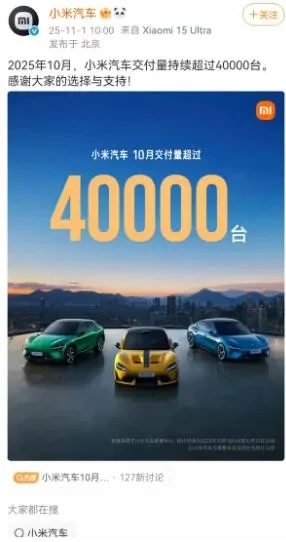
Li Auto announced that it sold 13,159 vehicles in October. The SAIC flagship Li Auto LS9 will have its global debut on November 4th. Xiaomi Auto announced that it delivered 31,767 vehicles in October 2025. Xiaomi announced that its car deliveries will continue to exceed 40,000 units by October 2025. Leapmotor announced that its total deliveries in October reached 70,289 units, representing a year-on-year increase of over 84%.
Seres released its Q3 2025 financial report. The company achieved operating revenue of RMB 110.534 billion and net profit attributable to shareholders of the listed company of RMB 5.312 billion in the first three quarters, representing a year-on-year increase of 31.56%. From January to September this year, Seres' cumulative sales of new energy vehicles reached 304,629 units.
In terms of sales, the total deliveries of the entire Wenjie series have exceeded 800,000 units to date. Among them, the Wenjie M9 has achieved a cumulative delivery of over 250,000 units in 21 months since its launch, setting a new record for deliveries of models priced at 500,000 RMB; the Wenjie M8 has achieved a cumulative delivery of over 100,000 units, maintaining its position as the best-selling model in the 400,000 RMB segment for four consecutive months since its launch; and the all-new Wenjie M7 has achieved a cumulative delivery of over 20,000 units in 36 days since its launch, becoming a phenomenal best-selling model.
Regarding the development trends of the automotive industry, Cui Dongshu, Secretary-General of the China Passenger Car Association (CPCA), recently published an article stating that the external environment is becoming increasingly complex and severe, with unilateralism and protectionism intensifying, impacting the stability of the automotive industry chain and supply chain. The foundation for the domestic economic recovery is still not solid, and challenges such as insufficient effective demand and disorderly market competition remain, making the task of stabilizing industry growth still arduous. "With the trade-in subsidy policy for old cars igniting the 2025 car market, the effect was particularly significant from January to September, and our annual forecast for domestic car retail sales growth needs to be revised upwards. However, the pressure in 2026 is significant, and we look forward to long-term and strong follow-up policies in the future, such as reducing personal income tax for car buyers, promoting the sale of new energy vehicles in rural areas, optimizing the application process for C7 economy electric vehicle driver's licenses, exempting compliant pure electric vehicles with a range of less than 200 kilometers from vehicle purchase tax, encouraging car purchases for marriage, and encouraging car purchases for childbirth, among other improvement measures, to boost car consumption and promote economic growth."
In addition to the continued strong sales of new energy vehicles, Robotaxi is also accelerating its rollout in China.
On October 31, DeepRoute.com announced an agreement with the Wuxi Municipal Government to build a testing and R&D base, further accelerating the rollout of its Robotaxi business. DeepRoute.com CEO Zhou Guang stated that the company plans to launch its Robotaxi business with consumer-grade mass-produced vehicles by the end of this year, becoming the first company in China to operate a Robotaxi business using consumer-grade mass-produced vehicles.
It is understood that, compared to the traditional approach of "modified vehicle + high-precision map" commonly used in the industry, Yuanrong Qixing's Robotaxi vehicles are built based on consumer-grade mass-produced vehicles and do not require additional customized sensors . With dedicated hardware, deployment costs are lower, and system stability and platform compatibility are stronger. Technically, DeepRoute's Robotaxi shares the same technical framework as mass-produced vehicles already on the market, enabling technology feedback.
Starting this year, an increasing number of Robotaxi users are achieving large-scale commercial operation, proving the feasibility of the technology. In the second half of 2025, Pony.ai... The seventh-generation Robotaxi has been launched, and the fleet size will expand to 1,000 vehicles. According to data from Frost & Sullivan, the compound annual growth rate of China's Robotaxi market will reach 140.7% from 2025 to 2030, demonstrating significant development potential and commercial value.

(Source: Securities Times) (Times)