Just this past weekend, US President Trump posted a sarcastic comment about those opposing tariffs, stating that he would "pay at least $2,000 in dividends to every American." Treasury Secretary Bessenter countered that this could be achieved through tax cuts in the landmark economic policy bill he signed earlier this year.
However, is this truly a case of "shared joy" after profiting from tariffs, or a "last resort" to quell public opinion? An analysis released on Monday suggests that the potential "tariff bonus" check could cost twice as much as the revenue generated by the tariffs.
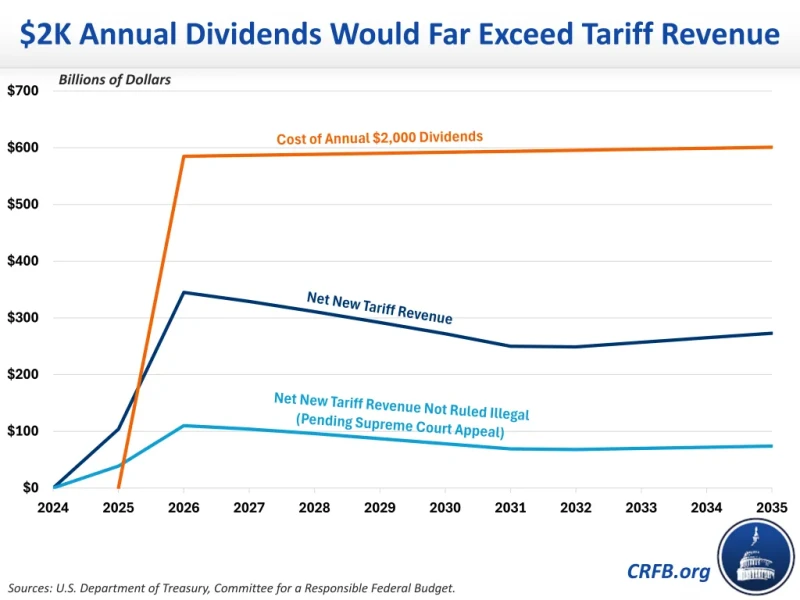
According to the Committee on Responsible Federal Budget (CRFB), a bipartisan research organization, the scale and scope of the "dividend" proposed by Trump could cost more money than the tariffs could potentially generate.
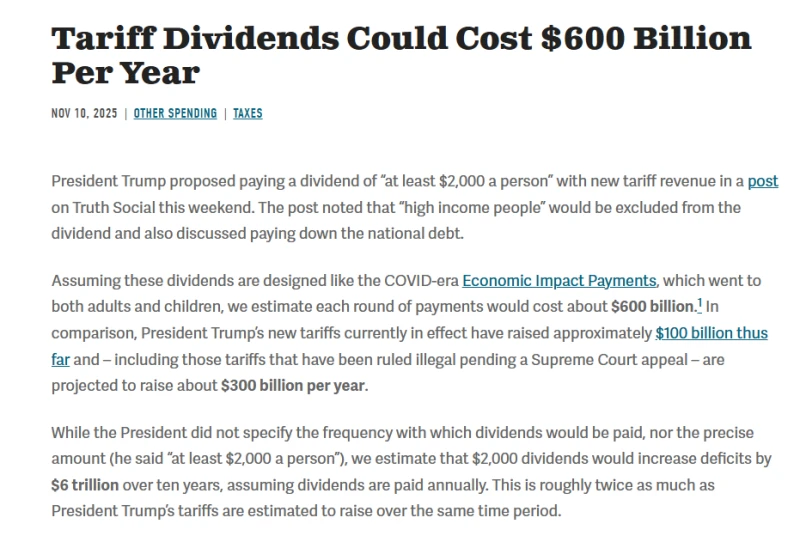
The CRFB further points out that if the Trump administration follows guidelines for stimulating spending during the COVID-19 pandemic, its "tax refund checks" could cost $600 billion. Meanwhile, the agency's data shows that U.S. tariffs are projected to generate only $300 billion in federal revenue by the end of this year, compared to just $100 billion so far.
The CRFB wrote in its report: "With our national debt rapidly approaching historic highs and annual budget deficits nearing $2 trillion per year, policymakers must focus on actually reducing the deficit and putting the debt on a downward trajectory."
"The additional tariff revenue should be used to reduce the deficit—as several government officials have said—rather than passing that revenue on to taxpayers in the form of cash dividends," the agency added.
Although the president did not specify the frequency and amount of the bonuses (he only said “at least $2,000 per person”), the CRFB estimates that a bonus of $2,000 per person per year would increase the fiscal deficit by $6 trillion over a decade. This is roughly twice the deficit increase projected by President Trump’s tariffs during the same period.
CRFB's analysis also shows:
Without increasing revenue, current tariff revenue could be used to pay out a "dividend" of $2,000 per person every two years, starting in early 2027.
If the Supreme Court upholds the lower court's ruling—in which case most of President Trump's tariffs would be illegal—then the revenue from the remaining tariffs would be enough to pay a "dividend" of $2,000 per person seven years later.
Using tariff revenue to pay "dividends" means that the revenue cannot be used to reduce the deficit or offset borrowing under the "Big and Beautiful" tax reform bill.
If all tariff revenue were used to pay "dividends," the debt would reach 127% of GDP by 2035, instead of the current legal limit of 120%; and if only $2,000 of "dividends" were paid annually, the debt would reach 134% of GDP.
On Monday, Trump claimed that the U.S. would use the remaining tariff revenue from "dividend" checks to "reduce our debt." He added that when considering the federal revenue generated by his tariffs, people should take into account the expected investments, including "trillions of dollars" from large corporations.
(Article source: CLS)