Capital Economics recently stated that the Federal Reserve, which has always been consensus-oriented, has recently experienced increasing internal divisions, to the point that next month's interest rate decision may be deadlocked .
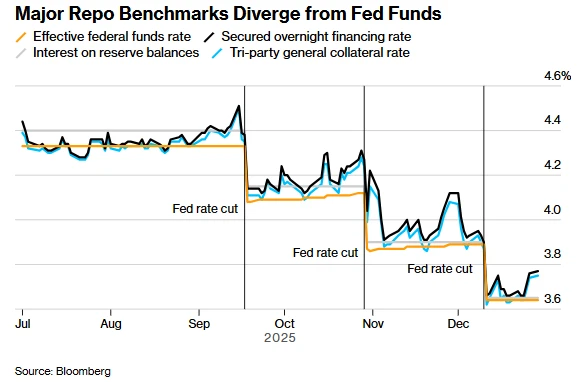
Following two rate cuts, recent comments from Federal Reserve policymakers have become increasingly hawkish, as persistently high inflation above the Fed’s target has reduced hopes for further policy easing at the December 9-10 meeting.
The September jobs report released by the U.S. Labor Department last Thursday (delayed due to the government shutdown) failed to change the internal divisions within the Federal Reserve. The mixed report showed that September job growth exceeded expectations, but data from previous months were revised downwards, and the unemployment rate rose to its highest level in four years.
But Williams , the third-in-command at the Federal Reserve and president of the New York Fed, His remarks last Friday turned the tide. He stated that he believed there was "still room for further rate cuts in the short term" to bring the benchmark interest rate closer to a neutral level.
As a result, the probability of an interest rate cut in December has surged dramatically, rising from less than 40% the previous day to over 70%. The three major U.S. stock indices also rebounded collectively on Friday, reversing the sharp decline of the previous day.
However, Williams ' remarks have further complicated the Fed's policy outlook for December.
The Federal Reserve's interest rate decisions are voted on by the 12-member Federal Open Market Committee (FOMC). According to the rules, a simple majority vote is required for approval, meaning at least seven votes are needed. These 12 voting members include seven members of the Federal Reserve Board of Governors, the president of the New York Federal Reserve Bank, and four rotating regional Federal Reserve Bank presidents.
In a report last Friday, Capital Economics economists attempted to gauge voting intentions. The four regional federal presidents on the FOMC—Boston Fed President Collins, Chicago Fed President Goolsby, St. Louis Fed President Musslump, and Kansas City Fed President Schmid—are skeptical or even outright opposed to the idea of a rate cut next month. Fed Governors Barr and Jefferson also signaled caution.
On the dovish side, the three Federal Reserve governors appointed by Trump—Michelle Bowman, Stephen Milan, and Christopher Waller—have been calling for interest rate cuts, and Williams ' remarks last Friday suggest he may be joining this camp.
Capital Economics stated, "Currently, there are only four votes in favor of a rate cut and six against, but given that Williams and Fed Chairman Powell often share the same views (and Fed Governor Lisa Cook usually aligns with Powell's position), we could end up with a six-to-six tie."
"Then the situation will become very chaotic because it's unclear whether Powell has the decisive vote, so the vote to change policy may not be able to take place at all," the agency said.
JPMorgan Chase Michael Feroli, chief U.S. economist, also stated in a research report last week that both maintaining the current interest rate and lowering it are likely to face considerable opposition. The situation at the December Fed meeting is very close.
What will happen if a draw occurs?
There has never been a tie in the voting history of the Federal Reserve, and the rules and procedures of the FOMC do not explicitly address this scenario.
Robert Eisenbeis, former director of research at the Atlanta Federal Reserve, had previously stated that the federal funds rate would remain unchanged in the event of a tie.
He explained that the Federal Reserve does not have an overturning clause, meaning the chairman has no power to force a change in the decision. In the event of a tie, it is unclear whether policymakers will hold a revote at the current meeting or wait until the next meeting to make a decision .
“There is no precedent for this. I think there might be an option for a revote, but if not, the interest rate will remain unchanged; if the interest rate is not adjusted, it will be reviewed and voted on again at the next meeting,” Eisenbeis said in August.
Although the Federal Reserve has never faced a tie in the vote, it has come close several times. Christopher Hodge, chief U.S. economist at Natixis CIB Americas, noted in a July report that the FOMC has passed decisions by a single vote three times, though the last time this happened was in 1973.
Hodge, who previously served as chief economist at the Federal Reserve Bank of New York, stated that no official public document explicitly mentions how a tie would be handled .
However, he stated that the Federal Reserve Chair has enormous power in chairing meetings and guiding decision-making, and that the FOMC, as an autonomous committee, has the authority to amend its own rules.
“In the absence of explicit rules for breaking a deadlock, the chair is generally considered to have the power to cast a decisive vote or guide the committee to reach a consensus—a practice more common in other deliberative bodies with chairs,” Hodge explained in August. “This is not explicitly stated in any of the documents I have reviewed; it is more of a convention than a rule.”
If the Federal Reserve experiences a tie, the Bank of England's approach may serve as a reference. This summer, the Bank of England's Monetary Policy Committee was locked in a historic deadlock: four members voted to keep interest rates unchanged, four voted to cut rates by 25 basis points, and one voted to cut rates by 50 basis points.
This prompted the Bank of England's Monetary Policy Committee to hold a revote for the first time since its inception in 1997, ultimately lowering the interest rate by 25 basis points from 4.25% to 4% by a 5-4 vote.
(Article source: CLS)