On November 25, the Nikkei 225 index opened higher and continued to rise in the morning session, surging by more than 1% at one point. However, it began to plunge in the afternoon Japan time, briefly turning negative, before stabilizing slightly and closing up 0.07% at 48,659.52 points.
SoftBank's sharp decline may have been a significant drag on the market. Following a plunge in the previous trading day, the stock plummeted by as much as 11% today, closing down nearly 10%. Based on this estimate, SoftBank's market capitalization has evaporated by over 245 billion yuan in the past two trading days.
One analyst said, "The market is worried that OpenAI will face a more severe competitive environment after the strong reviews of Google Gemini 3, which has hit SoftBank's stock price."
SoftBank Group, heavily invested in OpenAI, released its earnings report on November 11, revealing that on March 31, SoftBank Group and OpenAI signed a definitive agreement for a follow-on investment of up to $40 billion in OpenAI Global. After deducting $10 billion to be lent to co-investors, SoftBank Group's actual investment is expected to be $30 billion. In October 2025, SoftBank Group and OpenAI signed an amended agreement, enabling the company to fully invest an additional $22.5 billion in its second round of financing without certain conditions; subsequently, the company will complete the full investment through SoftBank Vision Fund 2 in December 2025.
Less than a month ago, SoftBank Group briefly became the second Japanese company, after Toyota Motor, to surpass a market capitalization of 40 trillion yen (approximately US$255 billion), but its market capitalization has since fallen by more than 40% from its peak.
At that time, the Bloomberg Billionaires Index showed that SoftBank Group founder Masayoshi Son's personal net worth soared by 248%, reaching $55.1 billion (approximately 392.8 billion yuan) and regaining the title of Japan's richest person, ending Uniqlo founder Tadashi Yanai's long-standing leading position.
AI Trends Shift
Google "ascends the throne"
Although ChatGPT is currently the subject of artificial intelligence OpenAI, the “initiator” of the AI boom, is also one of the biggest beneficiaries. However, with competitors constantly catching up, the direction of the AI boom in the United States seems to have changed recently.
software company Salesforce Google CEO Marc Benioff recently announced that he will abandon OpenAI's ChatGPT in favor of Google's newly released Gemini 3 AI model, calling it a "crazy" leap forward in inference, speed, and multimodal capabilities.
He wrote on social media: “OMG! I’ve been using ChatGPT every day for the past three years. I just spent two hours experiencing the Gemini 3. I can’t go back. This leap is amazing—inference, speed, images, video…everything is clearer and faster. It feels like the world has changed again.”

This post quickly attracted market attention, and as of press time, it had been viewed over 3 million times. Moreover, given Salesforce 's deep collaboration with OpenAI and Anthropic in the field of artificial intelligence , Benioff's endorsement is striking and highlights how the preferences of top technology leaders are rapidly shifting as models become faster and better.
Salesforce is a leading global enterprise software company headquartered in San Francisco, California, USA. Founded in 1999 by Benioff and several former Oracle engineers, it is a cloud computing company. The pioneer in the CRM (Customer Relationship Management) field is widely regarded as one of the forerunners in promoting the global adoption of the "Software as a Service" (SaaS) business model.
Google's parent company, Alphabet, and its DeepMind division released Gemini 3 last week, describing it in a blog post as "the most powerful agent and inductive coding model to date," capable of generating and understanding text, images, videos, and code, and enabling tighter integration within the Google ecosystem. Alphabet also stated that the AI model outperforms OpenAI's ChatGPT 5.1 and Claude Sonnet 4.5 in areas such as scientific reasoning and agent tasks.
It's worth noting that, according to sources, Meta is discussing plans for data centers in 2027. The report also states that Meta uses Google's AI chips—known as Tensor Processing Units (TPUs). Meta may also lease chips from Google Cloud next year.
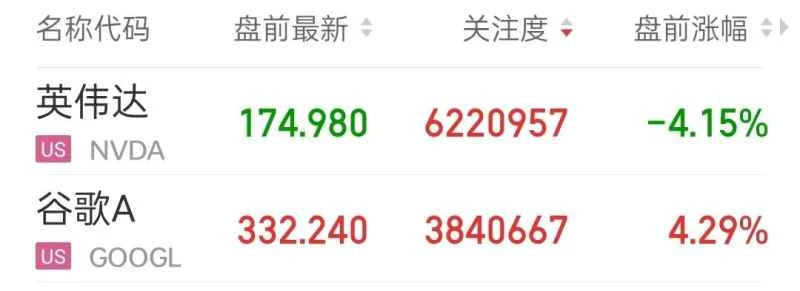
Following this news, as of press time, Google's stock price rose 4.29% in pre-market trading today, while Nvidia's rose... It then fell by more than 4%.
Once the agreement is reached, it will help establish TPUs as an alternative to Nvidia chips. Currently, Nvidia chips are the "gold standard" for large tech companies and startups, with companies like Meta and OpenAI relying on their computing power to develop and run AI platforms. Google has previously reached an agreement with Anthropic to supply it with up to 1 million TPU chips. However, Nvidia still dominates this market.
This tensor chip was first developed over a decade ago, initially designed specifically for artificial intelligence tasks. Now, it's gaining momentum outside of Google's ecosystem, seen as a solution for training and running complex AI models. Its appeal is further amplified as global companies worry about over-reliance on Nvidia.
Japanese government bonds fell again.
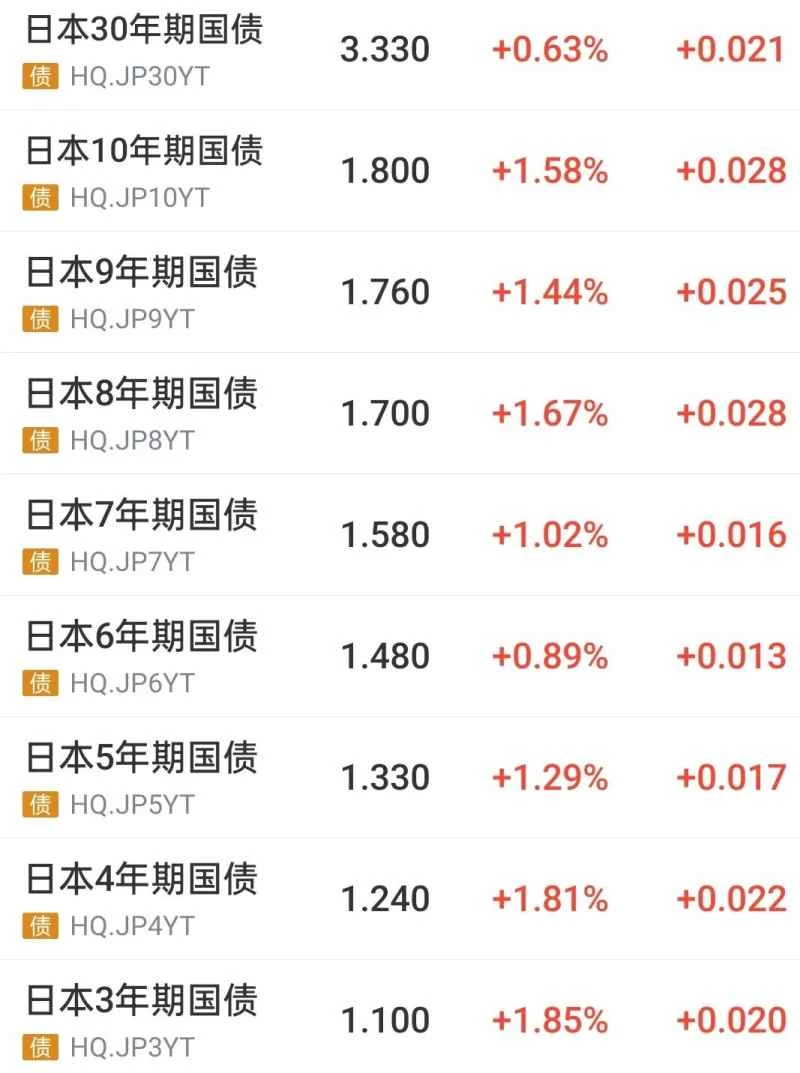
Notably, the Japanese government bond market, which has recently been troubling global markets, fell again today. The yield on 10-year Japanese government bonds surged back above 1.8%. The yield on 30-year Japanese government bonds rose 0.63 basis points to 3.33%.
On November 21, the Japanese cabinet introduced a supplementary budget of 21.3 trillion yen (approximately 3% of GDP), marking the first major economic policy since the Sanae Takaichi government took office and highlighting the new government's fiscal expansionist approach.
Huatai Securities The study suggests that the larger-than-expected supplementary budget is likely to boost Japan's economic growth in the short term, but given the current situation, Qualcomm... Against the backdrop of inflation, fiscal stimulus plans lacking the support of monetary policy normalization may increase the risk of inflation decoupling. Concerns about fiscal sustainability may push up the risk premium of long-term Japanese government bonds, leading to a further deterioration in the liquidity of long-term government bonds.
The term spread between long-term and short-term Japanese government bonds not only reflects market expectations for future economic growth but also implies concerns about fiscal sustainability. As Japan intensifies fiscal stimulus, these concerns have increased the risk premium for long-term Japanese government bonds, particularly given that the Bank of Japan holds a significant portion of these bonds. At the end of 2024, the Bank of Japan held approximately 52% of all Japanese government bonds, with an even higher proportion of long-term bonds. Furthermore, Japanese insurance... Declining corporate demand for long-term government bonds has weakened liquidity in Japanese long-term bonds, while rising risk premiums may further worsen the liquidity of Japanese long-term bonds.
Guojin Securities It is believed that the deteriorating geopolitical situation has also triggered a triple shock to the Japanese economy: the yen has depreciated, the yield on 10-year government bonds has soared to a 16-year high, and capital outflows have intensified; negotiations on the China-Japan-South Korea Free Trade Agreement have stalled again; and the number of Chinese tourists visiting Japan is expected to decrease by 60%, dragging down GDP by about 0.36%.
Furthermore, Takahide Kiuchi, a researcher at Nomura Research Institute in Japan, stated that the Japanese economy is already facing downward pressure due to US tariff policies, coupled with the deterioration of Sino-Japanese relations, posing significant hidden risks. If the situation does not reverse, the Japanese economy may continue to decline in the fourth quarter of this year. At this point, increased fiscal spending could lead to a continued plunge in Japanese government bonds, potentially triggering a series of black swan events similar to the collapse of the UK's pension system . Without intervention, the economy will continue to deteriorate.

(Source: Daily Economic News)