Japanese stocks and bonds jumped again!
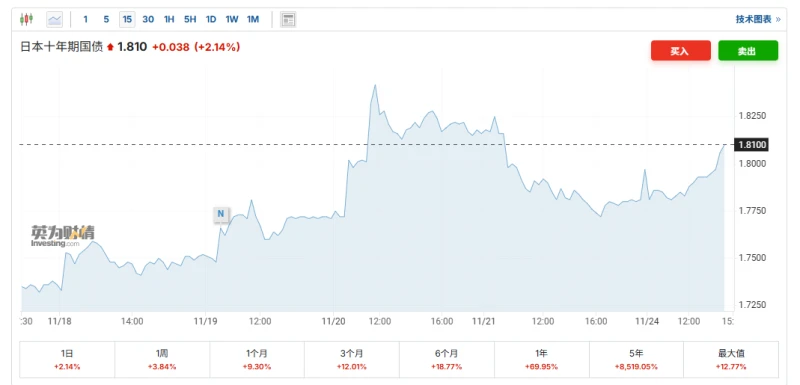
The surge in US stocks did not lead to a significant recovery in the Japanese stock market. Today (November 25), the Nikkei 225 index rebounded by more than 1% at one point, but then plunged. Meanwhile, the yield on Japanese 10-year government bonds surged again to above 1.8%.
More noteworthy is the sharp drop in Japanese capital giant SoftBank. The stock plunged to a two-and-a-half-month low on Tuesday, after falling as much as 11% in the previous trading day. This also significantly impacted the South Korean stock index.
So, what exactly happened? And how significant was the impact?
The Japanese market is changing again.
The Nikkei 225 index opened higher and continued to rise in the morning session, surging by more than 1% at one point. However, it began to plunge in the afternoon (Japan time), briefly turning negative, before stabilizing slightly and closing up 0.07% at 48,659.52 points.
SoftBank's sharp decline may have been a significant drag on the market. Following a plunge in the previous trading day, the stock plummeted by as much as 11% today, closing down nearly 10%. This was due to concerns about Alphabet's latest Gemini AI. The model could intensify competition for SoftBank's key investment in OpenAI.
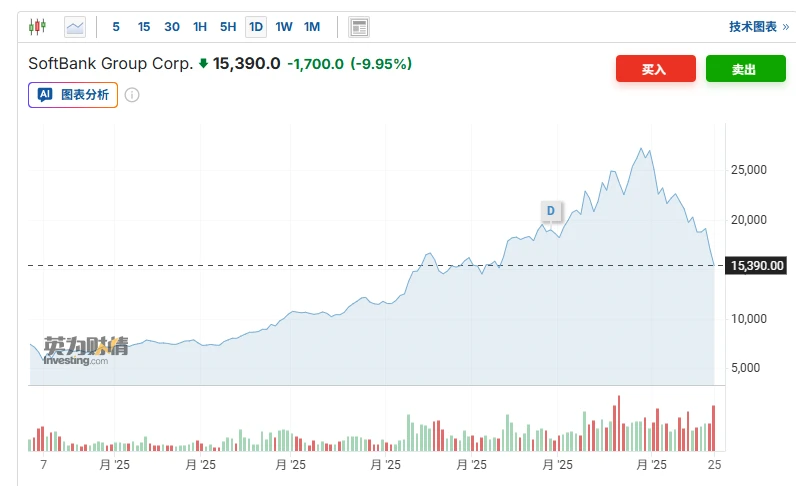
Mitsubishi UFJ eSmart Securities Tsutomu Yamada of the company said that concerns that the competitive landscape for OpenAI would become more intense after Google's Gemini 3 received positive reviews had impacted the stock price.
Notably, the Japanese government bond market, which has recently been troubling global markets, fell again today. The yield on 10-year Japanese government bonds surged back above 1.8%. The yield on 30-year Japanese government bonds rose 0.5 basis points to 3.325%.
Influenced by the Japanese stock market, the rebound in South Korean, Hong Kong, and A-shares narrowed around midday.
How significant will the impact be?
In fact, the liquidity crunch has eased somewhat after the Federal Reserve shifted its interest rate direction, as can be seen in the cryptocurrency market. Today, the cryptocurrency market saw a broad rally, with Bitcoin rebounding above $88,000 and Ethereum also rebounding nearly 4%, reaching around $3,000. From this perspective, systemic risks in the global market may be diminishing in the short term. However, disturbances in the Japanese market may still exist.
On November 21, the Japanese cabinet introduced a supplementary budget of 21.3 trillion yen (approximately 3% of GDP), marking the first major economic policy since the Sanae Takaichi government took office and highlighting the new government's fiscal expansionist approach.
Huatai Securities The study suggests that the larger-than-expected supplementary budget is likely to boost Japan's economic growth in the short term, but given the current situation, Qualcomm... Against the backdrop of inflation, fiscal stimulus plans lacking the support of monetary policy normalization may increase the risk of inflation decoupling. Concerns about fiscal sustainability may push up the risk premium of long-term Japanese government bonds, leading to a further deterioration in the liquidity of long-term government bonds.
The term spread between long-term and short-term Japanese government bonds not only reflects market expectations for future economic growth but also implies concerns about fiscal sustainability. As Japan intensifies fiscal stimulus, these concerns have increased the risk premium for long-term Japanese government bonds, particularly given that the Bank of Japan holds a significant portion of these bonds. At the end of 2024, the Bank of Japan held approximately 52% of all Japanese government bonds, with an even higher proportion of long-term bonds. Furthermore, Japanese insurance... Declining corporate demand for long-term government bonds has weakened liquidity in Japanese long-term bonds, while rising risk premiums may further worsen the liquidity of Japanese long-term bonds.
In addition, Guojin Securities It is believed that the deteriorating geopolitical situation has also triggered a triple shock to the Japanese economy: the yen has depreciated, the yield on 10-year government bonds has soared to a 16-year high, and capital outflows have intensified; negotiations on the China-Japan-South Korea Free Trade Agreement have stalled again; and the number of Chinese tourists visiting Japan is expected to decrease by 60%, dragging down GDP by about 0.36%.

(Source: Securities Times)