With AI ( Artificial Intelligence) The demand for computing power is growing exponentially, while ground data centers... Faced with insurmountable bottlenecks such as energy and heat dissipation, Silicon Valley tech giants have recently turned their attention to space, making the establishment of data centers in space the next battleground in their AI race.
Google CEO Sundar Pichai discussed the hot topic of "building data centers in space" on a podcast this week.
“Obviously, this is an ambitious and bold plan,” Pichai said. He acknowledged that the idea seems “crazy” now, but “when you really step back and think about the scale of computing power we will need in the future, it starts to make sense, it’s just a matter of time.”
Pichai's remarks were referring to Project Suncatcher, a new long-term research initiative recently announced by Google. According to a company blog post, Project Suncatcher aims to "one day be able to deploy machine learning at scale in space."
Pichai didn't reveal many details, only stating that "hopefully, by 2027, we will be able to deploy TPUs (Tensor Processing Units) somewhere in space." TPUs are Google's custom AI chips. .
"Maybe we'll even run into Tesla." "Roadster sports car," he joked.
Pichai's reference refers to a past "feat" by Elon Musk: Musk secured his older Tesla Roadster to a SpaceX rocket and launched it into orbit, with a mannequin in a spacesuit in the driver's seat. Launched in 2018, the Roadster remained in deep space until earlier this year, when astronomers mistook it for an asteroid.
But in the AI era, Musk and other tech giants' space ambitions are far beyond what the gimmick of the Roadster sports car could ever achieve back then.
"Starship should be able to deliver approximately 300 gigawatts of solar power into orbit annually." "AI satellites could even reach 500 gigawatts. The 'annual' scale is the key to this," Musk wrote on X earlier this month.
The numbers Musk mentioned represent unprecedented data center capacity. (Goldman Sachs ) Earlier this year, it was stated that the current global power capacity for terrestrial data centers is 59 gigawatts.
Global electricity demand is projected to double by 2050, partly due to the booming construction of AI data centers. In the United States, data centers are the biggest driver of this surge in electricity demand, putting immense pressure on the country's power grid.
Musk, Pichai, and other tech leaders have recognized that the power demands of AI data centers are difficult to meet. This is why they aspire to build data centers in space.
Amazon Founder Jeff Bezos predicts that data centers will move into space within the next 10 to 20 years.
“I do believe that over time, the world will be full of data centers,” OpenAI CEO Sam Altman said in an interview this July. “But you never know, because we might build data centers in space. For example, we could build a giant Dyson sphere in the solar system and say, ‘Hey, there’s really no need to build all this stuff on Earth.’”
At the recent US-Saudi Arabia Investment Forum, Musk stated that Earth receives only one two-billionth of the total solar radiation energy, making space exploration crucial for acquiring more energy .
Regarding Musk's viewpoint, Salesforce CEO Marc Benioff stated that space has "continuous solar energy , eliminating the need for batteries." "To provide power and cooling. The cheapest place to build a data center is in space," he wrote on X.
The latest news is that Beijing plans to build and operate a centralized large-scale data center system with a power exceeding one gigawatt (GW) in a 700-800 kilometer twilight orbit, aiming to move massive AI computing power into space. According to the plan, the data center system consists of space computing power, relay transmission, and ground control subsystems. The data center construction will be divided into three phases. The first phase, from 2025 to 2027, will focus on breakthroughs in key technologies such as energy and heat dissipation, iterative development of experimental satellites, and the construction of the first-phase computing constellation.

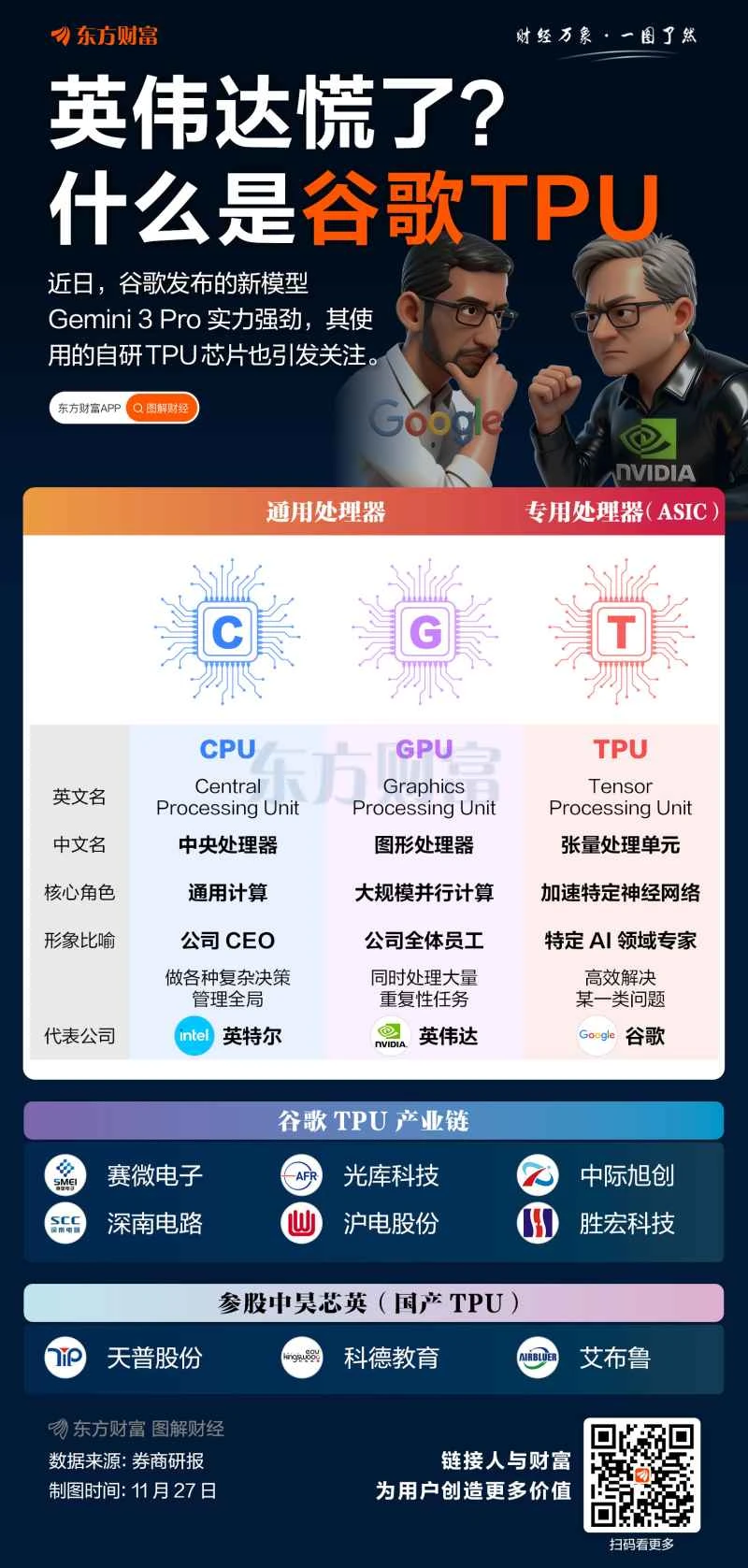
Dongcai Illustrated Guide: Some Useful Tips
Is Nvidia panicking? A graphic explaining what Google TPU is.
(Article source: CLS)