There's a Chinese proverb: "Thirty years east of the river, thirty years west of the river." But in today's rapidly changing AI landscape, the time it takes for fortunes to reverse can seem to be compressed to one-tenth:
The latest story may begin with two "red alerts":
The first "red alert" came from a long-established tech giant three years ago, when it was worried about a high-profile AI startup; the second "red alert," issued this week, is the opposite – the AI startup with a first-mover advantage is starting to panic because the former's product has made significant progress…
Many investors have probably already guessed the names of these two companies—yes, they are Google and OpenAI.
According to industry insiders, on Monday, OpenAI CEO Altman told employees in an internal Slack memo that the company would launch a "red alert" operation, which would involve allocating more resources to ChatGPT and delaying the release of other products. The company uses three different color codes—yellow, orange, and red—to describe different levels of urgency required to solve problems.
This internal memo to all employees is by far the clearest indication that OpenAI is facing pressure from competitors who have narrowed the startup's lead in the AI race. Of particular concern to Altman is Google, which last month released a new version of its Gemini AI model that outperformed OpenAI in industry benchmarks, sending the search giant's stock price soaring.
Interestingly, many investors who closely follow the AI industry may vaguely recall that in December 2022—shortly after the official launch of ChatGPT—Google also issued a similar "red alert" within the company.
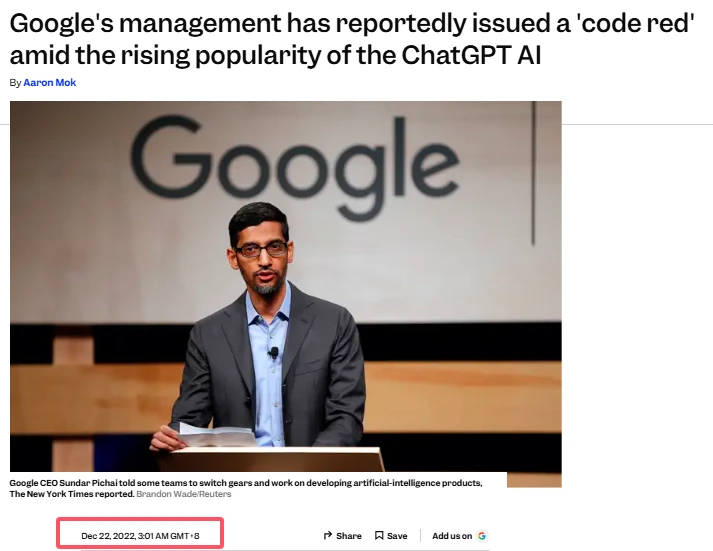
According to an internal memo and recording disclosed by the media at the time, Google CEO Sundar Pichai participated in multiple discussions surrounding Google's artificial intelligence . The meeting focused on strategy, and multiple teams within the company were instructed to refocus their efforts on addressing the threat posed by ChatGPT to its search engine business. Reportedly, teams in Google's research, trust and security departments, as well as others, were ordered to refocus their efforts to assist in the development and rollout of AI prototypes and products.
Undoubtedly, the quiet reversal of the "red alert" issuers in just three years clearly indicates that OpenAI's throne in the AI model field seems to be under threat as Google relentlessly pursues and even attempts to overtake it. And as OpenAI transforms from a "disruptor" to a "defender," this battle for AI supremacy may have officially entered its second half…
Google is catching up.
OpenAI's biggest rival is undoubtedly Google's Gemini 3 model, which has been widely praised since its release.
The model's powerful capabilities demonstrate that Google is no longer lagging behind in the artificial intelligence race. Not only is OpenAI feeling uneasy, but Nvidia, the world's most valuable company, is also concerned. Recent reports on the progress of Google's self-developed TPU chip have also forced Google to prioritize its own AI chips . defend.
Data shows that Gemini's user base has been growing since the release of its image generator Nano Banana in August. The search giant announced in November that Gemini's monthly active users had surpassed 650 million, a significant increase from 450 million reported in July. In contrast, OpenAI claims nearly 800 million weekly active users—while its lead remains, it is being steadily eroded.
Salesforce CEO Marc Benioff recently stated that he has abandoned ChatGPT and switched to Gemini 3 due to the "amazing" progress of Gemini.
“My God,” Benioff wrote on the X platform last month, “I’ve been using ChatGPT for three years. But after just two hours with the Gemini 3, I’m hooked. The leap (to the Gemini 3) is insane—inference capabilities, processing speed, image generation, video processing…everything is sharper and faster. It feels like the world has been turned upside down again.”
It is reported that Altman's latest "red alert" also specifically mentioned Gemini 3, although he implied that OpenAI's upcoming new model still "outperforms" Google's flagship model in tests, and emphasized that OpenAI's Imagegen image generation model will be enabled first for ChatGPT users.
However, it's clear that ChatGPT is facing increasing industry skepticism regarding its ability to maintain its advantage in the large language model race. In recent months, OpenAI has struggled particularly to balance user expectations for its chatbot. The relationship between security concerns and improving user experience. Its GPT-5 model, released in August, also failed to win over some users – many complained about its cold tone and difficulty answering simple math and geography questions.
Vastly different financial situations
From a financial perspective, the cost of competing in the field of artificial intelligence is extremely high. Compared to OpenAI, Google is gaining a significant advantage thanks to its advertising business, a true "cash cow."
Admittedly, Google plans to invest $91 billion to $93 billion in capital expenditures this year, with the majority going towards artificial intelligence costs. However, its revenue reached $100 billion last quarter alone—of which $74.18 billion came from its advertising business.
At the same time, unlike OpenAI, Google can leverage its massive scale to achieve a full-stack advantage, controlling the development of artificial intelligence from R&D to chip manufacturing to its internal cloud platform (which carries all businesses).
In contrast, OpenAI is currently not profitable and must continuously raise funds to survive, which puts it at a financial disadvantage and makes it unable to compete with Google and other technology companies that can use their revenue to invest.
In recent months, many on Wall Street have expressed growing concerns about OpenAI's escalating AI spending commitments, totaling at least $1.4 trillion over the next eight years. OpenAI's spending is also more aggressive than its main startup rival, Anthropic, which, according to its own financial projections, needs to grow revenue to approximately $200 billion to achieve profitability by 2030.
In his latest "red alert," Altman stated that OpenAI will postpone the development of other projects, such as advertising, AI agents for healthcare and shopping, and a personal assistant called Pulse. He encouraged team members to make temporary reassignments and indicated that the company will hold daily meetings for those responsible for improving ChatGPT.
However, this shift will undoubtedly exacerbate industry concerns that its profitability timeline will be delayed.
While OpenAI has an early advantage, Google holds the platform advantage.
In fact, objectively speaking, OpenAI has not squandered its first-mover advantage in recent years, especially this year it has achieved several major breakthroughs.
In recent months, OpenAI has entered the social media field through its TikTok-style AI video generation application Sora, and has also launched its own browser Atlas in an attempt to directly challenge Google Chrome.
In the battle to overcome bottlenecks in computing resources and energy supply, OpenAI has clearly played its trump cards. Faced with the enormous computing power gap and huge capital investment required for AI development, OpenAI has spearheaded a series of interconnected, cyclical financing cooperation models.
Microsoft US tech giants like Nvidia have invested heavily in OpenAI, which then uses the funds to purchase chips or cloud computing power from these giants. Essentially, this is a high-stakes gamble on computing power. Tech giants are attempting to secure future technological monopolies through deep partnerships, using capital to buy their way into a monopoly. Although the company remains privately held, its fate is already intertwined with that of Nvidia , Microsoft , and Oracle. Their fates are closely intertwined with those of the company.
This has led many to still perceive ChatGPT as the product most "closely associated" with AI—almost like Google is with web search. This first-mover advantage, if maintained, may continue to boost ChatGPT app downloads and usage, while also helping to counter Google's attempts to entice users to switch to Gemini or other AI products.
However, Google's rise is clearly not to be ignored.
Humans are "slaves" to habit, and many people have long been accustomed to using Google products or services daily—the tech giant is currently leveraging its platform advantages to continuously attract ChatGPT users.
Now, as OpenAI wisely begins to issue "red alerts" to remain vigilant, we are witnessing the intensification of this artificial intelligence race: Google, once a laggard, is gradually mastering AI technology and accelerating its progress.
For OpenAI, this serves as a reminder that when faced with the possibility of disruption, tech giants like Google still possess a strong foundation to wage a fierce resistance—and sometimes, even turn the tide.
Last May, before criticizing Google products, Altman stated, "I try not to think too much about the competition." Now, it seems those days may be gone forever…
(Article source: CLS)