On the 10th local time (early morning of the 11th Beijing time), the Federal Reserve will announce its latest interest rate decision and release a monetary policy statement.
Following this, Federal Reserve Chairman Jerome Powell will hold a press conference on monetary policy. According to the CME FedWatch Tool, the probability of a 25 basis point rate cut by the Fed this week is around 90%, almost a certainty, but the direction of the Fed's monetary policy next year remains unclear.
Therefore, the market will closely watch Powell's wording at the aforementioned press conference to see whether he says "in a good place" or "moderately limited" or "slightly above neutral," the latter of which would imply the start of a rate cut cycle in 2026.
In an exclusive interview with Yicai Global, Hu Jie, former senior economist at the Federal Reserve and professor at the Shanghai Advanced Institute of Finance at Shanghai Jiao Tong University, stated that, on the one hand, it is necessary to examine the priority relationship between the Fed's "dual mandate"—full employment and price stability. On the other hand, "the market still widely expects a rate cut in December. This is mainly because the current interest rate is in the 3.75% to 4.0% range, which is still a suppressive level. At this time, a 25 basis point rate cut would have a relatively limited impact on the economy, while helping to address potential downside risks in advance. Overall, a moderate rate cut may be a more prudent policy choice at this stage." He explained that the interplay of numerous uncertainties makes the Fed's policy decisions more difficult.
He also stated, "If the December meeting can implement a 25 basis point interest rate cut, the subsequent policy path may become clearer, and more economic data will be released successively. Therefore, the current stage may be the most agonizing phase in policy-making, after which the situation may gradually become clearer."
High interest rates are suppressing the US economy
The US economy has maintained a relatively high growth rate in recent years. For example, last year, the US GDP growth rate reached 2.8%. However, the market generally expects the growth rate to decline this year. The International Monetary Fund (IMF), in its World Economic Outlook released on October 14, predicts that the US economy will grow at a rate of 2% by 2025.
The main reason for this change is that the US's three-year-long high-interest-rate policy has begun to take effect. High interest rates themselves have a dampening effect on economic activity, but their impact was not obvious in the first two years because the US implemented extremely loose fiscal policies at that time, which to some extent offset the suppressive effect of high interest rates on economic activity.
Hu Jie believes that the inhibitory effect of high interest rates on the US economy is becoming increasingly significant: currently, the 30-year mortgage rate in the US remains above 6%, and if high interest rates continue, they will inevitably continue to suppress economic growth. "As the effects of previous fiscal stimulus measures gradually fade, the impact of high interest rates is becoming more prominent," he said.
Meanwhile, "from a political perspective, this is also a major concern for US President Trump, as the continued suppression of the economy by high interest rates could affect his chances in next year's midterm elections." He explained, "The current dilemma is that although inflation has eased somewhat, it is still at 3%, higher than the Fed's policy target of 2%. This forces the Fed to remain cautious in its policy implementation."
“In reality, the Federal Reserve has always needed to balance controlling inflation with supporting employment, a long-standing structural problem. This balance is particularly difficult now because both are performing poorly, coupled with data uncertainty and the fact that some policy effects (such as the actual impact of tariffs) are not yet fully clear. Although the impact of tariffs may appear to be lower than previously expected, its ultimate impact remains to be seen,” he said.
"At the same time, it's important to recognize that there's a lack of key US economic data releases. The Federal Reserve's current decisions are based solely on historical data and recently released supplementary data, but some core data remains missing. Based on the available information, whether or not to cut interest rates is indeed uncertain," Hu Jie said. Overall, the inflation and employment data that the Federal Reserve is most concerned about are not ideal.
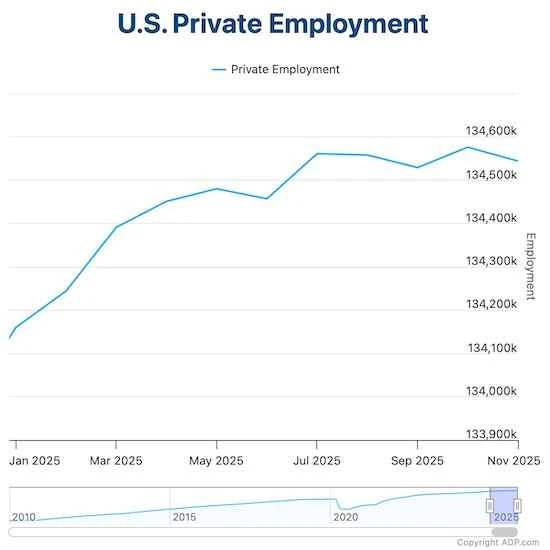
"The latest September Consumer Price Index (CPI) was around 3%, higher than the 2% target, but recent declines in oil prices and other factors have eased some of the upward pressure. Regarding the job market, the unemployment rate has risen to 4.4%, still historically low, but economic data shows signs of weakening. Non-farm payrolls in recent months have been less than optimistic, the US manufacturing Purchasing Managers' Index (PMI) contracted for the ninth consecutive month, and the Federal Reserve's Beige Book, which reports on regional economic conditions, also indicates a slowdown. In other words, the economic data is not bright, but it's not immediately heading into a recession," he said.
Hu Jie stated that under these circumstances, it is necessary to examine the Federal Reserve's "dual mandate," namely the priority relationship between full employment and price stability.
“From a legal perspective, while the Federal Reserve prioritizes full employment, in practice, controlling inflation is a higher priority,” he said. “To put it simply, if the unemployment rate rises due to a delayed policy response from the Federal Reserve, the outside world is generally not critical; however, if policy mistakes lead to runaway inflation, the Federal Reserve will face severe criticism. For example, Powell was heavily criticized when the CPI once soared to 9.1% in 2022. Therefore, the Federal Reserve usually tends to take a conservative stance.”
Next year will be a period of interest rate cuts.
Currently, the Federal Open Market Committee (FOMC) under Powell's leadership is in a state of division.
Hu Jie also believes that historically, such as during the tenure of former Federal Reserve Chairman Alan Greenspan, his personal prestige and performance often led other members to respect his opinions, and voting results tended to be consistent. "This contrasts with the Powell era."
However, he believes that "what is certain is that next year will be a period of interest rate cuts, the point of contention being the pace and magnitude. The Fed's decisions will still be based on data, but the chairman's personal style will influence the interpretation and judgment of the data."
"With Powell still in office in the first half of next year, there are expected to be one or two interest rate cuts. If Hassett takes over, and the economic trend does not change drastically, the rate-cutting process may continue," Hu Jie said. Hassett is currently the director of the National Economic Council and is Trump's preferred candidate to become the next Federal Reserve chairman.
Hu Jie said that if Hassett takes office, his working methods remain to be seen. "Although he shares similar views with Trump, if he completely follows Trump's opinions, there may be significant internal divisions, and the voting results may be more fragmented."
Specifically, "If Hassett takes office, he may accelerate the interest rate cut process, for example, after the December rate cut, he may further cut rates by about 100 basis points next year, showing a dovish tendency. But there is another possibility, that is, to continue to be cautious and gradually observe economic data before making decisions." Hu Jie said, "I personally expect the total interest rate cuts for the whole of next year to be about 100 basis points."
(Article source: CBN)