The Federal Reserve said Thursday that its Board of Governors unanimously voted to reappoint 11 regional Fed presidents for five-year terms, beginning March 1 next year. This is essentially a routine procedure, but it has been subject to stricter scrutiny under pressure from President Trump and his administration.
In a statement, the Federal Reserve said the reappointments were made after a comprehensive review by the Fed Board of Governors of the 12 regional Fed presidents and were unanimously approved by the Fed Board.
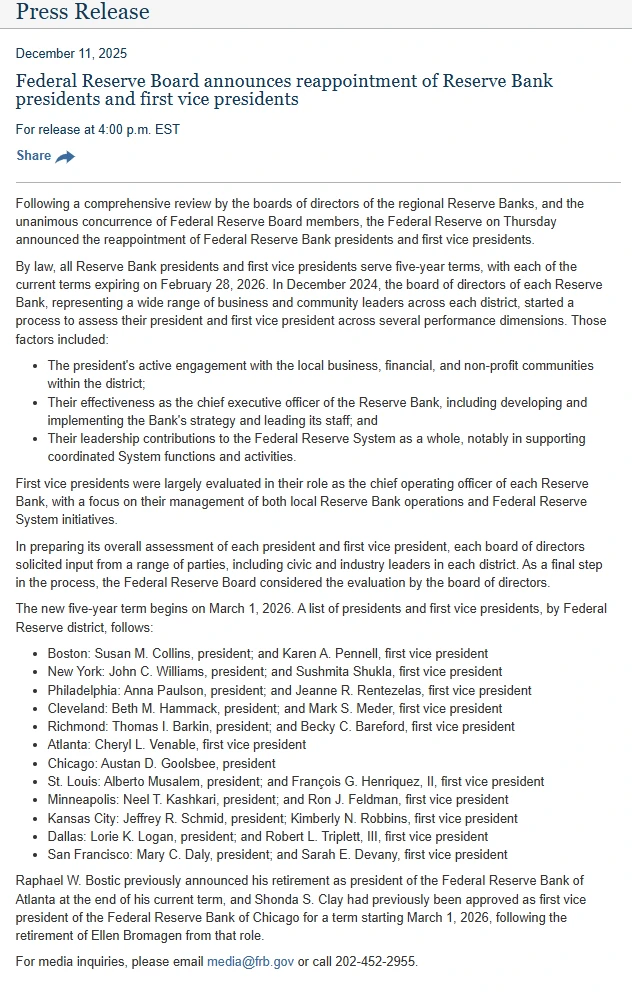
It is understood that, in addition to the Federal Reserve Bank of Atlanta Apart from Raphael Bostic, the presidents of the other 11 regional reserve banks were all re-elected.
Bostic had previously announced plans to retire early next year. Cheryl Venable, first vice president of the Atlanta Federal Reserve Bank , was re-elected and will serve as acting chair until the board finds a successor.
According to the law, all regional Federal Reserve presidents and first vice presidents serve five-year terms and must be re-elected at the end of each term. The current term will expire on February 28, 2026. According to the Federal Reserve's records, this time the Federal Reserve Board completed this process earlier than at least any time since 2006.
This move resolves a key issue surrounding the future composition of the Federal Reserve's monetary policy committee.
Why is it attracting attention?
For decades, this appointment process has been uneventful, with the outcome always predictable: regional Fed presidents receive a majority vote from the Federal Reserve Board for reapproval. However, as Trump seeks to strengthen control over key policies such as interest rates, the issue of the Fed's independence has been thrust into the spotlight, and this precedent has become a "weathervane" for observing whether the Fed's independence will face new challenges.
Previously, Trump's intention to fire Federal Reserve Governor Lisa Cook, and Treasury Secretary Scott Bessent's recent criticism of hiring regional Fed presidents from other regions, have drawn more attention to this process.
Furthermore, current Federal Reserve Chairman Jerome Powell's term expires next May, meaning Trump may only have weeks left to nominate his own "Federal Reserve leader." Previously, Trump stated he had decided who would succeed Powell and would announce the nomination early next year.
This week, following the Federal Reserve's latest interest rate decision, Trump again criticized the Fed for not cutting rates enough. He pointed out that the 25 basis point cut was "a rather small number that could have been doubled—at least doubled."
He also reiterated his long-standing criticism of Federal Reserve Chairman Jerome Powell, calling him "a rigid man" and saying the rate cuts were "quite small."
The Federal Reserve announced a 25-basis-point rate cut on Wednesday, lowering the target range for the federal funds rate to 3.50%-3.75%. This is the Fed's third rate cut this year, and the third consecutive rate cut since September. The total rate cuts this year have now reached 75 basis points.
(Article source: CLS)