Global Artificial Intelligence OpenAI, a leading AI company, said on Monday that the U.S. needs to significantly increase its investment in energy production capacity if it wants to maintain its lead in the AI race .
In recent months, this startup has signed a series of ambitious AI infrastructure construction agreements, which will require massive amounts of electricity. At a time when the US power grid is already strained, these massive data centers... This will exceed the local power supply limits.
In a blog post on Tuesday, OpenAI stated that the electricity needed to maintain an edge in AI far exceeds the current U.S. supply capacity, and the growing power shortage is threatening the U.S. leadership in this technology.
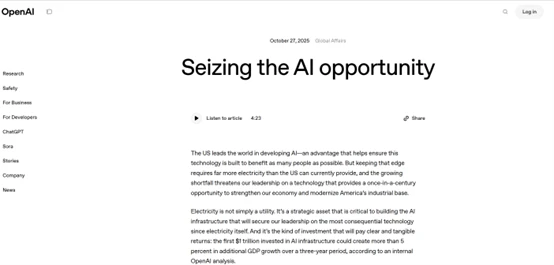
"Electricity is more than just a utility" It is also a strategic asset, crucial for building artificial intelligence infrastructure, which will ensure our leadership in the most important technology field since electricity itself.
OpenAI submitted an 11-page document to the White House Office of Science and Technology Policy, encouraging the United States to commit to building 100 gigawatts of new energy infrastructure annually. Production capacity.
“ Electricity is the new oil , and we believe the Trump administration should partner with the private sector to advance a massive national project—building 100 gigawatts of new energy capacity annually,” OpenAI wrote.
A gigawatt (GW) is a unit of measurement for electricity. Related analysis shows that 10 GW is roughly equivalent to the annual electricity consumption of 8 million American households.
OpenAI points out that the US added only 51 gigawatts of electricity last year and warns that this puts the US at risk of falling behind in the AI race.
If computing power is the "first half" of the AI race, then electricity is the key to determining who wins the second half.
Goldman Sachs A recent report pointed out that the power consumption of AI server clusters far exceeds the pace of grid expansion, and power supply may become the biggest bottleneck in the AI era. The report believes that the key to determining who can build the next wave of data centers is not faster chips, but more innovative power financing solutions.
(Article source: CLS)