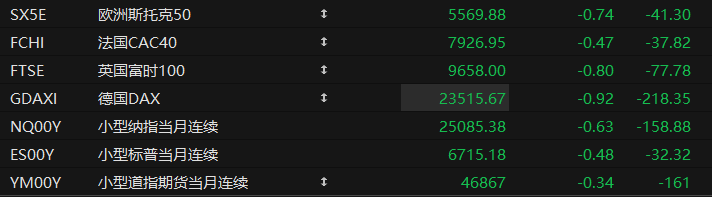
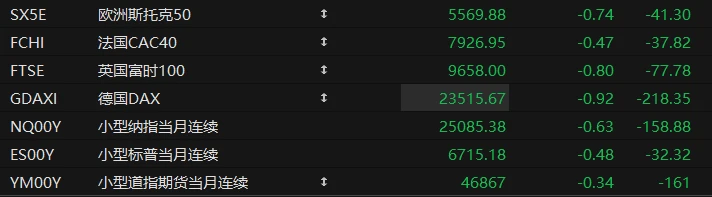
U.S. stock index futures fell across the board in pre-market trading on Friday, while major European indices also generally declined. As of press time, the Nasdaq... S&P 500 futures fell 0.63%, S&P 500 futures fell 0.48%, and Dow Jones futures fell 0.34%.
In terms of individual stocks, most major US tech stocks weakened in pre-market trading, with Nvidia among them. Google fell about 1.5%, while Tesla fell more than 1%. Meta, Amazon Microsoft fell nearly 1%. , apple The stock dipped slightly in pre-market trading.
Cryptocurrency stocks weakened, with IREN falling over 4%, Strategy down nearly 3%, Robinhood down over 2%, and Coinbase down nearly 2%. Opendoor, a popular online influencer stock, fell over 24% pre-market after reporting Q3 revenue of $915 million.
Popular Chinese concept stocks generally weakened in pre-market trading, with XPeng Motors among them. Alibaba fell more than 4%. Bilibili JD.com fell nearly 3%. NIO Li Auto It fell by more than 1%.
With the US government shutdown entering its sixth week, the Labor Department will be unable to release the crucial non-farm payrolls report for the second consecutive month. This economic data vacuum is putting the Federal Reserve's decision on a December rate cut in an unprecedented predicament.
On November 7, media reports indicated that as the shutdown continues, economists worry that some October data may never be released, particularly the unemployment rate, which is closely watched by the Federal Reserve. Furthermore, it's not just employment data that's missing.
Last month, the White House warned that the October Consumer Price Index report might also be unable to be released for the first time in history, as the data requires on-site visits to businesses. This would leave the Federal Reserve without an accurate assessment of the labor market situation or inflationary pressures, leaving it in a "blind spot" for decision-making.
Current futures market data indicates that investors still expect a slightly higher than 50% chance of a December rate cut, and private institutions have provided alternative data. However, economists emphasize that these data can never replace official statistics in terms of scope and reliability. Data quality issues may further solidify the hawkish and dovish stances of Federal Reserve officials, making decision-making even more difficult.
Hot News
Federal Reserve 's Williams It is expected that the balance sheet expansion will be restarted soon to meet market liquidity needs.
New York Federal Reserve President Williams said on Friday that the Fed may soon need to expand its balance sheet by buying bonds to meet the liquidity needs of the financial system. Last week, the Fed decided to stop reducing its bond holdings starting in December.
Speaking at the ECB's 2025 Monetary Markets Conference in Frankfurt, Williams said, "The next step in our balance sheet strategy will be to assess when reserves will fall from the current 'slightly above ample' level to 'ample'. When that moment arrives, we should begin the process of gradually restarting asset purchases."
He added, "Given the continued pressure on the repo market recently, and the growing signs that reserve levels are transitioning from 'ample' to 'ample but not excessive,' I expect we are not far from reaching that point."
At last week's Federal Open Market Committee (FOMC) meeting, the Federal Reserve announced that it would officially end its three-year "balance sheet reduction" program on December 1. This process aims to gradually reduce the bond holdings that the Fed purchased on a large scale during the pandemic to support the economy and financial system.
America's first trillion-dollar shopping season! Shopping enthusiasm remains high despite the inflation curse.
Despite deep inflation concerns among U.S. consumers, the National Retail Federation's 2025 forecast released Thursday indicates that U.S. spending during the November and December holiday shopping season is expected to exceed one trillion dollars, higher than last year.
The organization stated that retailers' sales reached $976 billion during last year's holiday season, a 4.3% increase year-over-year. This year's holiday season is projected to see total consumer spending between $1.01 trillion and $1.02 trillion, representing a 3.7% to 4.2% increase from last year.
The National Retail Federation (NRF) is the world’s largest retail industry association, with members including department stores, online platforms, independent retailers, restaurants, and more, representing over 3.8 million retail stores and employing over 52 million people.
Matthew Shay, president and CEO of the National Retail Federation, said on Thursday that consumers have shown surprisingly positive behavior and engagement. However, a growing number of consumers are becoming more discerning and are very interested in discounts.
Shay also emphasized that while holiday season spending has increased again, the growth rate may slow. However, his forecast figure is still higher than the average annual growth rate of 3.6% during the period from 2010 to 2018.
The AI craze suddenly cooled down, Goldman Sachs Three main reasons behind this!
US tech stocks have recently experienced significant volatility, with the AI sector's rally coming to an abrupt halt.
In response, Peter Bartlett, a technology, media, and telecommunications (TMT) industry expert at Goldman Sachs , pointed out that the market is experiencing its most difficult period since April, according to S&P. The CSI 500 index fell by more than 2% twice in three days, and the market trend is becoming increasingly unsettling.
Bartlett believes the three main factors contributing to increased market volatility are: rising skepticism about the future of AI, negative asymmetry in the tech earnings season, and concerns about a deteriorating US job market. Among these, OpenAI's comments regarding federal government "guarantees" for AI infrastructure spending have particularly shaken the market.
Goldman Sachs believes that, given current portfolio levels and the recent rapid gains in some sectors, the asymmetry in earnings reports is prompting investors to reassess the risk-reward ratio before the end of the year.
Cryptocurrency market capitalization evaporated by 20% in one month, almost erasing all gains for the year.
In just over a month, the cryptocurrency market has almost wiped out all of its market capitalization growth this year.
According to CoinGecko, the total market capitalization of cryptocurrencies once hit an all-time high of approximately $4.4 trillion on October 6, but subsequently fell by 20%, leaving the asset class with an annual gain of only about 2.5%.
Just days after hitting an all-time high, approximately $19 billion in leveraged positions were suddenly liquidated, a drop that severely damaged market confidence, and traders are currently showing little sign of betting on a rebound.
In regulatory agencies, global banks In a year in which institutional investors have embraced digital assets more closely, the recent performance of the cryptocurrency market has been astonishing, almost unpredictable.
US President Trump's attempt to make the US a "global cryptocurrency hub" once sparked a market frenzy, causing Bitcoin to surge by as much as 35%. However, market sentiment has reversed dramatically, and the total market capitalization of cryptocurrencies is now lower than when Trump took office.
Bitcoin has fallen 8% this week, nearing its worst weekly performance since March. Its price has even broken below the 200-day moving average, a key support level that has supported the market since the 2022 bear market.
US Stocks Focus
Musk and He Xiaopeng interact remotely: Tesla and Chinese companies will dominate the market.
On November 7, Tesla held its annual shareholder meeting at its Austin, Texas Gigafactory. Based on votes cast in person and in advance, shareholders approved CEO Elon Musk's new compensation incentive plan with over 75% of the votes in favor.
Shortly after the compensation package was approved, Tencent Technology exclusively learned that Zhou Hengxing, founder of the English-language tech media Pandaily and author of "The Altman Biography," had a conversation with Musk: "Hi Elon, congratulations on winning the big compensation package! (At the shareholders' meeting) you and the Optimus robot..." Its dancing is really good. By the way, have you seen any videos of XPeng robots ? It walks like an elegant lady; perhaps it's time for another 'Game on'.
Musk responded, "That's right. Tesla ." "Chinese companies will dominate the (future humanoid robot ) market. Other Western companies are simply not strong enough. I have great respect for competition from China; there are so many smart and hardworking people there." Musk then commented on Pandaily's report about XPeng's humanoid robot. Like IRON's related posts.
English-language tech journalist Zhou Hengxing relayed this conversation to He Xiaopeng, founder of XPeng Motors , and then shared his reply with Elon Musk. He Xiaopeng responded, "I'm very happy that Elon won this shareholders' meeting, and I also voted in his favor. Furthermore, I believe Tesla's robots and Robotaxi are doing a fantastic job, and I look forward to even greater success."
Morgan Stanley: Robotics is Apple's undervalued next growth engine, potentially contributing up to 25% to its share price value.
Morgan Stanley , as Apple seeks its next wave of growth. The bank believes the answer may lie in an area that most investors haven't fully considered: robotics. In a recent report, the bank points out that robotics, particularly embodied intelligence, represents Apple's next underappreciated growth engine, an opportunity that could ultimately contribute up to 25% of its current share price value.
According to predictions by Morgan Stanley analyst Erik W. Woodring's team, humanoid robots alone could generate $133 billion in annual revenue for Apple by 2040, equivalent to nearly one-third of Apple's current revenue base. This prediction is based on a "neutral scenario" where Apple holds a 9% market share in the sector, which analysts believe translates to approximately $22 per share today.
In a more optimistic "maximum scenario," if Apple can replicate its success in the global smartphone market and capture 22% of the robotics market share, its related revenue by 2040 would approach $300 billion, contributing approximately $65 to its current share price. This assessment comes at a time of widespread market concern about slowing growth in Apple's iPhone business and its need for a new narrative, while the potential of the robotics business paints a new picture for investors.
Paying the price for US rare earth self-sufficiency: MP Materials sacrifices sales to China, resulting in a Q3 loss; magnet factory to achieve first-time production by year-end.
The company's Q3 revenue was $53.55 million, a 15% year-over-year decrease, slightly below analysts' expectations of $54.92 million. The quarterly loss reached $41.8 million, compared to a loss of $11.2 million in the same period last year. Excluding one-time items, the loss per share was 10 cents, compared to analysts' expectations of a loss of 18 cents per share.
This earnings report reflects the company's strategic shift from relying on overseas sales to becoming a leading U.S. rare earth miner and processor, as well as a magnet manufacturer. The company stated that it expects commercial magnet sales from its Oklahoma plant to begin before the end of the year. As of press time, MP Materials' stock was down more than 8% in pre-market trading on Friday.
Honda Motor Q2 profit missed expectations, leading to a significant reduction in fiscal year profit guidance.
Honda Motor Co. (HMC.US) lowered its annual profit forecast by about one-fifth and reported a 25% drop in operating profit for its second fiscal quarter. The decline was attributed to U.S. import tariffs and one-time costs related to electric vehicles. Japan's second-largest automaker lowered its annual operating profit forecast for the year ending March 2026 by 21% to ¥550 billion (approximately $3.65 billion), down from a previous forecast of ¥700 billion. The new forecast also takes into account production declines due to chip supply shortages.
For the six months ended September 30, 2025, its profits also declined sharply due to weak global demand and rising costs. The company's consolidated profit attributable to owners of the parent company fell 37% year-on-year to ¥311.8 billion (approximately US$2.03 billion). Diluted earnings per share for the period were ¥76.30, a significant decrease from ¥103.25 in the same period of the previous year. Operating profit fell 41% year-on-year to ¥438.1 billion, reflecting pressure from rising raw material costs and a slow recovery in major export markets.
(Article source: Hafu Securities) )