US Artificial Intelligence The landscape of the race is changing.
According to the latest news, Amin Vahdat, head of Google Cloud AI infrastructure, revealed at an internal meeting that Google must "double its computing capacity every 6 months," and the overall goal for the next 4-5 years is to achieve a "1000-fold increase in capacity."
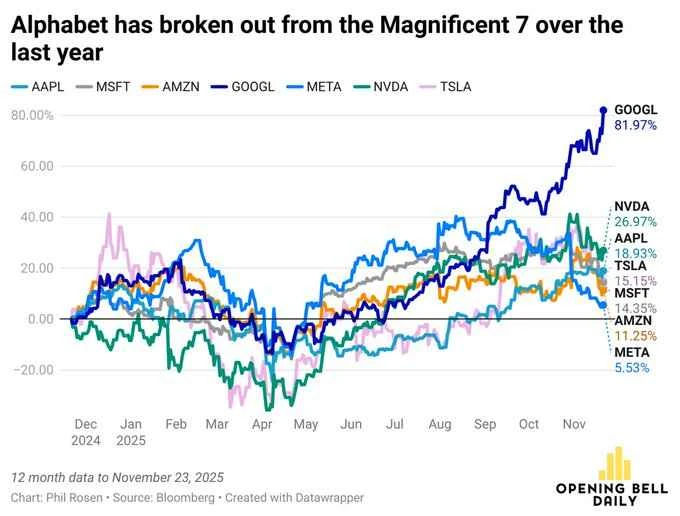
Driven by the release of its newly released AI model, Gemini 3, Google's stock price surged, rising 3.53% by the close of trading on Friday (Eastern Time). The stock has gained over 8% this week, pushing its market capitalization to $3.62 trillion, surpassing Microsoft's. It has risen to third place in the US stock market capitalization rankings.
Wall Street analysts say that Google's Gemini 3 has surpassed OpenAI's GPT-5.1 model, which was just released last week. OpenAI's dominance in the field of large AI models may be a thing of the past.
Google's major goal revealed
According to a recent report by CNBC, multiple sources revealed that Amin Vahdat, head of Google Cloud AI infrastructure, stated at a recent all-hands meeting that Google must "double its computing capacity every 6 months," with the overall goal for the next 4-5 years being to achieve a "1000x increase in capacity."
According to conference materials, in his presentation titled "AI Infrastructure," Vahdat explicitly stated that "the competition for AI infrastructure is the most critical and expensive part of the entire AI race." He emphasized that Google's mission is "not to see who spends more," but to build more reliable, higher-performance, and more scalable infrastructure.
The demonstration reportedly took place a week after Google's parent company, Alphabet, released better-than-expected third-quarter earnings.
In its latest earnings report, Alphabet once again raised its capital expenditure forecast, the second time this year, projecting that capital expenditures in 2025 will be between $91 billion and $93 billion. The company also stated that capital expenditures will see "significant growth" in 2026.
This means that Google, Microsoft , and Amazon Together with the four major AI giants, including Meta, their combined capital expenditure this year will reach $380 billion.
Vahdat stated that Google's advantage lies in its ability to predict the future form of AI models, thanks to DeepMind's long-term research capabilities.
He said, "We must deliver 1,000 times the computing power, storage, and networking capabilities at the same cost and with the same energy consumption."
However, Google CEO Sundar Pichai warned at the meeting that 2026 will be an "extremely tense year," with AI competition, cloud demand, and computing power pressure all simultaneously driving up the company's investment pace.
Regarding the widely discussed "AI bubble," Pichai responded that there is indeed such discussion in the market, but "at this moment, the risk of underinvestment is far greater than that of overinvestment."
Pichai further pointed out that Google Cloud's revenue grew 34% year-over-year to over $15 billion this quarter, but "the growth could have been even faster with more computing power."
He cited the example of Veo, a video generation tool upgraded last month, which was unable to be rolled out to more users due to insufficient computing power, thus limiting its spread. However, he also emphasized that with capital expenditures constantly rising, the company still needs to maintain healthy free cash flow.

The AI landscape is changing.
Currently, Wall Street analysts believe that Google's AI model Gemini 3 is eroding OpenAI's leading advantage in the AI race.
"Given Google's size, industry position, and first-mover advantage in search, Gemini could grab market share, leaving OpenAI and other companies behind," said Mike Orourke, chief market strategist at JonesTrading.
AI skeptic Gary Marcus also wrote in his latest article: "OpenAI has basically squandered the technological lead it once had; Google has caught up."
In terms of multimodal processing capabilities, the Gemini 3 Pro has established a significant advantage over its competitors. In multimodal benchmark tests such as MMMU-Pro, ScreenSpot-Pro, and Video-MMMU, this model shows a significant leap in performance compared to the Gemini 2.5 Pro, and generally surpasses GPT-5.1 and Claude 4.5.
In image understanding logic reasoning tests, including benchmarks such as Humanity's Last Exam, ARC-AGI-2, AIME 2025, and MathArena, the Gemini 3 Pro significantly outperforms its predecessor as well as competitors such as GPT-5.1 and Claude 4.5.
Another noteworthy signal is the narrowing user gap. Google claims its Gemini app has 650 million monthly active users. In contrast, OpenAI CEO Sam Altman stated last month that ChatGPT has 800 million weekly active users. Despite the different statistical methods, the competitors' user growth momentum is evident.
Faced with fierce competition, OpenAI's main strategy currently seems to be massive investment, with plans to spend over $1.4 trillion on AI data centers over the next few years. Construction.
This aggressive capital expenditure strategy could transmit uncertainty from Wall Street to the private market.
For investors, this means that finding a reasonable basis for OpenAI's "sky-high valuation" is becoming increasingly difficult, given that intense competition may stifle potential revenue growth. This dilemma also echoes widespread market concerns about an "AI bubble," namely whether the current high valuations are sustainable.
(Source: Securities Times)