The emergence of Google's Gemini 3 series models is triggering a redistribution of AI power in Silicon Valley.
After two years of catching up, the market generally believes that Google's model has surpassed OpenAI, the former "AI bellwether." OpenAI CEO Sam Altman also admitted in an internal memo that the company is facing the dual challenges of a "tense atmosphere" and "economic headwinds" as competitors like Google make rapid progress. This shift in the AI race has also affected the stock prices of tech giants.
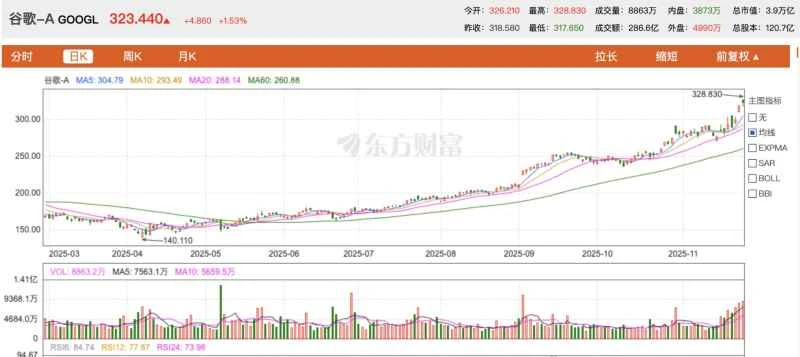
"I woke up to find Google's stock price had surpassed $320," remarked an AI industry insider. Google's market capitalization has repeatedly hit record highs in the past week. On November 26th, Google rose again by over 1.5%, closing at $323.4 per share, giving it a market capitalization exceeding $3.9 trillion, currently ranking third in US stock market capitalization. Google's stock price has increased by over 20% in the past month.
In contrast, Microsoft , which has a close collaboration with OpenAI, Nvidia Oracle bone script The stock prices of tech companies such as AMD have fluctuated and declined recently, and the trillion-dollar bet previously signed by OpenAI has been re-examined, with the bubble theory resurfacing.
The reshuffling of AI rankings is having a profound impact on capital markets. To mitigate risk, Nvidia and Microsoft recently announced strategic partnerships with Anthropic, a competitor of OpenAI. OpenAI is also actively seeking to "save itself," but the battle remains unresolved, and its future trajectory remains to be seen.
OpenAI faces headwinds
Last week's release of the Gemini 3 Pro and Nano Banana Pro won acclaim in the AI community, with even Altman and Musk publicly praising them. Some netizens jokingly remarked that the Gemini 3 Pro might be Altman's "dream GPT-5".
In its latest research report, Goldman Sachs... Trader Rich Privorotsky points out that Google's Gemini 3 is a "disruptive model" that is reshaping the entire AI investment ecosystem, causing product cycles to be delayed, capital expenditures to rise, and returns on investment to become more uncertain for other companies. OpenAI is among the first to be affected.
All indications suggest that Altman had foreseen this storm. In a recently leaked internal memo from October, Altman acknowledged that Google's latest advancements in AI could bring "temporary economic headwinds" to the company. He also predicted that if competition continues, the company's revenue growth rate in 2026 could plummet to single digits.
At the time, Google had not yet released the latest model, but Altman pointed out in a memo that Google's development approach seemed to have surpassed OpenAI, and warned employees: "I expect the atmosphere outside will become difficult for some time."
At the time this memo was written, OpenAI was still making high-profile moves. From the end of September to October, OpenAI signed major contracts with Oracle , Nvidia , and AMD to build its "AI fleet." Although the stock prices of the companies involved soared after the collaborations were announced, how a company with billions of dollars in revenue could support $1.4 trillion in infrastructure investment remained a concern for investors.
Altman called the investment a "once-in-a-lifetime strategic gamble" and emphasized his optimistic outlook on the team's future development. However, a month later, as Google's momentum surged ahead, the market quickly "voted with its feet": the stock prices of companies closely collaborating with OpenAI, such as Microsoft , Nvidia, AMD, and Oracle , all fell.
Nvidia reached $212 per share on October 29, but has since fallen 16%; Microsoft has fallen 14% in the past month, AMD has fallen more than 20% in the past month, and Oracle surged to $345 per share after signing a $300 billion computing power contract with OpenAI, but has since fallen about 40%.
Wall Street is increasingly worried: if Google ultimately wins, will OpenAI be able to deliver on its massive financial promises?
Morgan Stanley OpenAI warned when it first announced these "circular deals" that such transactions could exaggerate market demand and obscure the true business logic. If OpenAI's future investment returns fall short of expectations, its current size could trigger a tech bubble.
Currently, OpenAI is valued at $500 billion, making it the world's most valuable startup. This valuation is highly dependent on its technological leadership, but as competitors like Google rapidly close the gap, this valuation will become increasingly untenable, and investor confidence is facing a test.
Altman has responded to questions about investment and bubbles multiple times this month. In his latest response, he disclosed revenue projections to "put out the fire": OpenAI's annualized revenue will exceed $20 billion this year and will grow to hundreds of billions of dollars by 2030.
However, the financial information OpenAI disclosed to its shareholders in September was different: the company achieved revenue of approximately $4.3 billion in the first half of 2025, about 16% higher than its total revenue for the previous year. This impressive revenue, however, cannot mask the enormous cost pressures behind it. The report shows that OpenAI suffered a loss of $13.5 billion in the first half of the year, and OpenAI predicts it will not achieve profitability until 2029.
Despite the pressure, Altman remained confident, stating, "We are strong enough to withstand the impact of other companies releasing excellent models." In his memo, he emphasized that even if OpenAI is "temporarily behind" in the current technological path, it must focus on "a very ambitious bet."
It is reported that OpenAI has initiated several self-rescue measures, including developing a new model codenamed "Shallotpeat" to fix technical vulnerabilities that occurred during the pre-training process, and collaborating with Foxconn. Collaboration to design and manufacture AI data centers in the United States Core components.
The victory of Google's full-stack ecosystem
In fact, OpenAI is already one of the fastest-growing companies in history. Since the official launch of ChatGPT in November 2022, in just three years, ChatGPT has reached 800 million weekly active users—a figure that was 400 million in February of this year. Both its revenue and user base represent a remarkable leap forward.
But rival Google is catching up too quickly. According to data released by Google last week, its Gemini app has 650 million monthly active users, compared to 350 million in March of this year. Although the figures differ and it's still some distance from ChatGPT's weekly active users, the gap is clearly narrowing.
According to the latest data from Similarweb, the Gemini 3 series may bring new user growth. On the day of its release, the Gemini app's daily visits broke historical records, surging to approximately 54 million, a figure significantly higher than the previous peak of 44 million, demonstrating the enormous potential for user attention and traffic growth brought about by the new version release.
Meanwhile, data from third-party app intelligence company Apptopia at the end of October showed that ChatGPT's mobile app growth may have peaked. The analysis indicated that while ChatGPT still sees millions of downloads daily, performing well, its overall growth rate is slowing, likely due to increased competition and changes in its AI model characteristics.
Looking back, Google's rapid comeback was largely due to its full-stack technology solutions and robust ecosystem—covering chips, cloud, big data models, and applications. Ben Reitzes, a technology strategist at Melius Research, also noted that Google's ability to threaten many AI companies stems from its "highest degree of vertical integration among major AI companies." This will be a crucial trump card for its future.
Unlike other AI competitors that need to rent computing power, Google has its own self-developed TPU chips and cloud services, which not only allows it to control costs but also enables it to create a business cycle by renting out computing power. In terms of product distribution channels, Google has the Android system, Google Search, and office suite, which have over 2 billion users worldwide, meaning its AI can directly reach a massive user base.
A virtuous cycle of "model + infrastructure + product ecosystem" is driving Google's continued growth. On October 30th, Google delivered a stellar financial report, with quarterly revenue surpassing $100 billion for the first time. Dolphin Research believes that Google has simultaneously benefited from the development dividends of both the upstream and downstream sectors of the AI industry wave.
It's worth noting that the market's previous concerns about "traditional search being replaced by AI search" have not materialized; Google's search and advertising businesses continue to maintain double-digit growth. Dolphin Research believes this is essentially due to the relatively weak competition and the strength of Google's own ecosystem, allowing Google to navigate its transformation relatively smoothly.
Google's rise to prominence proves that in the capital-intensive AI race, deep resource reserves and a broad product ecosystem are crucial. Currently, Google's quarterly profit is $35 billion, while OpenAI lost $13.5 billion in just six months. OpenAI's competitors not only possess technology but also have advantages in funding, data, computing power, and distribution channels.
In an internal memo, Altman stated that OpenAI has to do so many difficult things at once: be the best research lab, the best AI infrastructure company, and the best AI platform/product company. "It's terrible, but that's our destiny. And I wouldn't trade places with any other company."
At the beginning of this year, Google's stock price was around $190 per share, and has since increased by more than 70%. The market generally believes that, with its scale, industry position and ecosystem advantages, Gemini is expected to continue to seize market share and further squeeze OpenAI's living space.
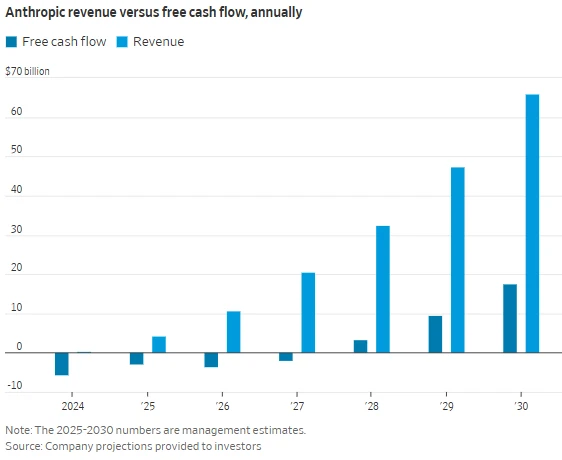
To mitigate risks, industry partners are quietly adjusting their strategies: Nvidia and Microsoft recently announced a strategic partnership with Anthropic. Specifically, Anthropic will invest $30 billion in computing resources to expand its Claude AI model on the Microsoft Azure cloud platform, with Nvidia providing the computing power.
Clearly, Nvidia and Microsoft don't want to put all their eggs in one basket; both are working to reduce their reliance on OpenAI. Microsoft has also previously partnered with Musk's xAI. The AI alliance has begun a new round of strategic alliances.
Currently, Google holds the temporary title of "new king" with its Gemini 3 series, but the battle is far from over. Anthropic is steadily building its presence in the programming and enterprise markets, while OpenAI, though its technological moat has been eroded, still maintains its brand and user base advantages. The AI power game in Silicon Valley. It is still being rewritten.
(Article source: CBN)