On December 1, local time, OpenAI CEO Sam Altman issued a "Code Red" in an internal memo, announcing the suspension of other projects and the allocation of more resources to enhance ChatGPT's capabilities.
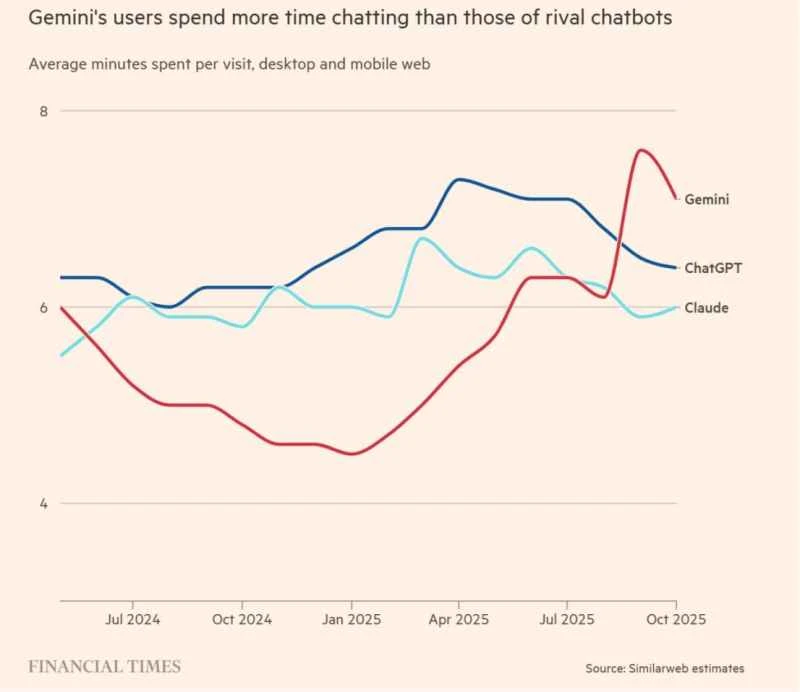
Three years ago, ChatGPT burst onto the scene, forcing Google's top management to sound a "red alert." Three years later, with the rapid release of models such as Gemini 3 and Nano Banana Pro, Google has made a strong comeback, and the average user time spent on Gemini has even surpassed that of ChatGPT for the first time.
This time, it was Ultraman's turn to panic.
OpenAI issues "red alert": projects cut, advertising halted, mysterious model exposed.
On Monday, according to media reports, Altman announced in an internal memo that the company had entered a "red alert" state, requiring the mobilization of more resources to fully enhance ChatGPT's capabilities in order to cope with increasingly fierce competition.
Altman warned employees internally that Google's strong comeback in the AI field could put "short-term economic pressure" on OpenAI, while the company's CFO Sarah Friar also admitted to investors last month that ChatGPT's growth had slowed.
In order to hold its ground in ChatGPT, Altman decided to suspend other non-core projects and concentrate all its efforts on ChatGPT. Among the suspended projects, the most notable is its advertising business, which has great commercial potential.
Previously, users discovered code for "marketplace content" and "search ads" in the beta version of ChatGPT, which was seen as a signal that OpenAI was about to launch advertising monetization. With approximately 800 million weekly active users, ChatGPT undoubtedly has the potential to become the next advertising giant. However, facing pressure from Google, OpenAI has had to temporarily shelve its plans.
Along with the advertising business, two other innovative projects were also put on hold: one was the AI Agent project, which could automate complex tasks such as shopping and health management; the other was the Pulse feature, which aimed to generate personalized information reports for users every day. But now, these explorations of the future must give way to the current battle for survival.
Next week, OpenAI also plans to release a brand new inference model.
Internal assessments show that this model outperforms the Gemini 3, but there is still more work to be done to improve the ChatGPT experience.
Furthermore, according to sources familiar with the matter, OpenAI is also developing a new generation of models. Last week, the company's Chief Research Officer, Mark Chen, revealed a new model codenamed "Garlic" to some colleagues. It fixes issues in the early architecture of GPT-4.5 and is expected to be released early next year as GPT-5.2/GPT-5.5.
Mark Chen stated that significant breakthroughs were achieved in pre-training during the development of Garlic, enabling the packaging of knowledge from large models into smaller architectures.
Gemini's average usage time per session surpasses ChatGPT for the first time.
According to a leaked internal memo, Altman admitted that Google performs exceptionally well in all aspects of large language models, especially in pre-training.
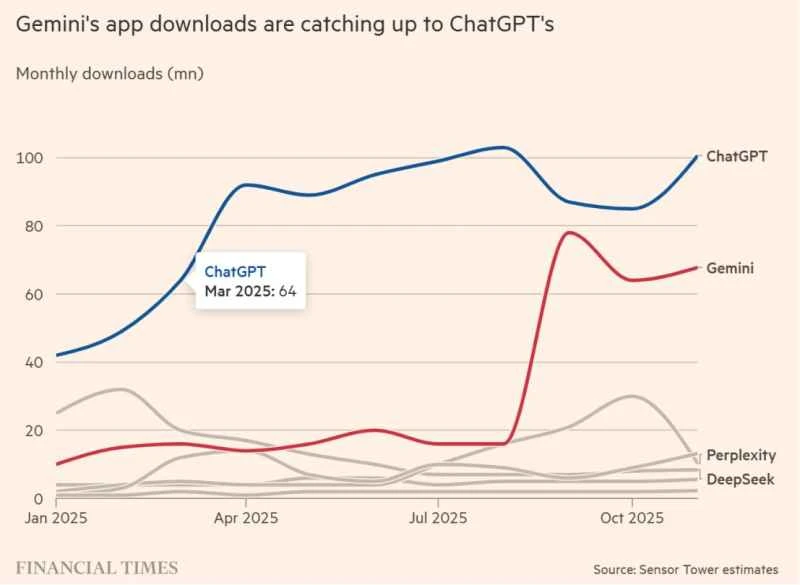
Moreover, Similar Web data shows that as of the end of October 2025, the average usage time of Google Gemini on desktop and mobile devices has surged to 7.2 minutes, surpassing ChatGPT (about 6 minutes ) for the first time.
According to Sensor Tower data, while ChatGPT still leads in app downloads with approximately 87 million monthly downloads, Gemini's catch-up speed is astonishing, soaring from approximately 15 million monthly downloads in mid-2025 to approximately 66 million by the end of October .
Salesforce CEO Marc Benioff previously stated publicly: " I used ChatGPT for three years, but after using Gemini 3 for two hours, I can't go back. The leap is insane—inference, speed, images, video…everything is sharper and faster."
According to semiconductor Industry research firm SemiAnalysis previously revealed that since the release of GPT-4o (May 2024), OpenAI has yet to complete a full, large-scale pre-training process designed for next-generation cutting-edge models. This pre-training bottleneck may explain why OpenAI's recent model releases have consistently been more hype than substance.
The highly anticipated secret project "Orion," originally slated for release under the name GPT-5 at the end of last year, was ultimately "downgraded" to GPT-4.5 due to unsatisfactory training results. GPT-5, officially launched this August, despite being touted by Ultraman as a "doctoral-level AI," has received a lukewarm reception from the industry.
The total debt surrounding OpenAI is approaching $100 billion.
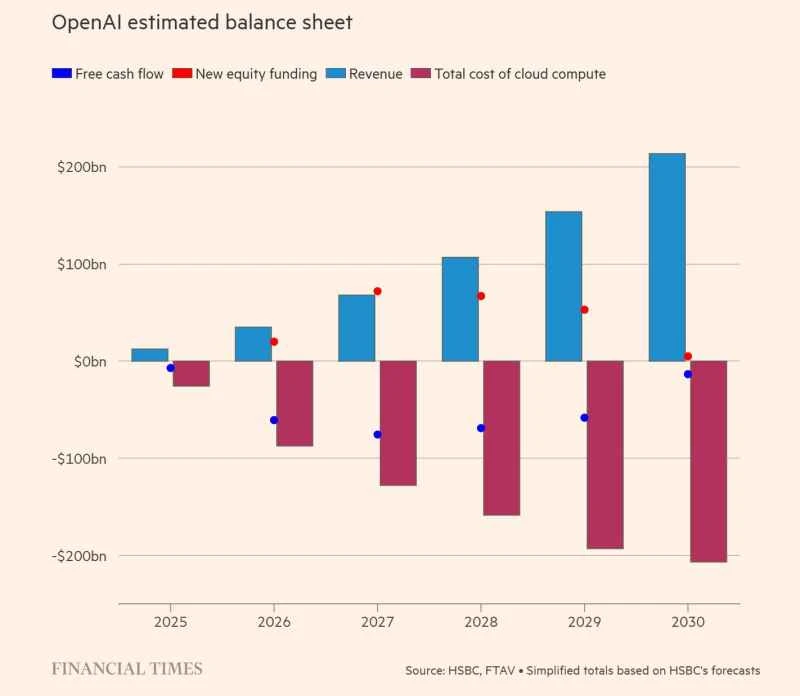
Recently, HSBC Bank A research report warned that even under the most optimistic growth assumptions, OpenAI will still not be able to achieve profitability by 2030.
It is estimated that OpenAI's costs in cloud and computing power will reach $792 billion from 2025 to 2030. By 2033, its total computing power commitments will soar to $1.4 trillion, with data centers alone accounting for a significant portion. The bill for leasing alone is as high as $620 billion.
The report predicts that OpenAI's cumulative free cash flow will remain negative by 2030, with a funding gap of up to $207 billion, which must be filled through additional debt, equity financing, or more aggressive revenue-generating methods. Given its inability to monetize through advertising and its difficulty in accumulating debt, the sustainability of its business model is facing challenges.
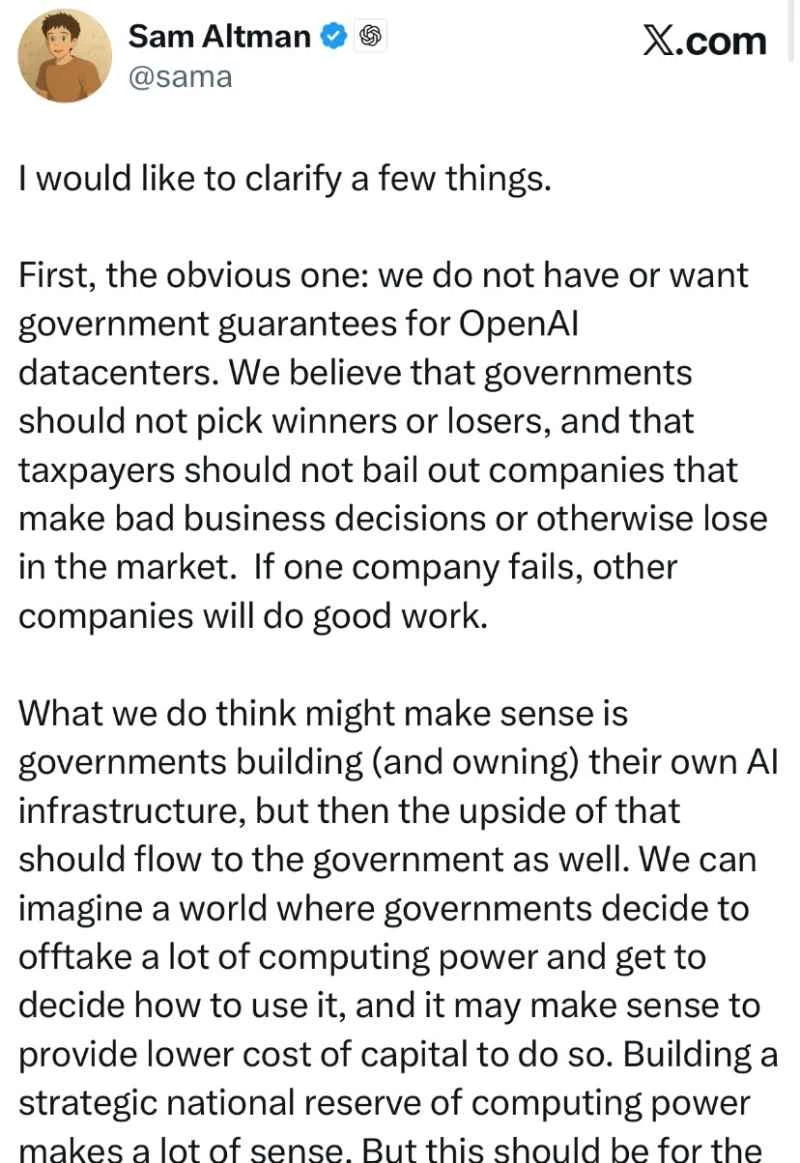
Altman stated last month that OpenAI's data center projects have committed to a total investment of approximately $1.4 trillion over the next eight years. However, the enormous expenditures have drawn criticism from SoftBank and Oracle. Partners such as CoreWeave are heavily indebted.
Late last month, media reports, citing sources familiar with the matter, indicated that banks had provided an additional $38 billion loan package to Oracle and data center construction company Vantage, with the funds intended to support the construction of new data centers for OpenAI. This financing deal is expected to close in the coming weeks. With this addition, the total debt surrounding OpenAI is approaching the $100 billion mark .
Disclaimer: The content and data in this article are for reference only and do not constitute investment advice. Please verify before use. Any actions taken based on this information are at your own risk.
(Source: Daily Economic News)