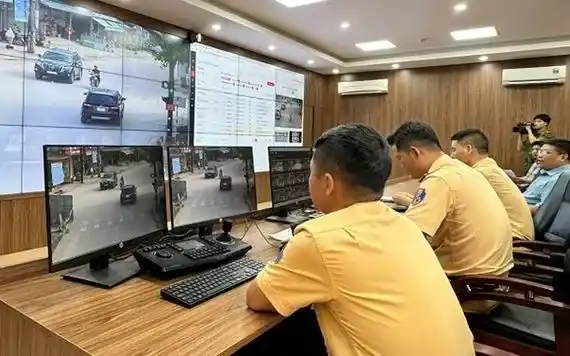
Deputy Prime Minister Nguyen Chi Dung signed Decision No. 502/QD-TTg dated March 28, 2026, approving the plan for connecting and sharing data between security and order surveillance camera systems, traffic violation processing and traffic management systems with the National Population Database, and sharing data with the Smart City Monitoring and Management Center.
The objective of this Plan is to ensure the implementation of a plan to connect and share data between security and order surveillance camera systems, traffic violation processing and traffic management systems with the National Population Database, and to share data with the Smart City Monitoring and Management Center. This aims to enhance the effectiveness and efficiency of state management in ensuring security and order, creating a safe and stable environment to serve sustainable socio-economic development, and contributing to improving the quality of life for citizens.
Strengthening monitoring capacity
The specific objective of the Plan is to establish a system for connecting, integrating, and exploiting video surveillance data, image analysis data (Metadata), and event data from security, order, traffic violation processing, and traffic management surveillance camera systems, ensuring secure transmission, storage, and controlled sharing with the Smart City Monitoring and Operating Center in accordance with the law and the authority of specialized management agencies.
Enhance real-time monitoring capabilities, promptly detect, warn, and respond quickly to emerging situations related to security, order, traffic safety, fire prevention, firefighting, rescue, and relief by the People's Public Security forces; connect and share data with the Smart City Monitoring and Operating Center to carry out assigned functions and tasks.
Controlled integration with the National Population Database and electronic identification and authentication platform aims to serve the verification, comparison, handling of violations, and state management in accordance with authority; while effectively exploiting population data to serve smart urban development, supplementing and enriching data, and enhancing the accuracy of analysis and recognition tasks from camera systems.
Overall architectural model
The architectural model of the integrated camera system is designed and built based on the Vietnam Digital Government Architecture, version 4.0, issued under Decision No. 292/QD-BKHCN dated March 25, 2025, of the Ministry of Science and Technology; and Official Letter No. 3640/BKHCN-CĐSQG dated August 4, 2025, of the Ministry of Science and Technology on the deployment of the Intelligent Operations Center (IOC) to ensure interoperability and efficient exploitation of information and data to serve the direction, management, and socio-economic development of the locality.
The integrated camera system is built on a distributed network architecture (DNA) model, allowing for distributed processing, storage, transmission, and management across different sites, independent of a central server, while maintaining centralized management capabilities at all levels of the surveillance system.
A solution for integrating, connecting, sharing, and managing data from surveillance camera systems.
Regarding data from the surveillance camera system invested in, managed, and operated by the People's Public Security Force.
Data from security and public order surveillance cameras is connected in a distributed manner to centralized connection points or directly to the commune-level police surveillance camera center (depending on distance and number of cameras); from centralized connection points to the commune-level police surveillance camera center; from the commune-level police surveillance camera center to the provincial-level police surveillance camera center (under the Provincial Police Command Information Center); and from the provincial-level police surveillance camera center to the Ministry of Public Security's surveillance camera data coordination and sharing center, ensuring uniformity and synchronization nationwide.
Live camera data will be stored in a distributed manner at surveillance camera centers at various levels, according to the needs of each unit and locality, and will be overwritten when the storage is full.
Camera data, after analysis and processing depending on its nature, scope, and importance, will be stored long-term at provincial-level police surveillance camera centers and surveillance camera centers of operational units under the Ministry to serve the operational work of the sector. Camera data analyzed and processed at commune-level police surveillance camera centers will be stored for a limited period, after which it will be reviewed, evaluated, extracted, and transmitted back to the provincial-level police surveillance camera center for long-term storage to utilize existing storage and processing infrastructure.
Data collected from surveillance cameras is sent to the Provincial Police Command Information Center and shared with the Smart City Monitoring and Operating Center to carry out activities according to assigned functions and tasks.
For data from the local investment's surveillance camera system.
Data from surveillance camera systems invested in, managed, and operated by departments, agencies, and units under the Provincial People's Committee at specialized monitoring centers (located at these departments and agencies) are integrated and centrally managed at the Smart City Monitoring and Operation Center. This integration is achieved through the Provincial Data Integration and Sharing Platform (LGSP), using the dedicated data transmission network of state agencies, virtual private network (VPN) services from network connection service providers, or by investing in a dedicated fiber optic network to ensure stable connectivity.
The specialized field monitoring center is responsible for storing surveillance camera data for a period appropriate to the requirements of each application; ensuring backup and regular or real-time data transmission to the Smart City Monitoring and Operating Center, maintaining the continuity, security, and synchronization of the system's data.
Camera data, integrated and centrally managed at the Smart City Monitoring and Operation Center, must be connected and shared with the Provincial Police Command Information Center.
For data from camera systems of organizations, businesses, and individuals who invest in and share them.
Data from camera systems of organizations, businesses, and individuals in the area is shared through an agreed-upon mechanism via centralized connection points to the commune-level police surveillance camera center, ensuring compliance with legal regulations on information security, safety, and personal data protection.
Surveillance camera data shared by organizations, businesses, and individuals is stored at the commune-level police surveillance camera center or via cloud computing services licensed by competent authorities.
The sharing of camera data by organizations, businesses, and individuals is carried out in accordance with Article 18 of the Data Law and related legal documents; the police agency receiving the shared data is responsible for protecting the data in accordance with the provisions of the Data Law, the Law on Personal Data Protection, and related legal documents.
Connect to the Authentication Center - National Population Database
The camera surveillance centers at all levels, and the smart city monitoring and operation centers, are connected to the authentication center, performing data authentication functions electronically upon request. This serves the purpose of verification, comparison, handling violations, and state management within their respective jurisdictions, and does not connect directly to the national population database. All queries to population data must be conducted through a secure application programming interface (API) (https, VPN, digital signature, etc.), with a unique access identifier and full logging of each access; access rights are granted by the Ministry of Public Security and are limited by the number of data fields, purpose, time, and scope of use.
Managing data from surveillance camera systems.
Data collected from surveillance camera systems must be managed centrally, uniformly, and classified based on the requirements for data administration, processing, and protection as stipulated by the Data Law and related legal documents.
Establish authentication and access control mechanisms; apply data encryption, monitoring, system logging, and tracking of all access and data processing activities in accordance with the law on cybersecurity and network information security.
The processing of personal data collected from surveillance camera systems must fully comply with the regulations of the Law on Personal Data Protection and other relevant legal documents. Data from surveillance camera systems must not be provided or shared with organizations or individuals who are not authorized or assigned the function and duties as prescribed by law.
Implementation roadmap
Phase 1 - Preparation and implementation of the pilot model
Timeframe: From April 1, 2026 to September 30, 2026.
Implementation content: Organize pilot projects in Hanoi, Gia Lai province, and An Giang province (Phu Quoc special economic zone) to build a model for implementing an integrated system of security and order surveillance cameras, traffic violation processing, and traffic management, connected to the national population database. This will serve as a basis for evaluating and refining technical standards, regulations, and implementation methods nationwide.
Phase 2 - Implementation of the plan
Timeframe: From October 1, 2026 to December 31, 2027.
Implementation content: Organize and deploy a plan to integrate security and order surveillance camera systems, traffic violation processing, and traffic management, connecting them to the national population database and sharing data with the Smart City Monitoring and Management Center to serve state management in ensuring security and order and socio-economic development in all 34 provinces and cities.
Phase 3 - Expanding Socialization
Time: From January 1, 2028.
Implementation content: Expanding the connection of camera systems invested through socialized models, including cameras owned by organizations, businesses, establishments, and households, to the local monitoring system through an agreement mechanism, ensuring compliance with regulations on information security, safety, and personal data protection.