Like 2025, 2026 will be another "noisy" year: filled with issues surrounding Trump's tariffs, the Federal Reserve's interest rate cuts, an unstable job market, and artificial intelligence. Debates about the AI bubble, GPU depreciation schedules, and so on will continue incessantly.
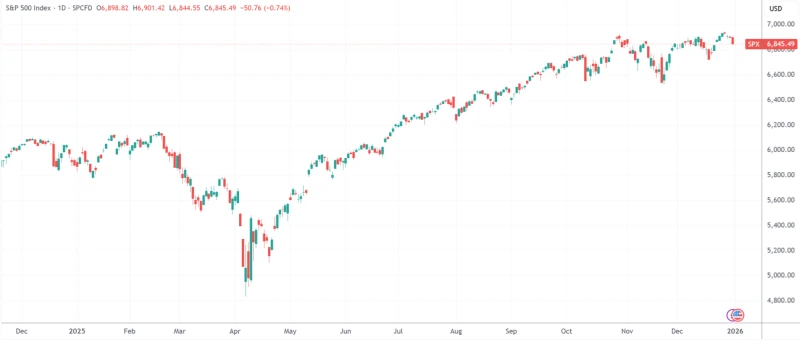
Based on three key characteristics of the 2025 market outlook—a 17% rise in the S&P 500; a market rebound after a downward spiral triggered by "Liberation Day" tariffs; and a gold price increase of over 60%—the media selected several "most accurate forecasters." In fact, most Wall Street strategists are relatively optimistic about 2025, but only a few have given target prices that most closely resemble reality (6845.5 points).
Prioritize buying US stocks
Société Générale Manish Kabra, a strategist at [company name], is one of them. He gave the S&P 500 a year-end target price of 6,750 points by 2025, because he believes that Trump's deregulation and low-tax policies will benefit the US economy.
Looking ahead to 2026, Kabra expects the S&P 500 to reach 7,300 points by the end of the year, and is optimistic about consumer cyclical stocks, financial stocks, and industrial stocks , believing that these stocks will benefit from the "big and beautiful" tax reform bill.
“My biggest appeal, and my view in 2025, is to prioritize buying American stocks. This is about the reindustrialization of America and everything related to it,” he said.
Nicholas Colas, co-founder of DataTrek Research, gave a closer target price of 6,840 for 2025, betting on the resilience of the U.S. economy. He has not yet given a target price for 2026, but Colas stated that materials, real estate, and utilities... The sector is likely to perform well in the new year.
Morning Star Chief market strategist David Sekera and Carson Research's chief market strategist Ryan Detrick correctly predicted the stock market rebound following the "Liberation Day tariffs."
Focus on AI applications
Looking ahead to 2026, Sekera suggests focusing on companies that "benefit from artificial intelligence ," rather than " AI builders." He points out, "2026 could be the year the market begins to shift more focus from AI hardware companies to those that can drive revenue growth and leverage AI to improve efficiency in their products and services."
Clearly, he's focusing more on AI applications this year. Some of the companies he cited include Clorox. Mondelez International ServiceNow and Kraft Heinz .
Detrick predicts that despite some weakness in the labor market, the economy will still exceed expectations in 2026, and says he believes the commodity boom is likely to continue.
“Overall, we like stocks, that’s true. But we think that increasing our investment in commodities relative to our bond investments—a practice that worked very well in 2025—is something we think can continue into 2026,” he added.
Emphasis on gold allocation
The last "prophet" was Jeffrey Gundlach, CEO of DoubleLine Capital and known as the "New Bond King," who correctly predicted gold's surge. After gold prices rose 27% in 2024, a further increase of over 60% seemed unlikely. But it turned out exactly as he predicted.
Most Wall Street strategists had a maximum gold price target of around $3,000 per ounce by 2025 and gradually raised their targets throughout the year. But Gundlach surpassed his peers from the outset. As early as March, he predicted gold would exceed $4,000 per ounce, and throughout the year he repeatedly emphasized his forecast as investors grew increasingly fearful of the devaluation of fiat currencies due to rising government debt.
“I think people view gold as an asset class because of concerns about the current geopolitical turmoil, including tariffs and other factors, as well as the massive amount of debt, and people are thinking about how we are going to deal with these issues,” he said in an interview last May. “So gold is, in some ways, a real monetary asset.”
Looking ahead, Gundlach previously recommended a portfolio consisting of 20% cash, 25% bonds, 10-15% "real assets" (such as gold), and 40% international equities.

(Article source: CLS)