Amidst concerns about high valuations, macroeconomic headwinds, and signals of intensified competition, and with artificial intelligence... U.S. tech companies closely associated with the boom experienced their worst week since April, with investor sentiment cooling significantly.
This week, the Nasdaq, dominated by technology stocks... The composite index fell by 3% cumulatively, marking its worst weekly performance since April. Among them, the market value of the eight leading companies most closely related to AI evaporated by approximately $800 billion (approximately RMB 5.698 trillion) , and the market value of all AI-related US companies has lost nearly $1 trillion since last Friday.
As the world's most valuable company, Nvidia It was among the first to be hit by this week's decline, losing approximately $350 billion in market capitalization. Just over a week earlier, the company had become the first to surpass a $5 trillion market capitalization.
Microsoft Oracle bone script Hebotong The company's stock price also declined this week.
Data shows that Google's parent company Alphabet and Amazon Last week, the four tech giants—Mercedes-Benz, Meta, Google, and AMD—reported a combined $112 billion in capital expenditures for the third quarter. Meanwhile, the entire industry is borrowing hundreds of billions of dollars to support its expansion in the field of AI.
Macroeconomic uncertainty has added another layer of uncertainty to the market. With key economic data missing due to the federal government shutdown, investors are increasingly worried that the labor market may have weakened significantly since the end of September.
Stephen Yiu, chief investment officer of Blue Whale Growth Fund, believes that "hiring has been very weak, the Fed has fallen behind the curve, and needs to cut interest rates more quickly." The fund's largest holdings... Yiu said he had acquired Nvidia , but added, "We don't own any of the other members of the 'Big Seven' tech giants, and I'm very concerned about them burning through cash to stay competitive."
Furthermore, it's worth noting that on November 7th, the cryptocurrency market experienced a sharp decline, with Bitcoin briefly falling below the $100,000 mark again. Data shows that over 250,000 people worldwide were liquidated within 24 hours.
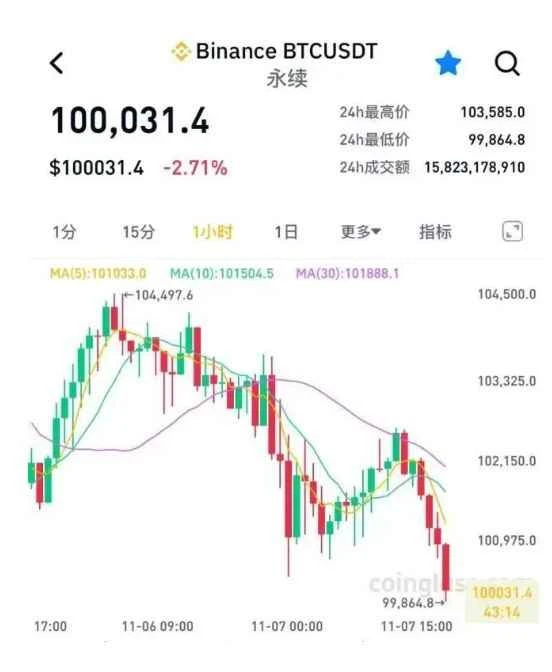
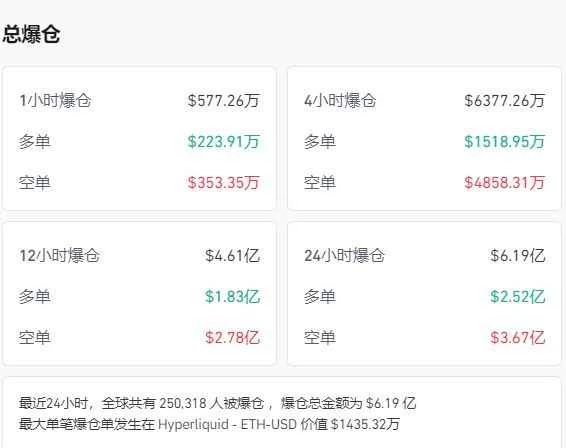
The cryptocurrency market has almost wiped out all the gains accumulated in the first ten months of this year in just over a month.
After a week of decline, Bitcoin prices stabilized and rebounded in late trading on November 7, rising above $103,000, but are still down about 18% from the record high of $120,000 set on October 6.
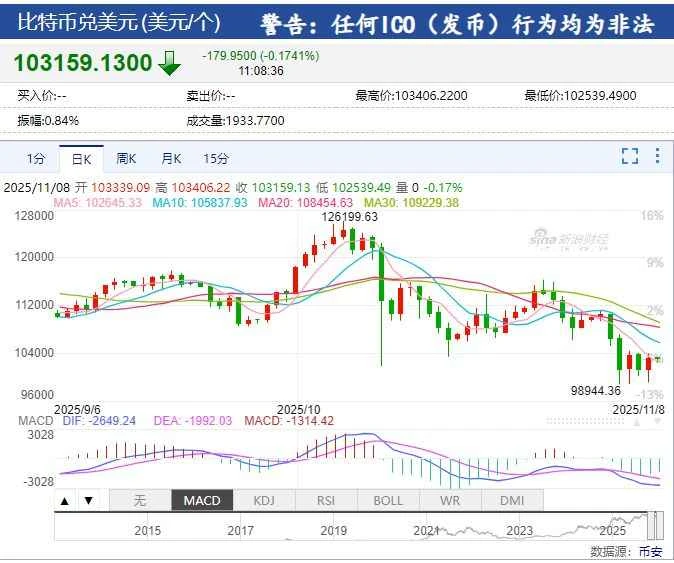
The weakness in cryptocurrencies is making some on Wall Street nervous, as Bitcoin is now seen as a leading indicator of the most volatile sectors in the U.S. stock market. The once-reliable "buy the dip" strategy appears to be failing, further exacerbating the wait-and-see attitude in the market.
Fund flow data confirms this cautious sentiment. According to Bloomberg, investors withdrew more than $700 million from digital asset ETFs in the past week alone, including BlackRock. Nearly $600 million flowed out of its Bitcoin fund.
According to media reports, World Economic Forum Chairman Borg Brende warned that the global financial market may face three potential bubbles: a cryptocurrency bubble, an AI bubble, and a debt bubble.
BTSE Chief Operating Officer Mejev stated that the recent pullback in digital assets stemmed in part from "market concerns that AI stocks are severely overvalued." He warned, "If AI and tech stocks experience a correction, Bitcoin could very well fall below $100,000, while altcoins could see even steeper declines."
Louis LaValle, CEO of crypto investment firm Frontier Investments, warned that Bitcoin's drop below the key support level of $100,000 may indicate that the sell-off is not over and that it could fall below $70,000 in the near future.
Daily Economic News (Comprehensive Securities) Times, publicly available market information
Disclaimer: The content and data in this article are for reference only and do not constitute investment advice. Investors should make their own decisions and bear their own risks.
(Source: Daily Economic News)